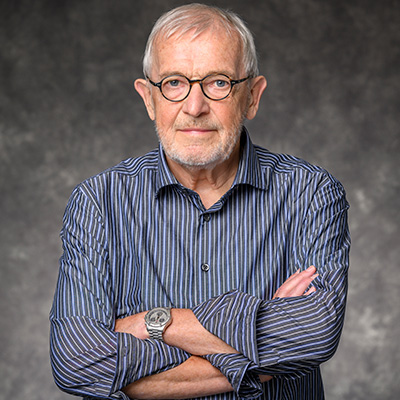
Building a telescope more than a kilometer under the ice in Antarctica was a gamble. But Francis Halzen had the audacity to try. Decades later, his visionary work has opened a new era of neutrino astronomy, and won the Belgian-born physicist the 2026 Nobel Prize in Physics.
Brian Greene sits down with Halzen to examine the effort to build the IceCube detector at the South Pole and use it to track high energy neutrinos from deep space. Covering the history of the neutrino from its theoretical origins to its confirmation, to the science underlying the IceCube detector, to the challenges of constructing it, the conversation explores a new way for scientists to examine the cosmos.
Greene and Halzen discuss the search for dark matter, mapping the galactic plane with neutrinos enabled by machine learning, potential insights into quantum gravity, as well as Halzen’s advice to young scientists: Follow your obsession, because understanding is the real reward. A compelling conversation on discovery, persistence, and the powerful pull of science at the frontier.
This program is part of the Rethinking Reality series, supported by the John Templeton Foundation.
This program can be watched here, and on our YouTube channel, starting at 7PM on Friday, October 16.
Brian Greene is a professor of physics and mathematics at Columbia University, and is recognized for a number of groundbreaking discoveries in his field of superstring theory. His books, The Elegant Universe, The Fabric of the Cosmos, and The Hidden Reality, have collectively spent 65 weeks on The New York Times bestseller list.
Francis Halzen has spent over 20 years working on telescopes that detect not light, but neutrinos—tiny, high-energy particles released by violent astronomical events like exploding stars, gamma-ray bursts and crashing black holes.