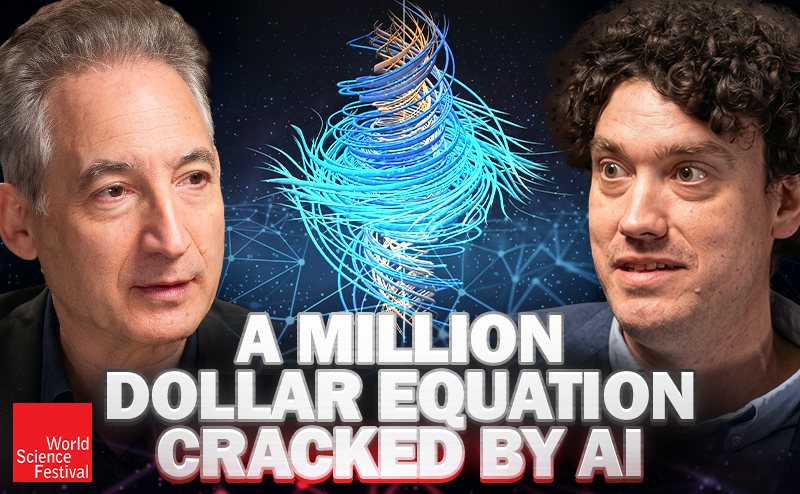


Tristan Buckmaster
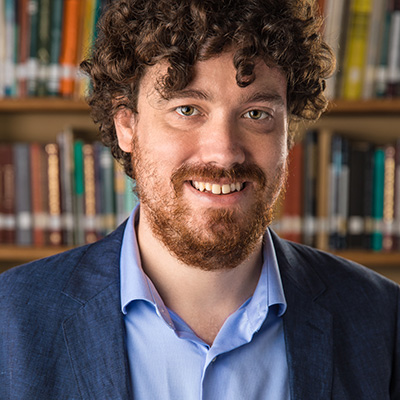
Tristan Buckmaster is an Australian-British mathematician who studies partial differential equations.
Buckmaster studied mathematics at Monash University in Melbourne and at the University of Bonn. He received his PhD in 2014 under the supervision of László Székelyhidi at the University of Leipzig (Onsager’s conjecture),during which time he also worked at the Max Planck Institute for Mathematics in the Sciences in Leipzig. He then spent three years as a Courant Instructor at the Courant Institute of Mathematical Sciences at New York University. In 2017, he became an Assistant Professor at Princeton University and in 2022 a Full Professor at the University of Maryland. He held the position in Maryland for only one year, taking up an additional professorship at the Courant Institute at New York University in 2022.
In 2017, he and Vlad Vicol proved that there are initial conditions under which weak solutions to the Navier-Stokes equations in hydrodynamics are not unique. Their work built upon the research of Jean Leray (1934), with Buckmaster and Vicol considering an even more general class of weak solutions. The regularity behavior of the solutions to the Navier-Stokes equations is the subject of one of the Millennium Problems, the Navier-Stokes existence and smoothness problem. In their proof, they used methods developed by László Székelyhidi and Camillo De Lellis, who had previously achieved a scientific breakthrough with these methods on a hydrodynamic equation closely related to the Navier-Stokes equations.
The Navier-Stokes equations are the subject of one of the Millennium Problems. Buckmaster played a key role in the final solution of the Onsager conjecture (Lars Onsager 1949) concerning a lower bound in the Hölder continuity of the weak solutions of the incompressible three-dimensional Euler equation with conservation of energy, which was the subject of his dissertation and was fully proven by Philip Isett. Below this bound, there are solutions with anomalous dissipation (non-zero dissipation of energy in the limit of vanishing viscosity of the Navier-Stokes equation, i.e., the transition to the Euler equation) that violate conservation of energy.
Buckmaster also worked on the differential equations in quasigeostrophic theory, the Euler equation arising from the Navier-Stokes equation in the transition of vanishing viscosity, the Korteweg-de Vries equation, the equations of magnetohydrodynamics (MHD), and the nonlinear Schrödinger equation. Here, too, questions of regularity were a central focus.
In 2019, he received the Clay Research Award with Philip Isett and Vlad Vicol. Buckmaster and Vicol received it for showing that weak solutions to the Navier-Stokes equation can be surprisingly wild (strong deviation from smoothness and highly ambiguous). Isett received the award for the complete solution to the Onsager conjecture mentioned above.
He is a Principal Researcher of the Simons Collaboration for Wave Turbulence.
 Share
Share