2,318 views | 00:12:22









Brian Greene and physicist Samir Mathur explore one of the deepest puzzles in modern physics, the true nature of black holes and the fate of information in the universe. Their conversation centers on the black hole information paradox, a problem that has challenged physicists for decades. If quantum mechanics says information can never be destroyed, how can black holes once thought to erase everything that falls into them be reconciled with that principle? Mathur introduces the fuzzball theory, a proposal from string theory suggesting that black holes are not empty regions but complex structures that preserve information. Greene and Mathur also revisit key developments in black hole physics, from entropy and Hawking radiation to modern ideas like firewalls and wormholes. They reflect on why certain approaches may fall short and whether recent theoretical insights are bringing the paradox closer to resolution. This conversation offers an engaging look at how physicists are rethinking black holes, quantum gravity, and the fundamental structure of reality.
This program is part of the Rethinking Reality series, supported by the John Templeton Foundation.
Brian:
A radical rethinking of what a black hole actually is. It’s called fuzzballs, but the dominant perspective in the field is not the fuzzball picture right now. What do you think it would take for everyone to finally get on the same page one way or another?
Samir:
So I think we are at the point where if people really want to sit down and just clearly ask exactly the kind of questions I was just asking you, there are enough theorems there that everything is completely boxed in.
Brian:
Interesting.
Samir:
And so if everybody sat down a room, it would be over.
Brian:
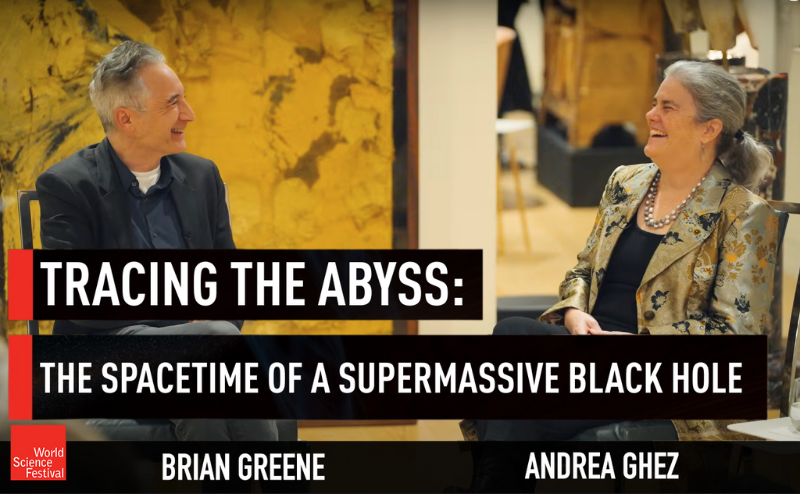
Hey everyone. Welcome to today’s conversation, which is going to focus on black holes, an arena of physics that is rapidly developing and one that has been a focus of physicists now for, oh goodness, 50, 60 years. It depends how far back you want to go. And I’m so pleased that we have as our guest, an old friend of mine. Not an old friend, a friend who I’ve known for a long time, Samir Mathur from Ohio State University. So welcome, Samir. So nice to see you.
Samir:
Thank you. It’s great to be here.
Brian:
I was thinking just before we got online here that you and I shared an office when we were postdocs at Harvard.
Samir:
That’s right.
Brian:
That must have been, what, the mid 1980s or mid to late 1980s, something like that?
Samir:
That’s right.
Brian:
Yeah.
Samir:
’89.
Brian:
So it’s going back, what, 40 years or so. And even back then, I recall black holes were a fascination of your research. So you’ve … I know you’ve done many things, but black holes have really been a centerpiece of your research. Would you call that accurate?
Samir:
Yeah. I think that is very true. Right from the second year of grad school, when I first heard about Hawking’s puzzle, somehow that really caught me. And I first worked in astrophysics for my PhD learning all this stuff. And then I realized that astrophysics didn’t really have all the tools required to tackle this problem. So I moved into string theory and then putting all the tools we have from various places, it’s just been a fascinating and long ride along [inaudible 00:02:19].
Brian:
It’s fantastic. And among your most famous works is an idea that I’d like to get to in do course in this conversation, a radical rethinking of what a black hole actually is. And so we’ll get there. The idea is called fuzzballs in case any of our audience have read ahead and are aware of this development. But I should say at the outset that if true, this is a profound upheaval in our understanding of one of the most mysterious objects to emerge from fundamental physics, one that we now know is actually real. We have data that shows these things are real.
So let’s step through things a little bit. In the classical non-quantum mechanical approach to black holes comes right out of the general theory of relativity. It’s a very simple process, right? You take any mass, according to general relativity, you squeeze it down spherical mass to a sufficiently small size. There’s a little formula for it that you can look up, and that’s how you get a black hole. So were you taken by the simplicity of this weird object coming from this very straightforward algorithm?
Samir:
Absolutely. The way you said it is exactly what happens. It’s the real miracle of gravity because gravity is attractive. Suppose you take a star and you don’t even have to squeeze it. Suppose it just exhausts all its fuel. So it doesn’t have the pressure to stay up against gravity. It starts shrinking. And if the star was heavy enough, then it’s a runaway process. The more it shrinks, the denser it gets, so the more it tries to shrink. And once you get into this runaway phase, there is just no choice in classical Einstein’s equations, but to squeeze all the way down to a point. And that means you get to infinite density. So that by itself is already very remarkable because most of the time in nature, things come to a balance. You squeeze and something presses out and you come to a balance somewhere. But here, one can show that the process is really a runaway process and you can’t stop it. And that’s the beauty of Einstein’s equations. At some point it tells you that if anything were to hold this up, the things which are at the surface of this squeezing object would have to move faster than the speed of light. And as long as you say that cannot happen, this thing has to keep squeezing. So it’s really that basic. And you get all the way down to a point of infinite density and that is very surprising.
Brian:
And so infinite density, of course, can be viewed as a clue that something’s not quite right with what we’re describing. Anytimes infinity, it’s a diagnostic tool that we physicists use to test our understanding. So how do you think about the … Well, I don’t want to jump the gun. You’re going to give us ways of thinking about it in a moment. But in the classical history of black holes, what did people say when they had this embarrassing fact that the center of a black hole had infinite density?
Samir:
So what people said in the beginning is what we’ll see doesn’t seem to be true now. But what they said in the beginning was the following. Indeed, we don’t want something to be infinite because then we can’t even use any mathematics to describe it. But then we have quantum mechanics in the real world and quantum mechanics makes everything a little bit fuzzy, but acts on very small distances. So perhaps what we thought was a tiny point would become just the scale of what quantum fluctuations would tell us it should be. The scale is called the Planck length, which is 10 to the power minus 33 centimeters. It’s really very, very tiny. And so that at least would remove the infinite density, but it wouldn’t really change much about the picture of the black hole. And the important picture for what we are going to discuss is that everything has gone to the center whether the center is a point or whether it’s just a Planck length in size, the whole black hole is actually a lot bigger. So if you make a black hole with the mass of the sun, its boundary would be about three kilometers in radius. And so that’s huge.
And so what the picture that people had was everything would be just empty because everything got sucked in and everything would be down not exactly to a point, but perhaps within a Planck distance of a central point. And the important point was that the boundary of this, what we call the horizon. Around there, there is nothing. It’s just empty. So the picture we are trying to actually get, which we got from classical physics, which is the one we’ll see leads to a problem, is the one where there is nothing at the horizon or inside the hole all the way until you get right near the center.
Brian:
So in a way, black holes as mysterious as they may be are incredibly simple in their ultimate description because what you’re describing is independent of the detailed features of the matter that may have collapsed downward. Once it gets into this runaway process, the end state is pretty much the same. If you give the mass other small details like charge and angular momentum that we can put to the side, but if you give the mass, then every black hole of the same mass is pretty much the same.
Samir:
Absolutely. And I think that really fascinated people in the beginning because if everything goes to a point and then all you have left is the gravitational field of this object you get something which is just completely round with no features. And this was such a striking phenomena that John Wheeler named this with the statement, black holes have no hair. They just have no features at all. They’re completely bald. And so people started thinking of this as a fundamental theorem, that black holes would really never have any features at all. Doesn’t matter what you start with. Once you make this little point in the center, all the features are gone and you always see the same thing. Only described by the gravitational field, and the field is determined by only one number, the total mass of the object.
Brian:
Right. Yeah. Just as a small footnote, I believe if I’m remembering correctly, you and I and a student worked on trying to find black hole solutions that did have some features on the outside.
Samir:
That’s right.
Brian:
And We found them, but they were unstable. You sort of kicked the system and it all dissipates away as I recall years and years ago.
Samir:
That’s right.
Brian:
Yeah. So there’s no distinguishing characteristics between one of these objects and the other. They just have their mass. And so it was a beautiful, clean story until people began to think about this a little bit more deeply. And I guess Jacob Bekenstein and Stephen Hawking famously began to question what happens when you start to bring a little bit of thermodynamics or quantum mechanics as the terminology is into the story. So can you just give us a sense of the new ideas that began to emerge, say, in the 1970s as people began to probe black holes yet more fully?
Samir:
Yeah. So around 1972, Bekenstein, who I believe was at Princeton working with Wheeler, he started asking this question, which goes back to what you said a minute before. If you can make a black hole outs of lots of different things, then all those things, they have somehow gone into the black hole. So there must be many possible configurations of the black hole somewhere inside there. We don’t quite know where they are, but should there be a way of counting how many configurations there can be for a black hole with the given mass, let’s say the mass equal to one solar mass? And it’s very hard to pose the question because if you ask the same thing for a box of gas, you could say, “Well, here are the atoms. I could put them here or I could put them there and you could count.” And the number of states that we get by this counting, it goes in the name of entropy. So we know how to find the entropy of pretty much everything around us.
But the black hole was a little bit mysterious because everything has gone to the center and vanished from view into this infinite density singularity. So where are all these configurations? Now Bekenstein couldn’t really see where they were, but he made some indirect arguments and gave an argument that the number of configurations should be given by the surface area of the black hole measured in Planck units. So that would be the entropy of the black hole. And that was quite fascinating because these arguments were just based on thermodynamics, which is a very universal law for all matter. And indeed, on this surface, there is nothing to see. It’s all the vacuum. So it’s very mysterious to everybody. There’s nothing to see anywhere. It’s all in the center and yet thermodynamical arguments are suggesting that if you want to count the number of states, they’re given by the area of the surface measured in Planck units.
So I should mention that if you do measure the area of the surface in Planck units, you do get an answer for the entropy, but it’s a huge number. It’s much bigger than the entropy of, let’s say a star, which collapsed to make that black hole. So a lot of new puzzles started from right there. What is actually going on inside the black hole? How does it have so many states? Where are all those states? Are they all hiding in this infinite density point near the center? Are they somehow on the surface or are we just thinking about this whole idea of entropy in the wrong way?
Brian:
And just quickly, this is the antithesis of the no hair theorem, which seems to say there’s no states because they’re all the same. They all look identical.
Samir:
Exactly. You can see the conflicts already emerging. On the one hand, you want the black hole to have many internal states because after all you could have made the black hole in many ways. And the thermodynamics tells you, yes, they should have an entropy and the number is even larger because if it’s given by this kind of calculation, it’s an even larger number, bigger than the number of ways you could have imagined making the black hole from ordinary matter. And yet there’s nothing to see. Black holes have no hair. So actually the field was quite split on this. Some people were saying Bekenstein’s argument doesn’t make sense. It’s just like a postulate, but there aren’t really any states. Some people were saying that maybe the number of states inside the black hole is potentially infinite. Some people were saying it’s zero and some people were saying it’s Bekenstein’s number. So things were all over the place.
Brian:
And then Hawking came along. And if I remember the history correctly, Hawking was very skeptical of what Bekenstein was saying. He set out to prove him wrong.
Samir:
That’s right.
Brian:
But that’s not where it went. Yeah.
Samir:
That’s right. So he was very skeptical in the beginning. And then he came across a very interesting calculation of his own, which strongly supported what Bekenstein was saying. So what Hawking found was that if you look at this gravitational field produced by the black hole, this is all that you have, all the masses in the center, and all you have is its gravitational effect. Then if you look at just this empty space, the vacuum, the vacuum actually becomes unstable when the gravitational field is so strong. And so the instability is very interesting. Imagine a piece of space-time near the horizon, which just looks like a vacuum in this classical picture. But if you look at quantum effects, then what would really happen is that that empty space just starts bubbling out with particles very slowly, but particles just emerge just out of this vacuum.
And if you ask where’s the energy for all that coming from, it’s somehow being extracted out of the energy, which was in the black hole, which was in the gravitational field of the black hole. So the black hole slowly loses energy. Energy is same as mass by equals MC squares. So the black hole is losing energy and these particles are just popping out of the vacuum and then drifting off to infinity. And so the black hole is slowly evaporating. So it’s a very mysterious phenomena because, of course, everything in the world can evaporate. You can have a glass of water and if you leave it out, it evaporates. You can have a star just burns away and sends photons out to infinity. It could just imagine it evaporating away. The difference here is that as this black hole is evaporating, the particles which are coming out are not coming out of the material which made the black hole. They’re coming out of the vacuum. Because all the materials which made the black hole all went to the center. But this welling up of stuff from the vacuum is happening closer to the horizon, which is quite far away from the center, three kilometers away, has nothing to do with the center.
Brian:
Right. And in fact-
Samir:
And so it’s somehow evaporating by a different process.
Brian:
And one point on that, we don’t have to dwell on it, but because it takes so long for this radiation to come out … Three kilometers is even an underestimate in some sense of how far away the radiation is from the singularity or the center, because there’s a time element as well. So this is in space-time, the distance between that radiation and the singularity is enormous.
Samir:
Absolutely. So it takes an extremely long time for the black hole to evaporate. It’s much longer than the age of the universe for a solar mass black hole. And so some of you are talking of distances which are enormous compared to the Planck length where quantum mechanics would possibly come and change anything. But the whole net effect of this was that when Hawking noticed the black hole was radiating, he went back to Bekenstein’s idea of thermodynamics because in thermodynamics, things have entropy and once they have entropy, they must have a temperature. And if they have a temperature, they must radiate. So there are laws which relate all these things to each other in rather inflexible ways. And what Hawking found was indeed the rate of radiation he was finding and the whole spectrum of the radiation which he was getting was exactly in accord with thermodynamics and fitted very beautifully with Bekenstein’s idea of entropy.
So the whole idea of black hole thermodynamics emerged from here. Once you add quantum mechanical effects onto the classical picture of the black hole, together with this, what we call semi-classical gravity, little bit of quantum mechanics added onto the classical picture of Einstein, we get a beautiful thermodynamics of black holes where black holes have an entropy, they have a temperature, they radiate at their temperature, and in some way it all seems to make sense.
Brian:
Yeah. And just colloquially speaking, Hawking like to frame it as black holes ain’t so black, right? Because once radiation is coming out from them, all of a sudden they’re looking like a more conventional object, like you say, that is slowly burning off its surface and the materials going to infinity. But there’s a catch here, which is the vital one, and it has to do with the information, content of this radiation. So this is something that we’ve been struggling with since the 1970s and perhaps with ever greater focus in recent decades. Just give us a feel for what the issue here is.
Samir:
Yes. As I was saying, this discovery of Hawking that black holes radiate is now called Hawking radiation. This was in 1974, and initially he was very happy with it because he got this nice consistent picture of black hole thermodynamics. But right the next year, 1975, he realized there was actually a very serious problem. And the problem was the following. This radiation was, as we said before, just welling out of the vacuum because the strong gravitational field in the vacuum. If something comes out of the vacuum, it has no information. It is featureless because the vacuum had no information, it is featureless. So the energy balance was working out fine. The black hole’s energy went down, the energy was all collected in radiation which showed up at infinity, but the information in the black hole, which told you what the black hole was made of, now that’s not in the radiation. So if the black hole is gone and now you’re left with the radiation, well, good, you have recovered all the energy, but you have lost all the information.
And the reason this is so bizarre is that it is not possible to write down any equations in physics where you lose information. Even in classical physics, if I give you the equation for bouncing a ball off this floor and hitting the ceiling, I can look at the final state of the ball and trace it back through the equation and say, “Hey, this is where it came from.” And the same is true in quantum mechanics. If I just look at the Schrödinger equation, if I look at the wave function at a later time, I can trace it back and say, “Hey, it came from this initial wave function.” But now you can’t do that anymore because suppose you make the black hole in one way with one kind of a star and suppose you could make it a different way with a different material, making up the star, but they had the same total mass. When they evaporate, the radiation which comes out by Hawking’s process has lost all information of what you started with.
So there is no possible law of physics that you could write down, which would take you from this initial configuration where you had a star, it made a black hole, the black hole evaporation, the whole process. If the end part doesn’t know what the initial state was, no equation can describe this. And this was very shocking because we really believe that physics should be described by equations and now suddenly we can’t describe by at least the equation of quantum mechanics that we know, and so we are completely lost. So Hawking’s claim was that the process of black hole formation and evaporation destroys quantum mechanics.
Brian:
Which is a huge statement. Quantum mechanics has been around since however you want to calculate it. You could say 1900, 1905 or 1927, whichever date you want to … And it has always worked. There’s no example in which a prediction of quantum mechanics has not correctly described the data, but now in this esoteric realm of black holes and Hawking radiation coming from them, Hawking is saying that if you push quantum mechanics to that extreme, it does break. And so what did people say about this idea?
Samir:
So I will say that people were very shocked and they didn’t know what to say, but the calculation was very simple and it was clear. And so the field actually split again. Some people actually went along with Hawking and said, “Yes, we indeed lose quantum mechanics. We have to go back to the drawing board and start with a whole new process of describing physics where losing information, which is described by having entropy, some kind of disorder, is built into our equations in a fundamental way.” So thermodynamics and basic physics will somehow be combined and some new kinds of equations should emerge. People tried that. It wasn’t very easy to do. It wasn’t very successful, but that was one set of people.
Brian:
Did you try that at all? Did you try that approach yourself?
Samir:
No. I did study it a little bit, but it didn’t seem to make any greater mathematical sense. So no, I haven’t done much with that. In fact, what people found was if they tried to do that and they tried to mix this ideas of entropy with quantum mechanics, you end up violating energy conservation, and that is something you really don’t want to give up. So that’s why that progress in that direction stalled. But the other set of people, what they did was they said, “Well, if we have to save quantum mechanics, we can do it in the following way.” Let’s assume the black hole evaporates become smaller, smaller, smaller, but when it gets down to a very small size, which is of order of the Planck length, then quantum effects will become essentially quantum gravitational effect because that’s scale of quantum gravity. And since we don’t really understand quantum gravity, maybe there’s some magic in quantum gravity that says, “Well, don’t evaporate any further. Let’s just stop here.” That kind of an object is called a remnant.
So if you say that the whole evaporation process doesn’t lead to the black hole evaporating away like Hawking thought, but often the black hole becomes this tiny remnant. In one way you have gotten away from your puzzle because you could say all the information of the star is now locked up in this tiny remnant, so you haven’t really lost it. Now it’s very hard to get out of the remnant or to see what is doing there, but it’s still locked up in that remnant. So that’s called a remnant scenario. And a lot of people actually believe that because there was nothing else they could do. But there was a lot of challenges with the remnant scenario and most people don’t really like it. And the reason is that small remnant has to be Planck size because that’s where quantum gravity is going to kick in. But you could have started with a black hole of any size, this big or that big or that big. So the amount of information you can trap in that remnant is really infinite. Now, in no normal theory of physics, can you put an infinite amount of information in a finite volume at finite energy. And so you have to change your physics in some drastic way anyway. So it wasn’t a very good solution.
Brian:
Yeah. Yeah. And other directions though that people went were to try to think of more exotic ways in which quantum mechanics would not break and yet the information might in some way, shape or form actually come out of a black hole. Of those approaches, which struck you as the most promising way to go?
Samir:
So I must say one thing here on which I will probably touch upon later again when we talk about the story in string theory. A lot of people had the following thought. A black hole, as we just said, emits a large number of particles before it evaporates. So suppose the black hole wasn’t exactly the vacuum, but there was some small, small corrections to this vacuum. So now you’re almost having Einstein’s theory because Einstein theory said it’s just this featureless vacuum. We’ve made just a very tiny correction to it, but suppose these tiny deformations of the space-time could introduce delicate correlations among this very large number of emitted particles. Then when these delicate correlations perhaps might be able to encode all the information of the matter in the black hole into the outgoing radiation. Because Hawking had assumed that the space-time was just exactly the vacuum, and if a small change to the vacuum could encode the information in what was going out, then you could have your cake and eat it too. You’re close to your classical physics because you’ve almost got empty space, and yet you’ve got your information and coding delicate correlations among the emitted particles. So a lot of people tried this in various variants.
Brian:
And I remember you argued convincingly that it did not work as I recall.
Samir:
So interestingly, in 2009, approved with theorem using some results in quantum information theory that you can’t do this. And so you can actually prove the following, that if you make the corrections, let’s say of one person’s strength compared to the strength of the background gravitational field, you can only recover 1% of the information. Now that of course doesn’t help. So it shows you that you must make a complete change to the black hole to get out of here, to get out of the puzzle.
Brian:
And what was the reaction in the community to that argument?
Samir:
I think a lot of people were very confused because a lot of people even in the string theory community had been somehow pinning their hopes on this idea of small corrections. Because on the one hand, in string theory, people had believed that information would be recovered. And the reason for that belief went to the fact that string theory is something which actually allows us to understand quantum gravity almost completely clearly, because you can just see that there isn’t any mysteries hiding at the Planck scale. At the Planck scale, you just have a few strings, you have a few branes, you know how they interact, you know how to count them, you know what to do with them. So the mysteries of the Planck scale were no longer mysteries because we had a very good theory for them. And then Strominger and Vafa building upon some work of Susskind and saying, they came and showed very beautifully that if you try to make a big bunch of strings and branes and you actually try to count how many states that gives, you find its entropy. It exactly matches back to the number that Bekenstein had postulated. So somehow it seemed to be that string theory and these strings and branes are really describing black holes beautifully.
Brian:
Yeah. And just quickly for the audience, hold on to that thought. So branes, you’re referring to the membranes, the higher dimensional extended objects that accompany strings within the structure of string theory itself. So Strominger and Vafa, they took strings and various membranes and intertwined them in just the right way to create something that looked like a black hole, but now you could count the number of configurations because you knew the ingredients that you used to build it up in the first place.
Samir:
Exactly. So the whole difference between string theory and all the theories of particle physics that came before that is that normally in particle physically just have point-like particles and all they can do is buzz around. With string theory, you get what are called extended objects like a string can stretch. A brain is a two-dimensional sheet which can stretch. And once you start taking bound states, binding together objects which can stretch, you get a much larger number of configurations that you can make with the same energy. And it’s only with this much larger number of possible configurations that you can actually match onto the Bekenstein entropy. In fact, you can easily prove that if you had any theory of just point particles, you could never get to the large number that Bekenstein had postulated for the entropy of a black hole. And so the fact the entropy matched exactly down to the last factor of two in Strominger and Vafa’s work with the prediction of Bekenstein, it was a remarkable success for string theory. That here we have a theory which has really no free parameters. It just tells you a number, this has to be the answer, and it’s exactly on the dot down to the last factor of two and pi. It really validates the idea that this is the right way to think about quantum gravity.
Brian:
Yeah. That’s an important point that I try to emphasize to people. I don’t know if it always gets through that, yeah, we don’t have experimental evidence for string theory, but the deep mathematical consistency of a theory based on strings and membranes with other ideas that predated string theory had nothing to do with string theory that just emerged from the careful study of black holes in thermodynamics, which are these universal qualities. The consistency between the two isn’t quite an experimental verification, but it’s pretty compelling.
Samir:
Very compelling. Yes.
Brian:
And so once Strominger and Vafa had this beautiful way of explicitly counting the states within an object that really can be thought of, As a black hole, we seemed to take a giant step forward toward understanding the structure and the makeup of black holes, but still the information problem puzzle persisted. And so there were approaches maybe you want to spend a moment on black hole complementarity, which is effectively what you were making reference to before, is that was a primary approach. And then if we can change gears and talk about your alternative way of thinking about this.
Samir:
Yeah. So what happened with the calculation of Strominger and Vafa is that they did count the number of states of the black hole, the number of configurations, but without actually knowing what those configurations were. And that might seem a little surprising, but it was an indirect argument. So what happens is that in string theory, you can go to a limit where you switch gravity off. And in that limit, it’s rather easy to count the number of states of these strings. They’re just strings just bouncing around without any gravity and you count them. And then there is an argument that at least for a special class of black holes that they were working with, the number of states will not change if you switch gravity back on. So this is an indirect way of counting because once you switch gravity back on, which is when you really get the black hole, you don’t actually know what the states look like.
Now, what you really want to know is what happens when you switch gravity back on. And so at that point they said, “Well, we just get the usual classical black hole and we’ll try to count its area divided units of Planck length and then compare with that entropy.” So we hadn’t really changed the picture of the black hole at that stage. But obviously the next step to deal with was let’s take these same strings and branes that Strominger and Vafa counted when they switched gravity off and then slowly try to increase the gravitational coupling and actually ask what happens when you make the coupling strong enough to make a black hole? What do the states look like? Now there were two obvious choices and most people had thought that all these strings and branes, when the gravity is switched back on, would all be sitting right in the center of the black hole at this tiny Planck length little blob and everything else would be empty space, just like the classical picture.
But when we did that calculation, we got a surprise. That’s not what happened. As you increase the coupling away the gravitial strength all the way back from zero or to the value that it actually has, you find this bunch of strings and branes starts fluffing up and there’s something very peculiar to these extended objects. They just start fluffing up. And as they’re fluffed up, if you notice what size they had, it was very interesting. The size was always of the order of the size of the horizon. So somehow in string theory, when you try to make a black hole by squeezing things in, they don’t want to squeeze. They always maintain a size, which is at least the size of the horizon that you would have gotten from the classical theory. So then what we found was if you can never squeeze things inside, you never get to the situation of runaway collapse.
You never actually get to the situation where the graphical field becomes strong enough to have this welling of particles out of the vacuum. These things don’t radiate in the way that Hawking thought the entire picture of the black hole is different. In a way, it’s actually much simpler because now the black hole had just been replaced by what you might call a string star, just a bunch of strings and branes making a star-like object with a radius, which is the order of what we thought what the horizon was. So the entire picture of the black hole interior has radically altered. And the reason this changes radical is because we normally thought that string theory or any theory of quantum gravity would only change your picture of how things should be at very microscopic scales. But what we are now finding is that making a change at completely macroscope scares … You can take a black hole as big as you want, but with that much mass, with that many strings, the size of the ball that you end up making will always have a size which is of order the horizon size. So that’s what we call the fuzzball.
Brian:
And so in that picture, how does the notion of Hawking radiation work? Is there an analog that happens and how do you describe it in the fuzzball language?
Samir:
Yes. So we could compute the radiation from this object in a few simple explicit cases, and it’s very beautiful. The rate of radiation matches exactly the rate you would have got from Hawking’s calculation. But the method by which the radiation is produced is completely different. In Hawking’s calculation, the radiation had emerged by being pulled out of the vacuum by the strength of the gravitational field. But now it comes out just the way any other normal body radiates. The way a star radiates is because the atoms near the surface of the star are in some excited state, they come down to a lower energy state and the extra energy is given off as a photon that comes to us. But now exactly the same thing was happening. A string would be vibrating. It would lose some energy and drop to a complication with a slightly lower vibration and the extra energy would come off as a graviton.
So now it reduces just like a star would radiate. And so now there is no information puzzle because this object is radiating from the strings making it up. And so if the string had this shape, it would radiate in this way, the string had this shape, it would radiate in that way. And that’s how the information is preserved when a star radiates its stuff because the information on the surface in the atoms is carried out by the radiation. And now similarly, the information in the strings at the surface of the fuzzball is carried out by its radiation.
Brian:
And is there an event horizon? In other words, is there a point of no return for a fuzzball? Or if you fall in, can you somehow pull away?
Samir:
So it’s very important that there is no horizon because if you squeeze things, if you manage in any theory to squeeze things where they fall inside the event horizon, the event horizon is described as the point of no return so that even light cannot escape out from there. So even in string theory, I would say we have not found any evidence that you can ever have anything traveling faster than the speed of light. And so if you could really squeeze something inside the horizon, then nothing could come out and the information would again be trapped. So the really beautiful thing we are finding is that string theory somehow is very clever. It doesn’t allow you to squeeze things so much that you would ever create a horizon. New effects come up just at the time that things become that dense and they start creating these fuzzballs instead.
Brian:
And so what would it be like to fall into a fuzzball versus falling into a black hole?
Samir:
Good. So in the classical black hole, the picture is that as you drift in through the horizon, you feel nothing because you’re just wafted in and there’s nothing there. Only when you reach the center when everything is very dense, you will get pulled apart and crushed. But I think in the fuzzball it is different. As you come near the surface of the fuzzball, I think strings materialize out of the vacuum just outside the fuzzball and they grab you and they tear you also apart into little strings, which then join up with the strings which are already there in the entire fuzzball, and then you just become part of the fuzzball. So it’s like as if you’re falling into a star and little flares reach out and grabbed you and tear you apart and then merge you into the star and then everything gets eaten up and settles back there. So I don’t think that you would really continue right away all the way through the surface of the object as if there was no problem.
Brian:
And how then does this compare to another idea that was developed and is still studied, the idea of a firewall. So there’s this notion that came out of a famous paper with the acronym AMPs from the four authors and in trying to really make sense of the information puzzle. They were led to the possibility that there is no real interior to a black hole. Rather, there’s a shell, a firewall where the old boundary, the old event horizon would be. And if you were to fall in, you’d get incinerated, you’d slam into this surface. On the surface description that I just gave … Sorry to use the word surface twice. It sounds somewhat similar to the fuzzball picture. Can you give us a sense of how they talk to each other, these two ideas?
Samir:
Right. So the fuzzball is an object. We’re trying to describe the black hole and in some theory, the black hole might have a vacuum and just something in the center, or it could be like a string star, which is the fuzzball. So that’s an actual object and actual theory and what you actually get depends on the theory. Now firewall is not an object. The firewall is a behavior. So the firewall is trying to say if something is falling into an object, which would come from some theory, if you go through smoothly through the horizon, you would say there is no firewall. If you get caught up and burnt, you would say there is a firewall. So the question would be phrased as, does the fuzzball have firewall behavior or vacuum in fall behavior?
Brian:
Right.
Samir:
And in fact, the example that the firewall people gave when making their arguments was, well, we expect the fuzzball to behave like a firewall. So the question is that argument correct? It’s very fascinating. I do think that in the end, the claim they are making that things would burn up at the surface of a fuzzball. I feel it is correct, but the argument they gave, it turned out as actually not correct. So it turns out there was an internal loophole in the argument. And because of that loophole, it’s actually possible to make a counter example quite easily. You can make what we call a bit model where you just imagine some dynamics for this fuzzball, not the dynamics which necessarily come from quantum gravity because we don’t even understand it completely. But you could make a toy model of something where the information comes out and yet somebody falling in notices almost nothing as he goes in.
So the catch in the argument is that what they were using was properties of Hawking radiation. They were trying to turn Hawking’s argument around. Hawking had said that if you have a vacuum around the horizon, you lose information. So they said, “Well, if you don’t want to lose information, then you can’t have the vacuum there.” So up to here, same statement as Hawking. But then they went a little further and said that with adding a few extra assumptions, we can prove that if something is falling in, this thing which is not the vacuum will be very sharp and will burn you up. It can’t be a gentle change. It has to be a sharp change. But to do that, they made some extra assumptions and it turned out those extra assumptions actually violate causality.
So we actually wrote a paper, myself and David Turton’s called The Flaw in the Firewall Argument. And so we showed that their basic goal was to keep causality, because if you violate causality, the fact you can’t travel faster than speed of light. If you can violate causality, there’s never any information puzzle. You can take something from center of the black hole and you can put it outside. But there’s a catching the set of assumptions that it was implicitly violating causality. So the argument wasn’t quite right. But I think the claim that you would actually a fuzzball would show you firewall behavior, I do think that is likely to be the case. You can’t prove it or disprove it because you don’t understand enough about the dynamics of fuzzballs and string theory at this stage. And as I said, you can make a toy model of the dynamics where you don’t see firewall behavior. But I think it’s unlikely because the model has to behave in a certain way. And I see no reason why fuzzball should behave in that way.
So I think the firewall people did us a great service by bringing to the community the idea that black holes don’t have to be these featureless things. Before that, not many people were focusing on the issue. But I did want to point out the argument had a loophole in it, even though it raised a lot of interest. And I do think that it’s likely that fuzzballs behave like firewalls.
Brian:
And so it’s very unlikely, of course, but can you imagine … Now we actually use radio telescopes, a consortium of them to image black holes. Until the Event Horizon Telescope, all the evidence in favor of black holes is very indirect, either mathematical. Roger Penrose giving mathematical arguments of the inevitability of black holes or observations of stars whipping around the center of the Milky Way Galaxy, giving evidence for there being an enormous black hole. But when you take a photograph and you actually see, you know these things are real. Is there any chance of a difference in predictions from the conventional story and the fuzzball story that we might one day be able to see through observation?
Samir:
So I think observations of black holes or the purpose of distinguishing the traditional classical black hole from fuzzballs are going to be extremely hard. And the reason is the following. Whenever we say we actually image a black hole, like we say we have an Event Horizon Telescope that sees the event horizon of a black hole-
Brian:
It’s seeing the stuff outside. Yeah.
Samir:
Yeah. It’s not really true because what we are seeing what’s called the last stable orbit of photons. It’s roughly two or three times the radius of the black hole, depending on how much spin it has, because anything that gets too close to the horizon actually then just spirals in. So any light that you want to get out of the black hole to us as an observation doesn’t come from near the horizon, but from something which is about three times further out. And the same is true for gravitational waves. When two black holes are merging, a lot of waves are produced in the vicinity of the merger, but some part of the waves, those inside this last stable orbit, they just fall into the final black hole and only the part which is from outside for roughly twice the radius, they float out to us and that’s what we see.
On the other hand, there are abstract rough calculations or estimates we can do with fuzzballs. We suggest that the size of a fuzzball, even though it’s larger than the horizon, would only be of the order of a few Planck lengths outside the horizon radius. And that again goes back to the fact that the Planck length really is a basic length scale in quantum gravity in some way.
Brian:
Sure.
Samir:
And it’s very interesting, if you take a solar mass black hole and you have a surface which is let’s say one Planck length outside the horizon radius, and suppose it tries to emit some light to us to say, “Hey, I’m a surface here, these are my features.” Most of the light rays emerging from there, they’ll turn around and fall right back into the object. Only a light ray which is very close to being radially emitted would ever get out of there.
And the little angle, the solid angle which can actually emerge from that close is 10 to the power minus 77. So only one part in 10 to the power 77 of the light coming out from that point can ever come to us. And so I think of this in this context as a positive thing. Somehow there is something in the black hole which is trying to maintain a classical part of its dynamics. It’s trying to shield us from the full quantum gravity so that from outside it will look like a classical black hole. But when you go to add the horizon radius, it all becomes quantum mechanical.
Brian:
So this is a very radical proposal. And just really to summarize for the audience, there’s no information puzzle when you burn coal because the radiation is coming from the surface of the coal and therefore it knows about the structure of the coal. The original problem was radiation coming from the event horizon of the black hole, if the mass of the black hole is crushed at the singularity so far away, how could that radiation carry that information? Now you’re saying, “Hey, it isn’t coming from the singularity. There’s actually structure, branes and strings that are playing the role of the coal, and that’s where the radiation is coming from.” And so it restores, in a sense, more conventional ways of thinking about how the world works. But I think it’s also fair to say … And do correct me if you think I’m wrong, the dominant perspective in the field is not the fuzzball picture right now. Why do you think that is?
Samir:
Yeah. So I should say that the dominant perspective has been changing in a way which hasn’t been very clear to the public. So way back in the early 2000s, people were indeed split. The people doing fuzzballs were saying, “It has to be like this fuzzball.” While other people were saying, “No, the thing is really like the vacuum outside.” And even people doing string theory, so they’re really working with the same theory and still there’s this difference. But then you could turn around and ask the people who were saying, “It’s not a fuzzball and ask them, then how do you resolve the information puzzle?” And so they were pinning their faith in the idea of small corrections, that the black hole would really be almost like the classical black hole. It would not be like a fuzzball which is completely different from the vacuum all the way inside, but just gently different. And these small, gentle differences would then in a delicate way encode all the information in the radiation and so there is no problem.
Things changed in 2009 with the small corrections theorem because a theorem is just an absolute factor. You can’t get around the theorem. And so what theorem says is that if you don’t have a fuzzball, you can’t solve the puzzle unless you violate one of the assumptions of the theorem. And so let’s just look at what the theorem is really telling you. The theorem is saying that if you have an approximation to the old classical picture, an approximation is fine, being close to a classical picture is like being in the classical picture. It is saying you cannot solve the puzzle. Not having this vacuum there is what we call a fuzzball. So a fuzzball is something which is just some mess there, but not the vacuum. The two different things are close to the vacuum or nowhere close to the vacuum. The small correction theorem tells you that the only way that you would not be able to have a fuzzball and still get the information out is to allow long distance non-locality in the interactions.
So in some sense, you have just two choices. Either you say that the black hole is a fastball or you say that I have a smooth horizon, but my theory has non-local transport of information where something inside the black hole can magically couple to something far away. So now these ideas have been thought about before in the idea of like wormhole, which also appears in science fiction, that you could go from here and magically appear somewhere very far away. And so by far away, I mean not up to the horizon, this is really going all the way out to where the radiation is, which is billions of miles away. So now I think once you have this theorem, you really have to face some stark choices because now if you say you don’t want the black hole to be a fuzzball, you have to find some source of this very non-local effect in your theory. And I think it’s fair to say that there is no source of such non-local effects in string theory.
So I think around that time and also with the work of the firewall people, the AMPs people around that time, the view changed and people started saying, “Well, in its exact description, the black hole is really like a piece of coal.” So in that sense, they say, “Okay, it is a fuzzball, but …” And so what is the but? They said, “But there could be some approximate description in which it may still look like the classical black hole.” So that would be, again, like trying to have your cake and eat it too.
And a lot of the recent work on wormholes is based on trying to have your cake and eat it too thing. But in fact, we showed in a paper in 2022 that it was not possible. So a small corollary of the small correction theorem shows you that all the things that are coming out of the wormholes, a lot of them were trying to say that you can make some approximation to the fuzzball which will behave like the semi-classical black hole near the horizon, but you can actually show that’s not possible. And the reason is actually very simple. If there was a description by which you could take some kind of an approximate low energy dynamics and get a smooth horizon there, you could ask for the evolution of Hawking’s particles in that description and you’d see the pairs being created and then the small correction theorem tells you that the information is just going to be draft.
So in fact, by just making a corollary of the old theorem and the new theorem is called the effective small correction theorem, because says you can’t even make an effective description of the fuzzball, which is going to be approximately like empty space, it actually removes a lot of the things that the wormhole people were saying. So the description is the difference is now rather stark. Either you really believe in long distance non-local effects in string theory or you have to accept fuzzballs. A lot of the other things which have been said, which confused a lot of people in the field are just not correct. So now given these two choices, I don’t think it makes sense in string theory to say that there’s any alternative to fuzzballs because then you really have to go and find this non-local effect and I don’t think it’s there. I have really looked and I don’t think it’s there.
Brian:
How about the work of Harlow, for instance, arguing that the non-local effects are somewhat hidden within the complexity of the operations necessary to actually exert the non-locality. So the reason why it’s not obvious is we never consider these extraordinarily complex operations, Hawking’s calculations were insensitive to these complex operations, and that’s why they’re absent in the traditional framing.
Samir:
Yeah. I have studied those papers in great detail, and I must say that they do not make sense to me. And so let me explain why. You can ask the question in a very concrete way in this fashion, very complicated compared to what? So let’s make a black hole of mass 10 to the five Planck lengths, because that’s already much bigger than one Planck mass. So 10 to the five Planck masses.
Brian:
Sure.
Samir:
And so you make a black hole here, and let’s make another black hole of same size, very far away. And the distance between these, I’ll keep making it longer and longer. Let’s do that. Now there’s some amount of complexity here because 10 to the five Planck mass is a complicated black hole, and you can make it 10 to the power 10 if you want it. You can make it as complicated as you want. But let’s make the distance between them longer and longer. Let that be the dominant length scale in the entire argument. And now let us ask everybody the same question. Is there any effect between these two different pieces of strings here and strings there? Is there some new effect between them which would surprise somebody who was just doing ordinary textbook quantum mechanics?
Brian:
Yes.
Samir:
And now you get different answers from different people. Some people are telling you, yes, there are effects in gravity between this bunch of strings and that bunch of strings, even though the difference between them is arbitrarily large. That is real long distance non-locality.
Brian:
Yeah.
Samir:
Now some people are saying, no, there are no such effects in string theory, but I will do a very complicated operation here. Okay. I’m sorry. They would say there is an effect in the following sense. If I do a very complicated operation on the branes on this side, I can actually influence something on the branes on this side. And now that would really be a real non-local effect because normal physics doesn’t have such effects. And now you come to a very simple contradiction. You can describe these same strings by using what is called a gauge theory. That’s the gauge gravity duality of Maldacena. So now equation describe them by a field theory, which is just an ordinary field theory with a certain number of degrees of freedom. And now away there on the other side, you also have some branes driven by some field theory. And now if you ask somebody in this field theory language, if I do something very complicated with one field theory, does it really do something to the other field theory out there? And now everybody says no. And now you have a problem.
If you believe in gauge gravity duality, the gravity is nothing but field theory in a different language, just a change of variables. In one language we call it open strings. In one language, we call it closed strings. In terms of branes where you have just open strings and a field theory language, nobody’s arguing for any new effect because if they did, the people who do field theory would be at their throats. We’ve never seen any non-local effects like this in field theory. But if field theory and gravity are just a change of variables, how can something happen with these branes on this side when the other branes are billions of miles away? What effect is this? It’s not there in one language, how is it there in the other language? And I’ve talked to everybody, and at this point, nobody can get across it.
So the whole wormhole paradigm, I think was a confusion. People got confused among … Different people were saying different things, and they somehow ended up confusing each other, in my opinion. So in fact, I wrote a set of lectures at the Simons’ program we had last fall, which explains how four different groups got confused having four different similar sounding, but actually different thoughts. So there are some people who are coming from what are called ensemble average theories. It’s called the SYK model, but you don’t actually have a pure theory, but a theory which is statistically averaged. And people took results from there where you do get non-local correlations, but because of statistical averaging, and they applied it to gravity, which is not an ensemble average theory. The issue got further confused because some people think that gravity should be ensemble averaged as per the old work of Coleman, et al where you actually have wormholes from everywhere to everywhere.
So there were different groups coming from different sides and they somehow confused each other. But if you put everything down on paper at the same time and ask, can we find any derivation of the kind which has been claimed that somehow we can prove the information comes out or somehow we can prove for non-locality? I could not extract a coherent picture or any argument where you could get anything out of the entire wormhole paradigm.
Brian:
And so what do you think it will take to get consensus? This is a problem that people have been kicking around for a long time, and certainly there’s been a lot of progress, 2009 until today. What do you think it would take for everyone to finally get on the same page one way or another?
Samir:
So I think we are at the point where if people really want to sit down and just clearly ask exactly the kind of questions I was just asking you … I have some branes here, I have some branes here, what are you saying will happen? There are enough theorems there that everything is completely boxed in. The small correction theorem and the effective small correction theorem and the idea of AdS/CFT and what we know from spring theory and the calculations of fuzzballs. If we just put all of these on the board at one place, there’s really no way to escape. So I think it’s not like there is something to be done or to be found. I think the puzzle is over. But I think it’s a little bit like what happened two centuries ago with the second law of thermodynamics and even the first law of thermodynamics. People kept trying to build perpetual motion machines of the first kind and the second kind 200 years after we understood all about what can and cannot be done. I think today if somebody sits down clearly understands all the information which is out there, clearly all the theorems, all that’s known from string theory, all that’s known about black holes, there is nothing to be found. It’s just the clarity just needs to … We just have to be clear.
Brian:
Interesting.
Samir:
And so if everybody sat down a room, it would be over.
Brian:
Well, maybe we should get them all in a room. Well, look, obviously this is a fascinating subject and if indeed things churn out the way that you envision, you’ll have rewritten the rules of black hole physics, which is a non-trivial contribution to human understanding. So it’s a thrilling prospect and we’ll just have to see where it all goes from here. So maybe at some point, maybe a year from now, we should get on another one of these conversations and see whether things have gone in that direction, which of course would be enormously exciting. In any event, Samir, so great to see you after all these years and I’ve really enjoyed this conversation and looking forward to crossing paths sometime soon.
Samir:
Thank you. Brian. This was great.
Brian:
My pleasure. Thank you.
Brian Greene and physicist Samir Mathur explore one of the deepest puzzles in modern physics, the true nature of black holes and the fate of information in the universe. Their conversation centers on the black hole information paradox, a problem that has challenged physicists for decades. If quantum mechanics says information can never be destroyed, how can black holes once thought to erase everything that falls into them be reconciled with that principle? Mathur introduces the fuzzball theory, a proposal from string theory suggesting that black holes are not empty regions but complex structures that preserve information. Greene and Mathur also revisit key developments in black hole physics, from entropy and Hawking radiation to modern ideas like firewalls and wormholes. They reflect on why certain approaches may fall short and whether recent theoretical insights are bringing the paradox closer to resolution. This conversation offers an engaging look at how physicists are rethinking black holes, quantum gravity, and the fundamental structure of reality.
This program is part of the Rethinking Reality series, supported by the John Templeton Foundation.

Brian Greene is a professor of physics and mathematics at Columbia University, and is recognized for a number of groundbreaking discoveries in his field of superstring theory. His books, The Elegant Universe, The Fabric of the Cosmos, and The Hidden Reality, have collectively spent 65 weeks on The New York Times bestseller list.
Read More
Samir Mathur is a physicist who has spent over two decades working on the black hole information paradox. He has proposed that this paradox is resolved because the structure of black holes is radically altered in string theory: Instead of having all their mass at their center, black holes are “fuzzballs” with no regular horizon or singularity.
Read MoreBrian:
A radical rethinking of what a black hole actually is. It’s called fuzzballs, but the dominant perspective in the field is not the fuzzball picture right now. What do you think it would take for everyone to finally get on the same page one way or another?
Samir:
So I think we are at the point where if people really want to sit down and just clearly ask exactly the kind of questions I was just asking you, there are enough theorems there that everything is completely boxed in.
Brian:
Interesting.
Samir:
And so if everybody sat down a room, it would be over.
Brian:
Hey everyone. Welcome to today’s conversation, which is going to focus on black holes, an arena of physics that is rapidly developing and one that has been a focus of physicists now for, oh goodness, 50, 60 years. It depends how far back you want to go. And I’m so pleased that we have as our guest, an old friend of mine. Not an old friend, a friend who I’ve known for a long time, Samir Mathur from Ohio State University. So welcome, Samir. So nice to see you.
Samir:
Thank you. It’s great to be here.
Brian:
I was thinking just before we got online here that you and I shared an office when we were postdocs at Harvard.
Samir:
That’s right.
Brian:
That must have been, what, the mid 1980s or mid to late 1980s, something like that?
Samir:
That’s right.
Brian:
Yeah.
Samir:
’89.
Brian:
So it’s going back, what, 40 years or so. And even back then, I recall black holes were a fascination of your research. So you’ve … I know you’ve done many things, but black holes have really been a centerpiece of your research. Would you call that accurate?
Samir:
Yeah. I think that is very true. Right from the second year of grad school, when I first heard about Hawking’s puzzle, somehow that really caught me. And I first worked in astrophysics for my PhD learning all this stuff. And then I realized that astrophysics didn’t really have all the tools required to tackle this problem. So I moved into string theory and then putting all the tools we have from various places, it’s just been a fascinating and long ride along [inaudible 00:02:19].
Brian:
It’s fantastic. And among your most famous works is an idea that I’d like to get to in do course in this conversation, a radical rethinking of what a black hole actually is. And so we’ll get there. The idea is called fuzzballs in case any of our audience have read ahead and are aware of this development. But I should say at the outset that if true, this is a profound upheaval in our understanding of one of the most mysterious objects to emerge from fundamental physics, one that we now know is actually real. We have data that shows these things are real.
So let’s step through things a little bit. In the classical non-quantum mechanical approach to black holes comes right out of the general theory of relativity. It’s a very simple process, right? You take any mass, according to general relativity, you squeeze it down spherical mass to a sufficiently small size. There’s a little formula for it that you can look up, and that’s how you get a black hole. So were you taken by the simplicity of this weird object coming from this very straightforward algorithm?
Samir:
Absolutely. The way you said it is exactly what happens. It’s the real miracle of gravity because gravity is attractive. Suppose you take a star and you don’t even have to squeeze it. Suppose it just exhausts all its fuel. So it doesn’t have the pressure to stay up against gravity. It starts shrinking. And if the star was heavy enough, then it’s a runaway process. The more it shrinks, the denser it gets, so the more it tries to shrink. And once you get into this runaway phase, there is just no choice in classical Einstein’s equations, but to squeeze all the way down to a point. And that means you get to infinite density. So that by itself is already very remarkable because most of the time in nature, things come to a balance. You squeeze and something presses out and you come to a balance somewhere. But here, one can show that the process is really a runaway process and you can’t stop it. And that’s the beauty of Einstein’s equations. At some point it tells you that if anything were to hold this up, the things which are at the surface of this squeezing object would have to move faster than the speed of light. And as long as you say that cannot happen, this thing has to keep squeezing. So it’s really that basic. And you get all the way down to a point of infinite density and that is very surprising.
Brian:
And so infinite density, of course, can be viewed as a clue that something’s not quite right with what we’re describing. Anytimes infinity, it’s a diagnostic tool that we physicists use to test our understanding. So how do you think about the … Well, I don’t want to jump the gun. You’re going to give us ways of thinking about it in a moment. But in the classical history of black holes, what did people say when they had this embarrassing fact that the center of a black hole had infinite density?
Samir:
So what people said in the beginning is what we’ll see doesn’t seem to be true now. But what they said in the beginning was the following. Indeed, we don’t want something to be infinite because then we can’t even use any mathematics to describe it. But then we have quantum mechanics in the real world and quantum mechanics makes everything a little bit fuzzy, but acts on very small distances. So perhaps what we thought was a tiny point would become just the scale of what quantum fluctuations would tell us it should be. The scale is called the Planck length, which is 10 to the power minus 33 centimeters. It’s really very, very tiny. And so that at least would remove the infinite density, but it wouldn’t really change much about the picture of the black hole. And the important picture for what we are going to discuss is that everything has gone to the center whether the center is a point or whether it’s just a Planck length in size, the whole black hole is actually a lot bigger. So if you make a black hole with the mass of the sun, its boundary would be about three kilometers in radius. And so that’s huge.
And so what the picture that people had was everything would be just empty because everything got sucked in and everything would be down not exactly to a point, but perhaps within a Planck distance of a central point. And the important point was that the boundary of this, what we call the horizon. Around there, there is nothing. It’s just empty. So the picture we are trying to actually get, which we got from classical physics, which is the one we’ll see leads to a problem, is the one where there is nothing at the horizon or inside the hole all the way until you get right near the center.
Brian:
So in a way, black holes as mysterious as they may be are incredibly simple in their ultimate description because what you’re describing is independent of the detailed features of the matter that may have collapsed downward. Once it gets into this runaway process, the end state is pretty much the same. If you give the mass other small details like charge and angular momentum that we can put to the side, but if you give the mass, then every black hole of the same mass is pretty much the same.
Samir:
Absolutely. And I think that really fascinated people in the beginning because if everything goes to a point and then all you have left is the gravitational field of this object you get something which is just completely round with no features. And this was such a striking phenomena that John Wheeler named this with the statement, black holes have no hair. They just have no features at all. They’re completely bald. And so people started thinking of this as a fundamental theorem, that black holes would really never have any features at all. Doesn’t matter what you start with. Once you make this little point in the center, all the features are gone and you always see the same thing. Only described by the gravitational field, and the field is determined by only one number, the total mass of the object.
Brian:
Right. Yeah. Just as a small footnote, I believe if I’m remembering correctly, you and I and a student worked on trying to find black hole solutions that did have some features on the outside.
Samir:
That’s right.
Brian:
And We found them, but they were unstable. You sort of kicked the system and it all dissipates away as I recall years and years ago.
Samir:
That’s right.
Brian:
Yeah. So there’s no distinguishing characteristics between one of these objects and the other. They just have their mass. And so it was a beautiful, clean story until people began to think about this a little bit more deeply. And I guess Jacob Bekenstein and Stephen Hawking famously began to question what happens when you start to bring a little bit of thermodynamics or quantum mechanics as the terminology is into the story. So can you just give us a sense of the new ideas that began to emerge, say, in the 1970s as people began to probe black holes yet more fully?
Samir:
Yeah. So around 1972, Bekenstein, who I believe was at Princeton working with Wheeler, he started asking this question, which goes back to what you said a minute before. If you can make a black hole outs of lots of different things, then all those things, they have somehow gone into the black hole. So there must be many possible configurations of the black hole somewhere inside there. We don’t quite know where they are, but should there be a way of counting how many configurations there can be for a black hole with the given mass, let’s say the mass equal to one solar mass? And it’s very hard to pose the question because if you ask the same thing for a box of gas, you could say, “Well, here are the atoms. I could put them here or I could put them there and you could count.” And the number of states that we get by this counting, it goes in the name of entropy. So we know how to find the entropy of pretty much everything around us.
But the black hole was a little bit mysterious because everything has gone to the center and vanished from view into this infinite density singularity. So where are all these configurations? Now Bekenstein couldn’t really see where they were, but he made some indirect arguments and gave an argument that the number of configurations should be given by the surface area of the black hole measured in Planck units. So that would be the entropy of the black hole. And that was quite fascinating because these arguments were just based on thermodynamics, which is a very universal law for all matter. And indeed, on this surface, there is nothing to see. It’s all the vacuum. So it’s very mysterious to everybody. There’s nothing to see anywhere. It’s all in the center and yet thermodynamical arguments are suggesting that if you want to count the number of states, they’re given by the area of the surface measured in Planck units.
So I should mention that if you do measure the area of the surface in Planck units, you do get an answer for the entropy, but it’s a huge number. It’s much bigger than the entropy of, let’s say a star, which collapsed to make that black hole. So a lot of new puzzles started from right there. What is actually going on inside the black hole? How does it have so many states? Where are all those states? Are they all hiding in this infinite density point near the center? Are they somehow on the surface or are we just thinking about this whole idea of entropy in the wrong way?
Brian:
And just quickly, this is the antithesis of the no hair theorem, which seems to say there’s no states because they’re all the same. They all look identical.
Samir:
Exactly. You can see the conflicts already emerging. On the one hand, you want the black hole to have many internal states because after all you could have made the black hole in many ways. And the thermodynamics tells you, yes, they should have an entropy and the number is even larger because if it’s given by this kind of calculation, it’s an even larger number, bigger than the number of ways you could have imagined making the black hole from ordinary matter. And yet there’s nothing to see. Black holes have no hair. So actually the field was quite split on this. Some people were saying Bekenstein’s argument doesn’t make sense. It’s just like a postulate, but there aren’t really any states. Some people were saying that maybe the number of states inside the black hole is potentially infinite. Some people were saying it’s zero and some people were saying it’s Bekenstein’s number. So things were all over the place.
Brian:
And then Hawking came along. And if I remember the history correctly, Hawking was very skeptical of what Bekenstein was saying. He set out to prove him wrong.
Samir:
That’s right.
Brian:
But that’s not where it went. Yeah.
Samir:
That’s right. So he was very skeptical in the beginning. And then he came across a very interesting calculation of his own, which strongly supported what Bekenstein was saying. So what Hawking found was that if you look at this gravitational field produced by the black hole, this is all that you have, all the masses in the center, and all you have is its gravitational effect. Then if you look at just this empty space, the vacuum, the vacuum actually becomes unstable when the gravitational field is so strong. And so the instability is very interesting. Imagine a piece of space-time near the horizon, which just looks like a vacuum in this classical picture. But if you look at quantum effects, then what would really happen is that that empty space just starts bubbling out with particles very slowly, but particles just emerge just out of this vacuum.
And if you ask where’s the energy for all that coming from, it’s somehow being extracted out of the energy, which was in the black hole, which was in the gravitational field of the black hole. So the black hole slowly loses energy. Energy is same as mass by equals MC squares. So the black hole is losing energy and these particles are just popping out of the vacuum and then drifting off to infinity. And so the black hole is slowly evaporating. So it’s a very mysterious phenomena because, of course, everything in the world can evaporate. You can have a glass of water and if you leave it out, it evaporates. You can have a star just burns away and sends photons out to infinity. It could just imagine it evaporating away. The difference here is that as this black hole is evaporating, the particles which are coming out are not coming out of the material which made the black hole. They’re coming out of the vacuum. Because all the materials which made the black hole all went to the center. But this welling up of stuff from the vacuum is happening closer to the horizon, which is quite far away from the center, three kilometers away, has nothing to do with the center.
Brian:
Right. And in fact-
Samir:
And so it’s somehow evaporating by a different process.
Brian:
And one point on that, we don’t have to dwell on it, but because it takes so long for this radiation to come out … Three kilometers is even an underestimate in some sense of how far away the radiation is from the singularity or the center, because there’s a time element as well. So this is in space-time, the distance between that radiation and the singularity is enormous.
Samir:
Absolutely. So it takes an extremely long time for the black hole to evaporate. It’s much longer than the age of the universe for a solar mass black hole. And so some of you are talking of distances which are enormous compared to the Planck length where quantum mechanics would possibly come and change anything. But the whole net effect of this was that when Hawking noticed the black hole was radiating, he went back to Bekenstein’s idea of thermodynamics because in thermodynamics, things have entropy and once they have entropy, they must have a temperature. And if they have a temperature, they must radiate. So there are laws which relate all these things to each other in rather inflexible ways. And what Hawking found was indeed the rate of radiation he was finding and the whole spectrum of the radiation which he was getting was exactly in accord with thermodynamics and fitted very beautifully with Bekenstein’s idea of entropy.
So the whole idea of black hole thermodynamics emerged from here. Once you add quantum mechanical effects onto the classical picture of the black hole, together with this, what we call semi-classical gravity, little bit of quantum mechanics added onto the classical picture of Einstein, we get a beautiful thermodynamics of black holes where black holes have an entropy, they have a temperature, they radiate at their temperature, and in some way it all seems to make sense.
Brian:
Yeah. And just colloquially speaking, Hawking like to frame it as black holes ain’t so black, right? Because once radiation is coming out from them, all of a sudden they’re looking like a more conventional object, like you say, that is slowly burning off its surface and the materials going to infinity. But there’s a catch here, which is the vital one, and it has to do with the information, content of this radiation. So this is something that we’ve been struggling with since the 1970s and perhaps with ever greater focus in recent decades. Just give us a feel for what the issue here is.
Samir:
Yes. As I was saying, this discovery of Hawking that black holes radiate is now called Hawking radiation. This was in 1974, and initially he was very happy with it because he got this nice consistent picture of black hole thermodynamics. But right the next year, 1975, he realized there was actually a very serious problem. And the problem was the following. This radiation was, as we said before, just welling out of the vacuum because the strong gravitational field in the vacuum. If something comes out of the vacuum, it has no information. It is featureless because the vacuum had no information, it is featureless. So the energy balance was working out fine. The black hole’s energy went down, the energy was all collected in radiation which showed up at infinity, but the information in the black hole, which told you what the black hole was made of, now that’s not in the radiation. So if the black hole is gone and now you’re left with the radiation, well, good, you have recovered all the energy, but you have lost all the information.
And the reason this is so bizarre is that it is not possible to write down any equations in physics where you lose information. Even in classical physics, if I give you the equation for bouncing a ball off this floor and hitting the ceiling, I can look at the final state of the ball and trace it back through the equation and say, “Hey, this is where it came from.” And the same is true in quantum mechanics. If I just look at the Schrödinger equation, if I look at the wave function at a later time, I can trace it back and say, “Hey, it came from this initial wave function.” But now you can’t do that anymore because suppose you make the black hole in one way with one kind of a star and suppose you could make it a different way with a different material, making up the star, but they had the same total mass. When they evaporate, the radiation which comes out by Hawking’s process has lost all information of what you started with.
So there is no possible law of physics that you could write down, which would take you from this initial configuration where you had a star, it made a black hole, the black hole evaporation, the whole process. If the end part doesn’t know what the initial state was, no equation can describe this. And this was very shocking because we really believe that physics should be described by equations and now suddenly we can’t describe by at least the equation of quantum mechanics that we know, and so we are completely lost. So Hawking’s claim was that the process of black hole formation and evaporation destroys quantum mechanics.
Brian:
Which is a huge statement. Quantum mechanics has been around since however you want to calculate it. You could say 1900, 1905 or 1927, whichever date you want to … And it has always worked. There’s no example in which a prediction of quantum mechanics has not correctly described the data, but now in this esoteric realm of black holes and Hawking radiation coming from them, Hawking is saying that if you push quantum mechanics to that extreme, it does break. And so what did people say about this idea?
Samir:
So I will say that people were very shocked and they didn’t know what to say, but the calculation was very simple and it was clear. And so the field actually split again. Some people actually went along with Hawking and said, “Yes, we indeed lose quantum mechanics. We have to go back to the drawing board and start with a whole new process of describing physics where losing information, which is described by having entropy, some kind of disorder, is built into our equations in a fundamental way.” So thermodynamics and basic physics will somehow be combined and some new kinds of equations should emerge. People tried that. It wasn’t very easy to do. It wasn’t very successful, but that was one set of people.
Brian:
Did you try that at all? Did you try that approach yourself?
Samir:
No. I did study it a little bit, but it didn’t seem to make any greater mathematical sense. So no, I haven’t done much with that. In fact, what people found was if they tried to do that and they tried to mix this ideas of entropy with quantum mechanics, you end up violating energy conservation, and that is something you really don’t want to give up. So that’s why that progress in that direction stalled. But the other set of people, what they did was they said, “Well, if we have to save quantum mechanics, we can do it in the following way.” Let’s assume the black hole evaporates become smaller, smaller, smaller, but when it gets down to a very small size, which is of order of the Planck length, then quantum effects will become essentially quantum gravitational effect because that’s scale of quantum gravity. And since we don’t really understand quantum gravity, maybe there’s some magic in quantum gravity that says, “Well, don’t evaporate any further. Let’s just stop here.” That kind of an object is called a remnant.
So if you say that the whole evaporation process doesn’t lead to the black hole evaporating away like Hawking thought, but often the black hole becomes this tiny remnant. In one way you have gotten away from your puzzle because you could say all the information of the star is now locked up in this tiny remnant, so you haven’t really lost it. Now it’s very hard to get out of the remnant or to see what is doing there, but it’s still locked up in that remnant. So that’s called a remnant scenario. And a lot of people actually believe that because there was nothing else they could do. But there was a lot of challenges with the remnant scenario and most people don’t really like it. And the reason is that small remnant has to be Planck size because that’s where quantum gravity is going to kick in. But you could have started with a black hole of any size, this big or that big or that big. So the amount of information you can trap in that remnant is really infinite. Now, in no normal theory of physics, can you put an infinite amount of information in a finite volume at finite energy. And so you have to change your physics in some drastic way anyway. So it wasn’t a very good solution.
Brian:
Yeah. Yeah. And other directions though that people went were to try to think of more exotic ways in which quantum mechanics would not break and yet the information might in some way, shape or form actually come out of a black hole. Of those approaches, which struck you as the most promising way to go?
Samir:
So I must say one thing here on which I will probably touch upon later again when we talk about the story in string theory. A lot of people had the following thought. A black hole, as we just said, emits a large number of particles before it evaporates. So suppose the black hole wasn’t exactly the vacuum, but there was some small, small corrections to this vacuum. So now you’re almost having Einstein’s theory because Einstein theory said it’s just this featureless vacuum. We’ve made just a very tiny correction to it, but suppose these tiny deformations of the space-time could introduce delicate correlations among this very large number of emitted particles. Then when these delicate correlations perhaps might be able to encode all the information of the matter in the black hole into the outgoing radiation. Because Hawking had assumed that the space-time was just exactly the vacuum, and if a small change to the vacuum could encode the information in what was going out, then you could have your cake and eat it too. You’re close to your classical physics because you’ve almost got empty space, and yet you’ve got your information and coding delicate correlations among the emitted particles. So a lot of people tried this in various variants.
Brian:
And I remember you argued convincingly that it did not work as I recall.
Samir:
So interestingly, in 2009, approved with theorem using some results in quantum information theory that you can’t do this. And so you can actually prove the following, that if you make the corrections, let’s say of one person’s strength compared to the strength of the background gravitational field, you can only recover 1% of the information. Now that of course doesn’t help. So it shows you that you must make a complete change to the black hole to get out of here, to get out of the puzzle.
Brian:
And what was the reaction in the community to that argument?
Samir:
I think a lot of people were very confused because a lot of people even in the string theory community had been somehow pinning their hopes on this idea of small corrections. Because on the one hand, in string theory, people had believed that information would be recovered. And the reason for that belief went to the fact that string theory is something which actually allows us to understand quantum gravity almost completely clearly, because you can just see that there isn’t any mysteries hiding at the Planck scale. At the Planck scale, you just have a few strings, you have a few branes, you know how they interact, you know how to count them, you know what to do with them. So the mysteries of the Planck scale were no longer mysteries because we had a very good theory for them. And then Strominger and Vafa building upon some work of Susskind and saying, they came and showed very beautifully that if you try to make a big bunch of strings and branes and you actually try to count how many states that gives, you find its entropy. It exactly matches back to the number that Bekenstein had postulated. So somehow it seemed to be that string theory and these strings and branes are really describing black holes beautifully.
Brian:
Yeah. And just quickly for the audience, hold on to that thought. So branes, you’re referring to the membranes, the higher dimensional extended objects that accompany strings within the structure of string theory itself. So Strominger and Vafa, they took strings and various membranes and intertwined them in just the right way to create something that looked like a black hole, but now you could count the number of configurations because you knew the ingredients that you used to build it up in the first place.
Samir:
Exactly. So the whole difference between string theory and all the theories of particle physics that came before that is that normally in particle physically just have point-like particles and all they can do is buzz around. With string theory, you get what are called extended objects like a string can stretch. A brain is a two-dimensional sheet which can stretch. And once you start taking bound states, binding together objects which can stretch, you get a much larger number of configurations that you can make with the same energy. And it’s only with this much larger number of possible configurations that you can actually match onto the Bekenstein entropy. In fact, you can easily prove that if you had any theory of just point particles, you could never get to the large number that Bekenstein had postulated for the entropy of a black hole. And so the fact the entropy matched exactly down to the last factor of two in Strominger and Vafa’s work with the prediction of Bekenstein, it was a remarkable success for string theory. That here we have a theory which has really no free parameters. It just tells you a number, this has to be the answer, and it’s exactly on the dot down to the last factor of two and pi. It really validates the idea that this is the right way to think about quantum gravity.
Brian:
Yeah. That’s an important point that I try to emphasize to people. I don’t know if it always gets through that, yeah, we don’t have experimental evidence for string theory, but the deep mathematical consistency of a theory based on strings and membranes with other ideas that predated string theory had nothing to do with string theory that just emerged from the careful study of black holes in thermodynamics, which are these universal qualities. The consistency between the two isn’t quite an experimental verification, but it’s pretty compelling.
Samir:
Very compelling. Yes.
Brian:
And so once Strominger and Vafa had this beautiful way of explicitly counting the states within an object that really can be thought of, As a black hole, we seemed to take a giant step forward toward understanding the structure and the makeup of black holes, but still the information problem puzzle persisted. And so there were approaches maybe you want to spend a moment on black hole complementarity, which is effectively what you were making reference to before, is that was a primary approach. And then if we can change gears and talk about your alternative way of thinking about this.
Samir:
Yeah. So what happened with the calculation of Strominger and Vafa is that they did count the number of states of the black hole, the number of configurations, but without actually knowing what those configurations were. And that might seem a little surprising, but it was an indirect argument. So what happens is that in string theory, you can go to a limit where you switch gravity off. And in that limit, it’s rather easy to count the number of states of these strings. They’re just strings just bouncing around without any gravity and you count them. And then there is an argument that at least for a special class of black holes that they were working with, the number of states will not change if you switch gravity back on. So this is an indirect way of counting because once you switch gravity back on, which is when you really get the black hole, you don’t actually know what the states look like.
Now, what you really want to know is what happens when you switch gravity back on. And so at that point they said, “Well, we just get the usual classical black hole and we’ll try to count its area divided units of Planck length and then compare with that entropy.” So we hadn’t really changed the picture of the black hole at that stage. But obviously the next step to deal with was let’s take these same strings and branes that Strominger and Vafa counted when they switched gravity off and then slowly try to increase the gravitational coupling and actually ask what happens when you make the coupling strong enough to make a black hole? What do the states look like? Now there were two obvious choices and most people had thought that all these strings and branes, when the gravity is switched back on, would all be sitting right in the center of the black hole at this tiny Planck length little blob and everything else would be empty space, just like the classical picture.
But when we did that calculation, we got a surprise. That’s not what happened. As you increase the coupling away the gravitial strength all the way back from zero or to the value that it actually has, you find this bunch of strings and branes starts fluffing up and there’s something very peculiar to these extended objects. They just start fluffing up. And as they’re fluffed up, if you notice what size they had, it was very interesting. The size was always of the order of the size of the horizon. So somehow in string theory, when you try to make a black hole by squeezing things in, they don’t want to squeeze. They always maintain a size, which is at least the size of the horizon that you would have gotten from the classical theory. So then what we found was if you can never squeeze things inside, you never get to the situation of runaway collapse.
You never actually get to the situation where the graphical field becomes strong enough to have this welling of particles out of the vacuum. These things don’t radiate in the way that Hawking thought the entire picture of the black hole is different. In a way, it’s actually much simpler because now the black hole had just been replaced by what you might call a string star, just a bunch of strings and branes making a star-like object with a radius, which is the order of what we thought what the horizon was. So the entire picture of the black hole interior has radically altered. And the reason this changes radical is because we normally thought that string theory or any theory of quantum gravity would only change your picture of how things should be at very microscopic scales. But what we are now finding is that making a change at completely macroscope scares … You can take a black hole as big as you want, but with that much mass, with that many strings, the size of the ball that you end up making will always have a size which is of order the horizon size. So that’s what we call the fuzzball.
Brian:
And so in that picture, how does the notion of Hawking radiation work? Is there an analog that happens and how do you describe it in the fuzzball language?
Samir:
Yes. So we could compute the radiation from this object in a few simple explicit cases, and it’s very beautiful. The rate of radiation matches exactly the rate you would have got from Hawking’s calculation. But the method by which the radiation is produced is completely different. In Hawking’s calculation, the radiation had emerged by being pulled out of the vacuum by the strength of the gravitational field. But now it comes out just the way any other normal body radiates. The way a star radiates is because the atoms near the surface of the star are in some excited state, they come down to a lower energy state and the extra energy is given off as a photon that comes to us. But now exactly the same thing was happening. A string would be vibrating. It would lose some energy and drop to a complication with a slightly lower vibration and the extra energy would come off as a graviton.
So now it reduces just like a star would radiate. And so now there is no information puzzle because this object is radiating from the strings making it up. And so if the string had this shape, it would radiate in this way, the string had this shape, it would radiate in that way. And that’s how the information is preserved when a star radiates its stuff because the information on the surface in the atoms is carried out by the radiation. And now similarly, the information in the strings at the surface of the fuzzball is carried out by its radiation.
Brian:
And is there an event horizon? In other words, is there a point of no return for a fuzzball? Or if you fall in, can you somehow pull away?
Samir:
So it’s very important that there is no horizon because if you squeeze things, if you manage in any theory to squeeze things where they fall inside the event horizon, the event horizon is described as the point of no return so that even light cannot escape out from there. So even in string theory, I would say we have not found any evidence that you can ever have anything traveling faster than the speed of light. And so if you could really squeeze something inside the horizon, then nothing could come out and the information would again be trapped. So the really beautiful thing we are finding is that string theory somehow is very clever. It doesn’t allow you to squeeze things so much that you would ever create a horizon. New effects come up just at the time that things become that dense and they start creating these fuzzballs instead.
Brian:
And so what would it be like to fall into a fuzzball versus falling into a black hole?
Samir:
Good. So in the classical black hole, the picture is that as you drift in through the horizon, you feel nothing because you’re just wafted in and there’s nothing there. Only when you reach the center when everything is very dense, you will get pulled apart and crushed. But I think in the fuzzball it is different. As you come near the surface of the fuzzball, I think strings materialize out of the vacuum just outside the fuzzball and they grab you and they tear you also apart into little strings, which then join up with the strings which are already there in the entire fuzzball, and then you just become part of the fuzzball. So it’s like as if you’re falling into a star and little flares reach out and grabbed you and tear you apart and then merge you into the star and then everything gets eaten up and settles back there. So I don’t think that you would really continue right away all the way through the surface of the object as if there was no problem.
Brian:
And how then does this compare to another idea that was developed and is still studied, the idea of a firewall. So there’s this notion that came out of a famous paper with the acronym AMPs from the four authors and in trying to really make sense of the information puzzle. They were led to the possibility that there is no real interior to a black hole. Rather, there’s a shell, a firewall where the old boundary, the old event horizon would be. And if you were to fall in, you’d get incinerated, you’d slam into this surface. On the surface description that I just gave … Sorry to use the word surface twice. It sounds somewhat similar to the fuzzball picture. Can you give us a sense of how they talk to each other, these two ideas?
Samir:
Right. So the fuzzball is an object. We’re trying to describe the black hole and in some theory, the black hole might have a vacuum and just something in the center, or it could be like a string star, which is the fuzzball. So that’s an actual object and actual theory and what you actually get depends on the theory. Now firewall is not an object. The firewall is a behavior. So the firewall is trying to say if something is falling into an object, which would come from some theory, if you go through smoothly through the horizon, you would say there is no firewall. If you get caught up and burnt, you would say there is a firewall. So the question would be phrased as, does the fuzzball have firewall behavior or vacuum in fall behavior?
Brian:
Right.
Samir:
And in fact, the example that the firewall people gave when making their arguments was, well, we expect the fuzzball to behave like a firewall. So the question is that argument correct? It’s very fascinating. I do think that in the end, the claim they are making that things would burn up at the surface of a fuzzball. I feel it is correct, but the argument they gave, it turned out as actually not correct. So it turns out there was an internal loophole in the argument. And because of that loophole, it’s actually possible to make a counter example quite easily. You can make what we call a bit model where you just imagine some dynamics for this fuzzball, not the dynamics which necessarily come from quantum gravity because we don’t even understand it completely. But you could make a toy model of something where the information comes out and yet somebody falling in notices almost nothing as he goes in.
So the catch in the argument is that what they were using was properties of Hawking radiation. They were trying to turn Hawking’s argument around. Hawking had said that if you have a vacuum around the horizon, you lose information. So they said, “Well, if you don’t want to lose information, then you can’t have the vacuum there.” So up to here, same statement as Hawking. But then they went a little further and said that with adding a few extra assumptions, we can prove that if something is falling in, this thing which is not the vacuum will be very sharp and will burn you up. It can’t be a gentle change. It has to be a sharp change. But to do that, they made some extra assumptions and it turned out those extra assumptions actually violate causality.
So we actually wrote a paper, myself and David Turton’s called The Flaw in the Firewall Argument. And so we showed that their basic goal was to keep causality, because if you violate causality, the fact you can’t travel faster than speed of light. If you can violate causality, there’s never any information puzzle. You can take something from center of the black hole and you can put it outside. But there’s a catching the set of assumptions that it was implicitly violating causality. So the argument wasn’t quite right. But I think the claim that you would actually a fuzzball would show you firewall behavior, I do think that is likely to be the case. You can’t prove it or disprove it because you don’t understand enough about the dynamics of fuzzballs and string theory at this stage. And as I said, you can make a toy model of the dynamics where you don’t see firewall behavior. But I think it’s unlikely because the model has to behave in a certain way. And I see no reason why fuzzball should behave in that way.
So I think the firewall people did us a great service by bringing to the community the idea that black holes don’t have to be these featureless things. Before that, not many people were focusing on the issue. But I did want to point out the argument had a loophole in it, even though it raised a lot of interest. And I do think that it’s likely that fuzzballs behave like firewalls.
Brian:
And so it’s very unlikely, of course, but can you imagine … Now we actually use radio telescopes, a consortium of them to image black holes. Until the Event Horizon Telescope, all the evidence in favor of black holes is very indirect, either mathematical. Roger Penrose giving mathematical arguments of the inevitability of black holes or observations of stars whipping around the center of the Milky Way Galaxy, giving evidence for there being an enormous black hole. But when you take a photograph and you actually see, you know these things are real. Is there any chance of a difference in predictions from the conventional story and the fuzzball story that we might one day be able to see through observation?
Samir:
So I think observations of black holes or the purpose of distinguishing the traditional classical black hole from fuzzballs are going to be extremely hard. And the reason is the following. Whenever we say we actually image a black hole, like we say we have an Event Horizon Telescope that sees the event horizon of a black hole-
Brian:
It’s seeing the stuff outside. Yeah.
Samir:
Yeah. It’s not really true because what we are seeing what’s called the last stable orbit of photons. It’s roughly two or three times the radius of the black hole, depending on how much spin it has, because anything that gets too close to the horizon actually then just spirals in. So any light that you want to get out of the black hole to us as an observation doesn’t come from near the horizon, but from something which is about three times further out. And the same is true for gravitational waves. When two black holes are merging, a lot of waves are produced in the vicinity of the merger, but some part of the waves, those inside this last stable orbit, they just fall into the final black hole and only the part which is from outside for roughly twice the radius, they float out to us and that’s what we see.
On the other hand, there are abstract rough calculations or estimates we can do with fuzzballs. We suggest that the size of a fuzzball, even though it’s larger than the horizon, would only be of the order of a few Planck lengths outside the horizon radius. And that again goes back to the fact that the Planck length really is a basic length scale in quantum gravity in some way.
Brian:
Sure.
Samir:
And it’s very interesting, if you take a solar mass black hole and you have a surface which is let’s say one Planck length outside the horizon radius, and suppose it tries to emit some light to us to say, “Hey, I’m a surface here, these are my features.” Most of the light rays emerging from there, they’ll turn around and fall right back into the object. Only a light ray which is very close to being radially emitted would ever get out of there.
And the little angle, the solid angle which can actually emerge from that close is 10 to the power minus 77. So only one part in 10 to the power 77 of the light coming out from that point can ever come to us. And so I think of this in this context as a positive thing. Somehow there is something in the black hole which is trying to maintain a classical part of its dynamics. It’s trying to shield us from the full quantum gravity so that from outside it will look like a classical black hole. But when you go to add the horizon radius, it all becomes quantum mechanical.
Brian:
So this is a very radical proposal. And just really to summarize for the audience, there’s no information puzzle when you burn coal because the radiation is coming from the surface of the coal and therefore it knows about the structure of the coal. The original problem was radiation coming from the event horizon of the black hole, if the mass of the black hole is crushed at the singularity so far away, how could that radiation carry that information? Now you’re saying, “Hey, it isn’t coming from the singularity. There’s actually structure, branes and strings that are playing the role of the coal, and that’s where the radiation is coming from.” And so it restores, in a sense, more conventional ways of thinking about how the world works. But I think it’s also fair to say … And do correct me if you think I’m wrong, the dominant perspective in the field is not the fuzzball picture right now. Why do you think that is?
Samir:
Yeah. So I should say that the dominant perspective has been changing in a way which hasn’t been very clear to the public. So way back in the early 2000s, people were indeed split. The people doing fuzzballs were saying, “It has to be like this fuzzball.” While other people were saying, “No, the thing is really like the vacuum outside.” And even people doing string theory, so they’re really working with the same theory and still there’s this difference. But then you could turn around and ask the people who were saying, “It’s not a fuzzball and ask them, then how do you resolve the information puzzle?” And so they were pinning their faith in the idea of small corrections, that the black hole would really be almost like the classical black hole. It would not be like a fuzzball which is completely different from the vacuum all the way inside, but just gently different. And these small, gentle differences would then in a delicate way encode all the information in the radiation and so there is no problem.
Things changed in 2009 with the small corrections theorem because a theorem is just an absolute factor. You can’t get around the theorem. And so what theorem says is that if you don’t have a fuzzball, you can’t solve the puzzle unless you violate one of the assumptions of the theorem. And so let’s just look at what the theorem is really telling you. The theorem is saying that if you have an approximation to the old classical picture, an approximation is fine, being close to a classical picture is like being in the classical picture. It is saying you cannot solve the puzzle. Not having this vacuum there is what we call a fuzzball. So a fuzzball is something which is just some mess there, but not the vacuum. The two different things are close to the vacuum or nowhere close to the vacuum. The small correction theorem tells you that the only way that you would not be able to have a fuzzball and still get the information out is to allow long distance non-locality in the interactions.
So in some sense, you have just two choices. Either you say that the black hole is a fastball or you say that I have a smooth horizon, but my theory has non-local transport of information where something inside the black hole can magically couple to something far away. So now these ideas have been thought about before in the idea of like wormhole, which also appears in science fiction, that you could go from here and magically appear somewhere very far away. And so by far away, I mean not up to the horizon, this is really going all the way out to where the radiation is, which is billions of miles away. So now I think once you have this theorem, you really have to face some stark choices because now if you say you don’t want the black hole to be a fuzzball, you have to find some source of this very non-local effect in your theory. And I think it’s fair to say that there is no source of such non-local effects in string theory.
So I think around that time and also with the work of the firewall people, the AMPs people around that time, the view changed and people started saying, “Well, in its exact description, the black hole is really like a piece of coal.” So in that sense, they say, “Okay, it is a fuzzball, but …” And so what is the but? They said, “But there could be some approximate description in which it may still look like the classical black hole.” So that would be, again, like trying to have your cake and eat it too.
And a lot of the recent work on wormholes is based on trying to have your cake and eat it too thing. But in fact, we showed in a paper in 2022 that it was not possible. So a small corollary of the small correction theorem shows you that all the things that are coming out of the wormholes, a lot of them were trying to say that you can make some approximation to the fuzzball which will behave like the semi-classical black hole near the horizon, but you can actually show that’s not possible. And the reason is actually very simple. If there was a description by which you could take some kind of an approximate low energy dynamics and get a smooth horizon there, you could ask for the evolution of Hawking’s particles in that description and you’d see the pairs being created and then the small correction theorem tells you that the information is just going to be draft.
So in fact, by just making a corollary of the old theorem and the new theorem is called the effective small correction theorem, because says you can’t even make an effective description of the fuzzball, which is going to be approximately like empty space, it actually removes a lot of the things that the wormhole people were saying. So the description is the difference is now rather stark. Either you really believe in long distance non-local effects in string theory or you have to accept fuzzballs. A lot of the other things which have been said, which confused a lot of people in the field are just not correct. So now given these two choices, I don’t think it makes sense in string theory to say that there’s any alternative to fuzzballs because then you really have to go and find this non-local effect and I don’t think it’s there. I have really looked and I don’t think it’s there.
Brian:
How about the work of Harlow, for instance, arguing that the non-local effects are somewhat hidden within the complexity of the operations necessary to actually exert the non-locality. So the reason why it’s not obvious is we never consider these extraordinarily complex operations, Hawking’s calculations were insensitive to these complex operations, and that’s why they’re absent in the traditional framing.
Samir:
Yeah. I have studied those papers in great detail, and I must say that they do not make sense to me. And so let me explain why. You can ask the question in a very concrete way in this fashion, very complicated compared to what? So let’s make a black hole of mass 10 to the five Planck lengths, because that’s already much bigger than one Planck mass. So 10 to the five Planck masses.
Brian:
Sure.
Samir:
And so you make a black hole here, and let’s make another black hole of same size, very far away. And the distance between these, I’ll keep making it longer and longer. Let’s do that. Now there’s some amount of complexity here because 10 to the five Planck mass is a complicated black hole, and you can make it 10 to the power 10 if you want it. You can make it as complicated as you want. But let’s make the distance between them longer and longer. Let that be the dominant length scale in the entire argument. And now let us ask everybody the same question. Is there any effect between these two different pieces of strings here and strings there? Is there some new effect between them which would surprise somebody who was just doing ordinary textbook quantum mechanics?
Brian:
Yes.
Samir:
And now you get different answers from different people. Some people are telling you, yes, there are effects in gravity between this bunch of strings and that bunch of strings, even though the difference between them is arbitrarily large. That is real long distance non-locality.
Brian:
Yeah.
Samir:
Now some people are saying, no, there are no such effects in string theory, but I will do a very complicated operation here. Okay. I’m sorry. They would say there is an effect in the following sense. If I do a very complicated operation on the branes on this side, I can actually influence something on the branes on this side. And now that would really be a real non-local effect because normal physics doesn’t have such effects. And now you come to a very simple contradiction. You can describe these same strings by using what is called a gauge theory. That’s the gauge gravity duality of Maldacena. So now equation describe them by a field theory, which is just an ordinary field theory with a certain number of degrees of freedom. And now away there on the other side, you also have some branes driven by some field theory. And now if you ask somebody in this field theory language, if I do something very complicated with one field theory, does it really do something to the other field theory out there? And now everybody says no. And now you have a problem.
If you believe in gauge gravity duality, the gravity is nothing but field theory in a different language, just a change of variables. In one language we call it open strings. In one language, we call it closed strings. In terms of branes where you have just open strings and a field theory language, nobody’s arguing for any new effect because if they did, the people who do field theory would be at their throats. We’ve never seen any non-local effects like this in field theory. But if field theory and gravity are just a change of variables, how can something happen with these branes on this side when the other branes are billions of miles away? What effect is this? It’s not there in one language, how is it there in the other language? And I’ve talked to everybody, and at this point, nobody can get across it.
So the whole wormhole paradigm, I think was a confusion. People got confused among … Different people were saying different things, and they somehow ended up confusing each other, in my opinion. So in fact, I wrote a set of lectures at the Simons’ program we had last fall, which explains how four different groups got confused having four different similar sounding, but actually different thoughts. So there are some people who are coming from what are called ensemble average theories. It’s called the SYK model, but you don’t actually have a pure theory, but a theory which is statistically averaged. And people took results from there where you do get non-local correlations, but because of statistical averaging, and they applied it to gravity, which is not an ensemble average theory. The issue got further confused because some people think that gravity should be ensemble averaged as per the old work of Coleman, et al where you actually have wormholes from everywhere to everywhere.
So there were different groups coming from different sides and they somehow confused each other. But if you put everything down on paper at the same time and ask, can we find any derivation of the kind which has been claimed that somehow we can prove the information comes out or somehow we can prove for non-locality? I could not extract a coherent picture or any argument where you could get anything out of the entire wormhole paradigm.
Brian:
And so what do you think it will take to get consensus? This is a problem that people have been kicking around for a long time, and certainly there’s been a lot of progress, 2009 until today. What do you think it would take for everyone to finally get on the same page one way or another?
Samir:
So I think we are at the point where if people really want to sit down and just clearly ask exactly the kind of questions I was just asking you … I have some branes here, I have some branes here, what are you saying will happen? There are enough theorems there that everything is completely boxed in. The small correction theorem and the effective small correction theorem and the idea of AdS/CFT and what we know from spring theory and the calculations of fuzzballs. If we just put all of these on the board at one place, there’s really no way to escape. So I think it’s not like there is something to be done or to be found. I think the puzzle is over. But I think it’s a little bit like what happened two centuries ago with the second law of thermodynamics and even the first law of thermodynamics. People kept trying to build perpetual motion machines of the first kind and the second kind 200 years after we understood all about what can and cannot be done. I think today if somebody sits down clearly understands all the information which is out there, clearly all the theorems, all that’s known from string theory, all that’s known about black holes, there is nothing to be found. It’s just the clarity just needs to … We just have to be clear.
Brian:
Interesting.
Samir:
And so if everybody sat down a room, it would be over.
Brian:
Well, maybe we should get them all in a room. Well, look, obviously this is a fascinating subject and if indeed things churn out the way that you envision, you’ll have rewritten the rules of black hole physics, which is a non-trivial contribution to human understanding. So it’s a thrilling prospect and we’ll just have to see where it all goes from here. So maybe at some point, maybe a year from now, we should get on another one of these conversations and see whether things have gone in that direction, which of course would be enormously exciting. In any event, Samir, so great to see you after all these years and I’ve really enjoyed this conversation and looking forward to crossing paths sometime soon.
Samir:
Thank you. Brian. This was great.
Brian:
My pleasure. Thank you.