1,059,863 views | 00:45:44






Do we invent the laws of physics? Why are we driven to find explanations? Brian Greene sits down with Marcelo Gleiser, theoretical physicist at Dartmouth College and Templeton Prize winner, for a conversation that moves between physics, philosophy, and the psychology of mortality.
Gleiser and Greene discuss whether life required more than ordinary chemistry to emerge, and what it would actually mean if scientists created life from scratch in a laboratory. The two confront the question of whether math is a human invention rather than something waiting to be discovered, and find a rare point of agreement with Greene’s own long-held view. They also discuss what psychedelics might reveal about the nature of reality, and whether consciousness could extend beyond the human brain into simpler forms of life. Later they address artificial intelligence: whether an AI that provides correct answers we can’t independently verify still counts as real knowledge, and why Gleiser doesn’t believe a machine could ever be conscious.
This program is part of the Rethinking Reality series, supported by the John Templeton Foundation.
– I allow for the possibility that the structure of that thing called reality might be sufficiently simple, that we really could get to the bottom of certain aspects of it. For instance, I think it’s conceivable we could get to the bottom of what are the fundamental ingredients? That’s a story that we can trace back 2000 years, you know, Democritus, you know, atoms and the void, to our more refined version, which is now the standard model of particle physics. I don’t necessarily think that is the end of the story, for a number of reasons that we don’t need to recount, but we both understand well.
– The way I think about this is that even if we got there, we would know we are there.
– Sure.
– That’s the problem. Not just understand, but probe in nature. It’s a matter of probing too. It’s a technological problem. You know, it’s like it’s, so you say, “Oh, the Higgs. We discovered the Higgs.” And you say, “Could the Higgs be composite? Could they be made of other stuff?” We need more technology to find out.
– Yeah.
– Right? And then let’s say in 25 years they say, “Yep, the Higgs is a composite,” okay? And then a composite of what? Oh, Gasarch’s. You know, Gasarch’s particles. They say, “We have Gasarch’s. Okay, now are the Gasarch’s composite? We don’t know. We need more technology.” And that’s the issue to me. It’s turtles all the way down.
– Hey, everyone. Thanks for joining us. I’m coming to you today from Brazil. This is Rio’s Innovation Week. And I’m so pleased that I’m in conversation with someone I’ve known for decades. That’s Marcelo Gleiser, who is the Appleton Professor of Natural Philosophy at Dartmouth College. He’s a theoretical physicist, of course, who works on the origins of the universe, of matter, of life. And in 2019, he was the first Latin American to be awarded the Templeton Prize. He’s the author of a number of books. I’m sure many of you are familiar with them, “The Island of Knowledge,” “A Tear at the Edge of Creation,” and “The Dawn of a Mindful Universe.” And they’ve been published in 18 languages. So, Marcelo.
– Hey.
– Thank you so much for joining us.
– My pleasure.
– Or I guess I’m really joining you.
– That’s true. You are my guest here-
– That’s right. That’s right.
– And I’m your guest here.
– That’s right. So it works.
– Perfect.
– Total symmetry, so I though we’d have a conversation that is part physics, part philosophy, part psychology, part existentialism, just kind of-
– I love it.
– Cover everything, right?
– Let’s do it.
– And so, you know, I wrote a book called “Until the End of Time” where I kind of framed the motivation that we have for trying to figure it all out. I mean, you know, we’re these primates crawling around on this wet rock and we have this urge to kind of figure it all out. Where does the urge come from? And for me, it comes, I think, from our recognition of our own mortality that we’re gonna die, right? So there’s an anxiety there.
– Yeah.
– As I read your perspective, it seems a little bit different, that the motivation- and correct me if I’m wrong- is this urge for awe and wonder and some kind of connection. I mean, are those distinct, do you think? Are they the same in different guises?
– I think they are the same. You know, it is weird that we’re sort of like monkeys that have an awareness of the passage of time and the finiteness of our presence in this planet, right? And Ernest Becker wrote “The Denial of Death,” right? This famous book, and that was a Pulitzer Prize in the 70s, I guess?-
– ’77, yeah, had a huge impact on me.
– Really?
– Yeah.
– Okay. Me too.
– Oh, really?
– Yeah, absolutely.
– I did not know that.
– Yeah-
– In fact, in my book, “Until the End of Time,” I start with Becker.
– Okay.
– And that’s sort of where this mindset that I have come from… So how did it impact… Like when did you encounter that book?
– About five, six years ago.
– Just that recent? Okay.
– Yeah, and I’m finishing a book now and I start talking about him too, so-
– There you go.
– So wow. We are very synced.
– If you have the 50th Anniversary Edition, I wrote the forward-
– Oh, wow.
– To that version.
– Okay.
– Yeah, so it was one of the, you know, there were many honors, Templeton Prizes. For me, the honor was Becker’s wife writing to me and saying, my book was resonant with what Ernest wrote. You know, he died very young.
– Yes, he did.
– Of cancer. And so to try to bring the recognition of mortality as a human being, and then we theoretical physicists recognize there’s a mortality to the universe, right? All this will end, and to me, the mirroring of those two is what really helps me understand our sense and sensibility. So how are you bringing Becker into this next book?
– So the idea is that it’s a topic people don’t want to talk about.
– Yeah.
– Right? So it’s the avoidance of the engagement with the fact that we have a finiteness in this place. And the book is, let’s not do that, you know?
– Yeah.
– And one of the things that, I dunno, I had a very traumatic loss in my life and my mother died when I was six in a very dramatic way. And I encountered loss very early on. And for a long time in my life, I always thought of myself that first I wasn’t a, I felt like a bit of a victim, Oh, why me? You know, why this happened to me? And also the notion that you’re looking for love in life in order to celebrate, you know, our everyday presence in this world. And then I had this thought that was kind of depressing, which was something like this that every day that you have to love someone is one day less that you have to love that person, right? And for many years, that was kind of how I dealt with this issue. And it was dragging me down because, oh, come on, I’m getting older, you know, this is not good. And then a few years ago after reading Backer, I had this notion, this is the wrong calculus. You know, this is the calculus of loss. You have to have the opposite, which is every day that you have to live is a privilege, so that you have another day to love that person, right? So I kind of framed it that way in this. And so understanding finiteness and our presence here, you know, being what it is, is an opportunity to embrace life with everything that we have.
– Yeah.
– So it was in that sense. And, honestly, if you think about the human creative, you know, impulse, right? It is really an expression of this urge to celebrate or to imprint our presence. You know, you only really die when people forget you existed, right? I mean, if I think of my ancestors in Ukraine, I go back to maybe my grandparents.
– Yeah.
– My great-grandparents, but that’s it.
– Almost nobody that I’ve ever spoken to can go further back. I mean, obviously some people work out family trees.
– Yeah.
– But the average person, they, like you say, they can remember the grandparents, maybe the great-grandparents, but that’s it. It’s sort of a three-generation unit that seems to persist.
– And it’s changing now with our technology, right?
– Yeah.
– I’m hoping that as long as we back up our data, you know, our great-great-grandchildren will know that there were these guys, Brian and Marcelo, you know, they actually talked in Rio. Like how cool is that, right?
– Right.
– About life and death. But, so that to me is very important. And I feel like why do we do this? You know, why do we spend our lives thinking about the origin of the universe, about time, about the origin of life, about what is consciousness? It’s very much to understand, right, this, it’s almost like a role. We are matter thinking about itself. And I feel like we owe to this privilege to create this path in life that we can contribute to understanding what does this mean, you know, being alive and thinking about-
– Now, of course, some people take that thought and go further, right? So we absolutely, I agree, we are these collections of particles in a highly organized state, allowing us to do things that, you know, the table and the chairs can’t, which is to reflect on ourselves and reflect on our makeup. But some people go further, of course, and say there’s a purpose, an inbuilt purpose to all of this. And that purpose is obviously some would say we’re made in the image of God, right? Some would say that, you know, we are the way that the universe can know itself, and that was part of some overarching plan that the universe wanted to be self-recognized. To me, I love those ideas, but I don’t think there’s anything to them. I think that when you have a certain amount of organization, consciousness emerges. I don’t think it’s anything more than that. Do you go further or?
– No, I’m with you. To me, the big mystery is how come without divine intervention, this happens?
– Yeah.
– I mean, how remarkable this is. You know what I mean? So to kind of put the onus of, oh, this is coming from the outside in, meaning there was some, you know, whatever that divine force that organized matter with the intention of having intelligence in the universe, so it could explain itself, sounds very convoluted to me, you know? And there is a Jain creation myth that says that if God really created us to think about God, what a vain God that is, right? And if God is that vain, it’s not a real perfect God. So what’s the point of all this?
– Right.
– So to me, the mystery is understanding how come matter without form, atoms, right, molecules grew and developed to become this? You know, how… And that’s so fascinating that putting God into this picture sort of takes it away instead of contributing.
– And so do you think, where do you think we are in that journey-
– Far away.
– Of trying to… Yeah. You know, I mean, there are a number of theories about both of those questions where I say both the origin of life and the origin of consciousness. The thing that strikes me is that there was a time, whatever, 100, 150 years ago, which when it came to the origin of life, the general sense was you need more than matter. You need something to be injected, you know, a long vitale, some vital quality that matter does not on its own have. And only with that would a collection of particles surge with the currents of life. Now, not many people, at least in the scientific world, think that way any longer. I think most people would say, “We don’t understand it yet, but you don’t need anything else.”. I suspect that rhythm will recapitulate when it comes to consciousness, but I’m not sure I have a strong argument beyond the historical resonance. I mean, do you think it is more?
– So let’s go with life first.
– Yeah.
– Which is complicated enough, in my opinion. So Henri Bergson, right? He’s the elan vital guy. He’s having a renaissance now. Not because a lot of people think that there is something. Well, actually, correction. There are lots of people thinking that there is something else. The whole panpsychism movement, I mean, is really growing very strongly. And I don’t know about you, but I have… It’s kind of like, it’s an idea I want to like and to embrace, but I just can’t yet. Yet. Maybe I will change my mind, you know, open-minded. But the notion that consciousness is everywhere in the universe, like, and that somehow there is an interaction between this, whatever this conscious, ethereal consciousness, and matter in order to create order and localize consciousness in humans, not just humans, but in animals in general, I don’t understand at all how that happens. You know, but there are people like Philip Goff, he was with us in Tuscany, and, I mean, he is very much aligned with this because he says there’s no alternative and-
– You mean from the continuum of levels of consciousness that we can already see that there’s no sharp break? But I always wonder, folks of that sort, are they familiar? I’m sure they are, but I guess they reject it, with the idea of a phased transition?
– Yeah.
– There are things that we physicists know where there’s a continuum, and then there is a sharp break.
– Right.
– And so it could be that the continuum idea is right and consciousness extends from- I don’t mean to put us at the pinnacle, but just for organizational sense, put us there- all the way down through the primates and all the way down to insects perhaps. But it could at some point break.
– Yeah.
– And therefore this idea that everything has some degree of consciousness, it’s not obvious to me that you’re led to that. Is there a stronger argument?
– So I think the complication is this, is that when we talk about phased transitions, right? It is all within matter and physics and the behavior of particles interacting with themselves. And the discontinuous epistemological jump that happens is that when matter becomes alive, it becomes something else. It’s not just matter anymore, because it becomes matter with autonomy. And even at the level of bacteria, right? I mean, you say, “Oh, but you need a nervous system. You need a brain.” You do not need the brain to want to stay alive. And this urge is very hard to quantify and to model, right? So the big question for me now is how the heck did that happen? You know, how do bacteria, you put them in a solution that has more glucose on one side than the other, and they self-organize to go towards, there is more sugar because they need to eat. And there is a whole, you know, protein receptor in, you know, their front, and there is a beautiful chain of biochemical reactions that organizes the information from the environment that is captured from this receptor into motion. But if you pause and you deconstruct this a sec and you say, so there is a little thing which is a one-cell organism that interacts with the environment, receives information from the environment and translates the information into motion, that is magical, right? And it’s really hard to kind of understand the transition from non-living matter, you know, abiogenesis, right? This non-living matter to living matter.
– But you used the word autonomy.
– Mm-hmm.
– Do you take that word literally as applied to say a bacterium?
– You know, lack of words, but basically-
– I mean, do you think that it has a choice? I mean, to my mind-
– It doesn’t have a choice.
– Okay.
– But it has this kind of impulse.
– Yes.
– You know, whatever that is. And why does it know that it has, or knowing may even be a strong word for a bacterium, right? But it wants to stay around. It wants to reproduce, right? And of course, as you move on up in cognitive ability, let’s put it that way, it becomes more sophisticated and strategies for survival becomes even more amazing to get to us, right? I mean, humans, at least in this planet, and this evolution of chemistry into biology, into autonomous creatures is really mysterious. So these guys say there is no way that we can go. And people talk about emergence, you know, strong emergences. And emergence nowadays, a lot of people are saying it’s just a filler word.
– I agree.
– Like, always –
– It’s like we don’t really understand that jump, so we say it emerged from something that was distinct to something that we’re trying to understand and we coat that transition with this word emergence.
– It’s like phlogiston and caloric.
– In the old days.
– Yeah, exactly.
– Yeah, yeah, yeah. But you use the word autonomous again. And I don’t mean to parse it, but the reason it makes my ears perk up, because it talks to free will. And to my mind, however complex an arrangement of particles can be, whether it’s the bacterium, whether it’s us, those particles are still guided by something I like to call physical law. And it’s a good question. We should come to what we truly mean by that, but let’s put that off for just a moment. I think we both agree that there are regularities in the world that are captured by some kind of governing principle that we’d like to call laws of physics. And I think the particles are always completely subject to those laws, which means there’s no opportunity, as far as I can tell, for any being, conscious or not, to intercede in the lawful motion, unfolding of those particles. So that bacterium, I think if we analyze it, we can’t really do that, at the level of its individual particles, we see the physical interactions that are somehow conspiring to yield what we call aggregate motion of the bacterium toward the glucose. But it’s nothing but physics instantiated in a complex collection of particles. Is that enough for you as a in principle explanation? Or do you think there’s something beyond that?
– Well, we just got a big grant to do exactly that-
– So you’re gonna tell us one day.
– Eventually. Give us three or four years. But that’s the, can we, just using what we know-
– Yeah.
– Which may be missing a big part of the whole story, right? Which is important. Really come up with models that would describe what we are using the word urge or autonomy, whatever we wanna call it, you know, to describe the behavior of these very simple creatures, right? And and we don’t know yet. But the fact is that life is this way and there is a complication, which is when we talk about life on Earth, right? The emergence of life on Earth, people say, “Oh, you know, we can try to reproduce that in the laboratory.” And I’m just going a little bit 90 degrees on laboratory-
– Yeah.
– And I don’t see how that’s possible, because we can’t go back four billion years ago to know exactly what was going on.
– Do you mean in practice or in principle?
– I mean, in both.
– So the in practice one I completely agree with, at least with our current level of understanding. But the in principle one’s an interesting, more interesting one for me as a theorist and you too perhaps since we don’t have to worry about going to the laboratory to prove anything that we’re talking about. But it strikes me, and I’m wondering if you see things differently. Were we to get a collection of particles that were one-to-one in correspondence with your particles, and we were to somehow- there’s the in principle, of course- arrange them just as your particles are currently arranged, it feels to me pretty convincing that that collection of particles would then be alive and would surge with the thoughts and meanings and feelings that you do. Or do you think that we’d be missing something ’cause it’s just matter and that’s not enough?
– No, no, that’s not… It’s really an epistemic problem. Like we just never can know enough –
– Sure.
– About what happened four billion years ago on Earth to be able to reproduce the conditions in a laboratory, to recreate-
– Oh, to like have the chain start again?
– It’s a real problem of, it’s a historic science, right? And it’s a semi-cosmology in a sense. We try to grab all this data from the past, but it comes to a point where we may not have enough and we keep filling up the blanks, but with Earth and the origin of life, so another way of thinking about this is, unless it could be proven theoretically that there are a very few number of biochemical pathways to go from non-life to life, even if you make life in a laboratory, you can never know if the way you made life in the laboratory is the one that happened here.
– How much does that matter? I mean, if we were able to create life in the laboratory, to me that would be, and many people too, of course, a milestone, not because we would have recapitulated, let there be light and all the past steps necessary for humans, but rather because it would show that life is nothing more than organized chemistry.
– Okay, so here’s the problem with that. Yes, that would be awesome and let’s go try. But one thing is to have life emerging on itself. The other thing is having an intelligence creating life in a laboratory with an intention of doing that. These are very different things, you know? And I think they belong to different categories of experiments, so to speak, because there was no, as far as you know, we’re just talking about this, there was no conductor saying, “Okay, carbon, oxygen, do this, nitrogen, let’s connect.” And ta-da, we have like a little prebiotic cell there, you know, with a membrane and this thing somehow begins to metabolize energy and reproduce itself. There was no one there doing this. It just happened, trial and error. God knows, deep time. It’s different from a guy in the lab-
– Well, God, we don’t know if God knows, right?
– Yeah.
– So that…
– Maybe God may not even know, right? There’s another creation myth from the Indians that said, not even the gods know about the Big Bang. That was basically the origin of everything. So the point is, these are different questions to me.
– They are, but I know the answer to this is yes, but I’m seeking just a little bit more nuance. The power of natural selection is that it can try a gazillion possibilities ’cause it has no shortage of time and no shortage of laboratory space to try out the possibilities. And so the experiments are clearly distinct, but the trial and error approach ultimately chose a pathway or a number of pathways from inorganic particles, molecules that are made of atoms, to collections that ultimately were single cell, multicellular, and once we get to that point, we don’t know every detail, but we can tell a rational story.
– Yeah.
– Of how we go from, say, a single cell to these complex beings. If we were able to truly create that single cell in the laboratory, yes, of course it would be an intelligence guiding the process, but I would view that simply as short circuiting the trial and error. Evolution, natural selection, it had to try this, that, that, that, because there wasn’t a conductor. The one difference, when you do have a conductor, the conductor can say, you know what?
– A shortcut.
– Let’s not try that now. Let’s just get the shortcut. That to me is an important difference, but I don’t see it as perhaps as fundamental as you do.
– Yeah, I just don’t think it’s as awesome as having something that happened here without the conductor, you know, and it happened and it evolved in this spectacular way in this planet. So there is this factor of awesomeness, let’s use that word in the right way, that, and of course having humans create life from no life in the laboratory is spectacular. No question about that. And it will show, as you’re saying, that you can start from a very fundamental soup of molecules, which is the idea, you know, that reductionism applied to the origin of life, to create something incredibly complex, right? And it is, when we say incredible, incredibly complex, it’s important to really stress that because a single cell has billions of molecules working in tandem in incredibly- I mean, it is a wonder, right? And I can see why people say there is no way this could be happening in trial, because, you know, you have the mitochondria that does this. Even, okay, don’t even go to eukaryotic cell. Stay with prokaryotic cells. It’s still an incredibly complex thing.
– Yeah, no, there are these animations, I’m sure you’ve seen them of, the inner workings, I think Harvard produced the light, the proteins are moving as if they’re, you know-
– Little agents.
– Little, you know, robots.
– Yeah.
– That are just pulling, you know, other molecules behind them to get them where they… It is utterly spectacular. And to me, that’s the wonder of natural selection. You know, all the molecular pathways that didn’t yield that kind of organized complexity failed.
– Yeah.
– And evolution, natural selection, had enough time and enough space to try everything out, not everything, but enough out to be able to hit upon solutions. To me, the added wonder of us being able to do this in a laboratory beyond it just being a spectacular moment in the evolution of the species we could do that, we might find that there are multiple distinct, radically distinct pathways toward getting to living systems. And if we could show that, then I think it begins to reflect on issues of life and the cosmos. I mean, if there are maybe thousands and billions of different pathways that yield different kinds of life forms, then perhaps the special conditions on Earth that facilitated what happened here, you may not need those special conditions out there because you’re not trying to replicate what happened on Earth. You’re just trying to hit on one of these thousands or billions of pathways.
– Absolutely, no, it opens up the whole new way of like, okay, maybe life is more common in the universe than we think it is. Well, some people think it is. I don’t.
– You don’t think life is common?
– I can’t say. Well, nobody can say there is just life here. That would be silly. But I don’t think it’s a very common thing, just because it’s such a complex arrangement of matter, you know? And it requires, not just the origin of life, but the sustainability for life to remain present in this planet. So it’s been almost four billion years of life on Earth. And that means the planet- and I’m gonna talk about this very soon- the planet needs to be able, I mean, I’m not saying the planet’s doing anything, but the atmosphere, the biofeedback mechanisms, you know, the currents, the moon, there are all sorts of special properties our planet has to have been… And that’s not easy, right? And we’ve seen, I don’t know, more than 6,000 planets right now. And it’s hard to find another one. There will be, of course there will be, because they’re talking about trillions of worlds in our galaxy alone, so there’ll be similar things going on. But one of the arguments that I have is that you can show, because of natural selection, because each planet, each moon has a very specific history. And because life is so contingent on the history of the planet, in the way it evolves, that this kind of life is only terrestrial, what we see here, right? And so, I mean, the guy that got the Templeton Prize this year is Simon Conway Morris, right? This biologist has this thing called convergent evolution, which says that there are optimization pathways for life in order to, if you’re looking for life somewhere else, this is a bilateral symmetry, you know, that allows animals to look around and do this, they will be repeated, you know, and the way the eye developed in different ways across the history of life on Earth. And I think that’s all good. But what is amazing to me is that any kind of life elsewhere will be different from life here, you know?
– And so, you know, going back to, you know, creation myths. There have been, there’s so many creation myths in our heritage. And it seems therefore that at least early on, anchoring our life in a story of origin seemed to be pretty important to us. As we come now to the modern age, yeah, there are cosmologists, people who think about, but it’s more niche, it feels, a little bit more technical, obviously, because it’s in a scientific domain. Have we lost something as a culture where creation stories are not as ubiquitous in the way we think about our lives as perhaps it once was?
– Hmm, that’s a good question because, you know, those creation myths were part of a religious culture, right? I mean, they were very much how the religion defined the power of God or Gods, or no gods, depending on the… And so we don’t do that anymore, right? So when we talk about cosmology in the modern time, we’re not associating that, of course, with any kind of gods, quite the opposite. The idea is to not, it’s to dissociate, right? But then comes the possibility that those new creation stories, meaning the stories that we are creating through our research, which is kind of awesome, right? That we spent our lifetime doing this. They are- and this is very much my position- you know, they are part of what I call a secular spirituality, you know, meaning completely detached from any kind of supernatural stuff. But this sense of belonging to the cosmic history, right? I mean, we can now, and we are the generation of physicists that actually saw this happening, right? I mean, we started in the ’80s, right, with unified theories, and then we found out so much about the fundamental particles and how stars work and how there is always transformation in the universe and what stars are the ultimate alchemists, right? They take hydrogen, right, and make you into singing opera, you know, just wait a long time. So basically this narrative to me is a creation narrative. You know, it’s mythic in its power, not in its religious framing, but it is awesome and it is spiritually, in my opinion, spiritually charged. And perhaps one of the things that is missing in the way we live our lives nowadays is that we lost the enchantment of this creation story, right? And just like Max Weber said, right, that… And so perhaps what we need to do is bring back this notion that we do belong, not just to the history of life on Earth, but to the history of life in the universe, like all the way to the beginning. We are connected with the whole story, right? To bring back this sense of belonging so that we kind of respect our planet a little better.
– If, you know, just going back to Becker, if we were immortals or if we encounter- I don’t even know what I would mean by this- you know, some alien life form that is as close to immortal as we could imagine, do you think that longevity would obviate the urge for that group to have a creation story?
– Hmm. That’s a very good question. And of course nobody knows the answer to this question. You can have an opinion on that because that’s such a… Immortality is such a, it’s like the infinite, right? I mean, it’s a wonderful concept, and we use it all the time, but we don’t know, right? I mean, is the universe infinite? Looks like it, within a percentage point or half a percentage point. You know, is time…. So we play with these ideas of immortality because we are afraid of dying, you know? So the idea of considering the possibility of immortality is really a non-acceptance of the fact that we are not immortal, right? And so I think-
– However much metformin or all the other drugs that people are taking today, you know?
– Yeah.
– So yeah, yeah, for sure.
– And, you know, and the whole transhuman movement, right? I mean, which to me is kind of… Well, how can I put it? Depressing, perhaps, you know, because you see a lot of people with a lot of money and a lot of power kind of desperate about the passage of time, right? And I find that a loss of life. You should be focusing on the life you have, not the life you want to have after you don’t have a life. I mean, it’s, right? It should be obvious, but it isn’t. So if there would be such a thing as immortality, you would lose sense of the passage of time.
– Yeah.
– And hence stories would not make any sense anymore.
– Right.
– And so beginnings and endings are irrelevant, and I think it would be incredibly boring to be that way.
– Right, so given the opportunity, you’d turn it down?
– I would turn it down.
– Wow.
– But I wouldn’t mind-
– So you actually, you put your money where your mouth is, ’cause I feel very similar to you, but I think if I was given that devil’s bargain of perhaps a very boring stretch, so-called eternity.
– Yeah, I think it would be very hard still not to jump at the opportunity to forestall, what we think of as the inevitable end.
– So, okay, let’s negotiate.
– Oh, so you want a better deal?
– I want to be-
– You wanna be able to have an opt-out clause at some point.
– I would say that I would like to see my grandchildren grow.
– Right.
– So if I could live 200 years, I’m happy.
– Right.
– But it’s not –
– Well, you’re very modest.
– Yeah, I’m very modest.
– You went from infinity to 100, which is-
– Yeah, yeah, yeah, because it’s more realistic. Like even medicine and-
– Well, you may even have a hundred in your future, right?
– Yeah. Who knows?
– It’s not unrealistic at all. If we shift a little bit from, you know, the infinity or immortality right back down to the finite, I gather that you view that the human brain is as, well, I think we both agree, the human brain evolved for a specific purpose, which is survival. And yet we use it in ways that it wasn’t designed for, which is to figure out things that are irrelevant to survival, right? The kind of work that we do and the kind of work that many people do. Does that yield some sort of inbuilt bias or blind spot that we will somehow never be able to understand the true reality because of this design issue?
– I’m very much on the team that says we’ll never be able to understand the true reality, you know, because I think that sentence doesn’t even make a lot of sense, you know?
– So you don’t think there is a true reality or the idea of understanding it?
– Yeah. No, there is something out there. Or in here or both.
– Yeah, right.
– Because, honestly, the separation is very tenuous. But it’s really a matter of, I always like to use this analogy of the map and the territory. You know, there is a territory. Of course there is a territory. But we only see the maps and we only create maps. And maps by definition are incomplete versions of reality. And so all the science, all the poetry, all the music, everything that we try to do are maps to what I call the four legs of existential existence, which is, I don’t know if that makes sense, but existential life, which is science, philosophy, art, and spirituality. And those four legs, to me, kind of like support all our creativity. And honestly, that’s as good as we go. And when we say, for example, we worked on the theory of everything, right? And to say, okay-
– A phrase that I, by the way, I don’t like.
– Good. Me neither. I used to call it GOD, the Geometry of Destiny. Come on, but anyway, so, why not? Because we humans, we have tremendous ability to create technologies, which is what differentiate us from any other animal we know on Earth, right? I mean, one thing is to have a nest, which birds do very nicely. The other thing is to get, you know, like raw materials and construct telescopes and spaceships. It’s a very different ballgame. And so that means that we amplified our view of reality tremendously, right? And that gave us the illusion that we can go to the very end, to the bottom to see everything, right? But the problem with that is that the very act of discovery, right? So when we are finding new things about the world, a new theory, a new force is discovered, right? You have to push the reset button, because then all sorts of new questions that we couldn’t even contemplate before show up. And so what end of reality is that? Because it’s really the process that brings us all this knowledge. And and so to me, epistemically, right? I mean, the way we learn about the world can never encompass the territory because all we do is maps, you know?
– But so there’s a lot that I agree there, and it strikes me that, you know, a position that I’ve articulated to a number of our colleagues over the years, and very few people agree with, but I suspect you will. I think math is a human invention. I don’t-
– Oh, good for you.
– I don’t think it’s out there.
– Yeah.
– You know? Whereas, you know, you’ve probably experienced as well, most of our colleagues don’t feel that way. It, you know it’s out there. You know, the concept of prime numbers is out there. And I’m like, no, the concept of prime numbers is in here. The concept of triangle is in here. There’s no platonic realm where these entities are actually living. But the one place where perhaps we’re a little bit oblique, I allow for the possibility that the structure of that thing called reality might be sufficiently simple, that we really could get to the bottom of certain aspects of it. For instance, I think it’s conceivable we could get to the bottom of what are the fundamental ingredients. That’s a story that we can trace back 2000 years, you know, Democritus, you know, atoms and the void, to our more refined version, which is now the standard model of particle physics. I don’t necessarily think that is the end of the story, for a number of reasons that we don’t need to recount, but we both understand well. But I do think it’s conceivable that that framework might be the right framework in the sense that there’ll come a point when, yeah, the book is closed. That chapter is written. Here are the ingredients. Now, again, I don’t know that, but I certainly allow that possibility. Do you allow for that or you just think, no, that’s just like the map and the reality, different, no matter how you slice it?
– Do you know, the way I think about this is that even if we got there, we wouldn’t know we are there.
– Sure.
– That’s the problem. You know, so we have this description, it’s awesome. Is this the end of the story? How can we know?
– Right.
– That’s the problem.
– No, I think that’s the general, with any exploration, what’s over the horizon, right? You can’t see it and the horizon is always receding. And so there’s just so much you can say in terms of your confidence, which you can build, but you can’t ever get it to 100%. But is that the essential blind spot that you see that we will never know that we’re there or do you think that, you know, I mean, I’m fond of saying there are all these intelligent animals on this planet: cats, dogs, whatever. I don’t think they understand general relativity, even though they’re smart. Why would we be any different that there are things that we just can’t comprehend because, again, the brain wasn’t developed to have ultimate knowledge. It was developed to get the next meal and find the next shelter and get a partner and be able to reproduce. So they’re just different design sensibilities and features in there. But do you think that there are fundamental limits on what the brain can understand?
– Not just understand, but probe in nature. It’s a matter of probing too. It’s a technological problem. You know, it’s like it’s, so you say, “Oh, the Higgs. We discovered the Higgs.” And you say, “Could the Higgs be composite? Could they be made of other stuff?” We need more technology to find out.
– Yeah.
– Right? And then let’s say in 25 years they say, “Yep, the Higgs is a composite,” okay? And then a composite of what? Oh, Gasarch’s. You know, Gasarch’s particles.
– Right.
– They say, “We have Gasarchs. Okay, now the Gasarch’s composite. We don’t know. We need more technology.” And that’s the issue to me. It’s turtles all the way down. And it’s a real problem in a sense. It’s not a problem to me. It’s okay. You know, I grew to accept that not knowing is okay.
– Yeah.
– You know? And I really embrace this notion called epistemic humility, that it’s okay to say there are some limits to what we can know.
– Yeah, to me, that really is the distinction if we’re talking about the overarching framework of science and religion. Religion seems to me less comfortable with saying, “I don’t know.”
– Yeah, that’s true.
– There’s always an answer there, whereas we’re quite comfortable going in and coming out saying, I don’t know. Two more quick topics, if you just can entertain for a moment. Obviously we approach the world with the brain that is configured as an ordinary brain is. We can affect how the brain processes the external world by having chemical changes, psychedelics, for instance. What would you say we learn or can learn about the nature of reality by affecting how we experience it in those ways?
– Hmm, yeah, so that’s the, I wouldn’t say million dollar question like Dr. Evil, but that’s the $100 million question’s more realistic because there is a big debate in this community. They say, are these medicines? We don’t call them drugs anymore because, you know, are these medicines allowing you to see things that you cannot see of the real world? Real, the reality we’re talking about before. Or it’s just a fabrication of a ton of oxytocin and dopamine and whatever, right?
– Just changing the receptor and so it has a different experience.
– Yeah, so there are two ways to deal with that, I think. One is to say it really doesn’t matter in a sense that the experience is what’s transformative.
– For the individual.
– For the individual. Yeah, it’s the experience that is transformative, that is healing, and so some of those medicines, I’m not the world’s expert on this stuff, but some of them do bring about this profound sense of unity with everything. This thing that Thich Nhat Hanh, you know, the Vietnamese monk called the interbeing, which I think is a beautiful.
– Yeah.
– And you really, it’s not like you conceptualize this thing. You feel it. You know, it’s like, yes, I am that tree. I know that I am part of it. And we are, because when you breathe the oxygen from the tree, the oxygen that was part of their molecules, there is now you, it’s part of you. When you eat something, it’s part of you, so-
– And the molecules in you were forged in the deep interior stars as you were saying earlier.
– So talk about cosmic interbeing.
– Absolutely.
– There you go.
– That would be a cool title for a book. You know?
– We could do it.
– Yeah, cosmic inter is a beautiful, the new story of life and, anyways.
– But, so there is that way of thinking. And then it’s the other school that says, yes, that these, it’s the Aldous Huxley story, the doors of perception, right? That the brain is efficient because it’s very good at focusing, right? So we have a task, we’re solving that horrible equation or, you know, doing a heart surgery or whatever it is, you’re focusing on that thing. And the brain does this at the price of excluding a huge amount of information out there.
– Right.
– And the opening of the doors of the perception is precisely this idea that you’re able to see reality in ways that you cannot.
– Ordinarily.
– Or is there reality? You know, and it’s hard to know, but one thing which is very true is that many religious rituals, not just from indigenous tribes in the Amazon and other places, but in ancient Greece, you know, the article of Delphi, you know, smelling those things. You know, there’s a whole new theory out there.
– That that was psychedelically driven in someone?
– Big time.
– That interesting.
– Yeah, there is even like some very kind of controversial ideas that the drinking of the wine, you know, in the Catholic mass, it was a spiked wine in the beginning, you know? And that’s why you found communion with God. ‘Cause, you know, the blood of Christ, I mean, really? And, but you know, if you’re an altered state, that becomes much more experiential.
– Yeah, yeah. Of course.
– Right? And so it’s in a sense, maybe, and this is something neuroscientists are studying more than I am, but one thing that is true, which is really spectacular, is that some of these medicines do create a window of neuroplasticity in the brain that allows therapists to actually help the healing process. It’s sort of like in a very fast way, right? I mean, you can spend 10 years doing psychoanalysis and you can have three sessions with a good therapist, with psilocybin or whatever it is, and you’re making enormous progress. And I have seen videos of this happening, so it’s not like hypothetical.
– Sure, you know, I’ve had conversations along those lines as well. Final question.
– Yeah.
– In this era of AI, the notion of mind and consciousness takes on a different slant. So two quick questions before we wrap up. If an AI comes along and provides us with the answer in the sense of we can ask it, is the Higgs composite? What happened before the big bang? You know, what happens at the singularity of a black hole? And somehow it provides us answers. We don’t understand how, but it gives us answers that we can check and it makes sense. And all of a sudden, how does that fit in to the limitation of human knowledge? Is that new knowledge if it comes from a black box and we don’t understand the narrative, the inner workings, the story, but yet we get to the result?
– We’re just gonna be amplifying our brain capacity through those machines, you know? But one thing that is hard for me to, it’s a big if, by the way, now let, you know-
– The big if in terms of AI getting there?
– Yeah.
– Yeah.
– Yeah, because in order to do all these things, you know, to have these discoveries, the AI has to have technological capacity and build instruments, because you can’t guess this stuff. You have to measure this stuff then.
– We don’t know that, right? I mean, it may be that, you know, a super brain starting with Einstein and quantum is just able to develop the mathematics to a place where it says, “Oh, you humans, you saw that singularity at the center of a black hole. No, no, here’s how you deal with it.” And it may be embedded in the math that we can’t see it, right?
– Yeah, that kind of AI is, to me, another name for God. You know, it’s sort of the omniscience of God, you know? And I just do not see how an algorithm based on statistical inference and, you know, LLMs, whatever. And of course, we’re just beginning this new adventure. Maybe in 20 years, I’ll be-
– And it may be a different kind of AI necessary to do that, that the scaling hypothesis doesn’t work.
– But then it’s sci-fi, right? I mean, I don’t know how, but yes, if-
– Well, sci-real, right? I mean, if-
– No, if this thing happens.
– If this thing happens,
– Yeah.
– Yeah.
– But I think we’re really far away from that right now, right? I mean, honestly.
– Yeah, I mean, you know, I share that intuition, but some of the leaders in the field are saying ’28, 2029. Yeah, so, you know, it’s hard to know.
– That’s marketing.
– It may well be, with all the money they need to build the data. Yeah, I totally agree with that. One quick final question. And again, it’s one of those speculative ones. We don’t know the answer, of course, but just your gut feeling. Can an AI system have consciousness?
– I really don’t think so. Absolutely do not think so, because to me, consciousness is not in the brain only. It’s embodied, and it’s experiential too.
– What if we give an AI-
– A robot?
– A body or, you know, some way of having some connection to the external world similar to our five senses?
– So that’s a really long conversation, but basically the experience of being alive, you know, of like being pinched and being kissed and crying and drinking wine, I don’t think that’s something you can program very well. You can fake it. And unless you have that, I don’t see how. You can develop some-
– But just curious, along those lines. I mean, someone who has a diminished capacity to engage with the world the way we’re familiar. Someone who’s lost a sense of sight, sense of hearing, maybe even sense of touch, do they have diminished consciousness then in this view?
– Well, I think then brain compensates in other ways, right? I mean, it does.
– So then couldn’t the AI conceivably compensate?
– Yeah. Yeah. I just don’t think it will be anything like human consciousness.
– Sure.
– It’d be whatever. I don’t know what it is.
– But perhaps there is some kind of self-awareness that could be instantiated in an artificial system.
– And then the big question is, would that self-awareness become autonomous? And that’s the scary part, right?
– See, and that’s the word I don’t even understand. I don’t think we’re autonomous. But maybe that’s for another conversation.
– Oh, okay, because-
– Yeah, ’cause I don’t think we have free will, yeah.
– Oh, okay.
– Yeah.
– I’m happy, I’m talking to a rabbi on Friday about free will actually in this conference.
– I’m looking forward to it. All right, well, Marcelo, thank you. Enjoyed this conversation.
– Thank you.
Do we invent the laws of physics? Why are we driven to find explanations? Brian Greene sits down with Marcelo Gleiser, theoretical physicist at Dartmouth College and Templeton Prize winner, for a conversation that moves between physics, philosophy, and the psychology of mortality.
Gleiser and Greene discuss whether life required more than ordinary chemistry to emerge, and what it would actually mean if scientists created life from scratch in a laboratory. The two confront the question of whether math is a human invention rather than something waiting to be discovered, and find a rare point of agreement with Greene’s own long-held view. They also discuss what psychedelics might reveal about the nature of reality, and whether consciousness could extend beyond the human brain into simpler forms of life. Later they address artificial intelligence: whether an AI that provides correct answers we can’t independently verify still counts as real knowledge, and why Gleiser doesn’t believe a machine could ever be conscious.
This program is part of the Rethinking Reality series, supported by the John Templeton Foundation.

Brian Greene is a professor of physics and mathematics at Columbia University, and is recognized for a number of groundbreaking discoveries in his field of superstring theory. His books, The Elegant Universe, The Fabric of the Cosmos, and The Hidden Reality, have collectively spent 65 weeks on The New York Times bestseller list.
Read More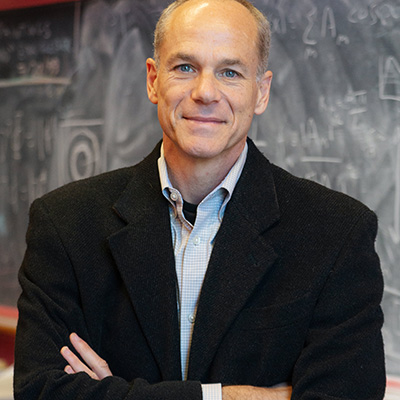
Marcelo Gleiser is a theoretical physicist, cosmologist, author, and the Appleton Professor of Natural Philosophy and Professor of Physics and Astronomy at Dartmouth College. His research spans early-universe cosmology, quantum …
Read More– I allow for the possibility that the structure of that thing called reality might be sufficiently simple, that we really could get to the bottom of certain aspects of it. For instance, I think it’s conceivable we could get to the bottom of what are the fundamental ingredients? That’s a story that we can trace back 2000 years, you know, Democritus, you know, atoms and the void, to our more refined version, which is now the standard model of particle physics. I don’t necessarily think that is the end of the story, for a number of reasons that we don’t need to recount, but we both understand well.
– The way I think about this is that even if we got there, we would know we are there.
– Sure.
– That’s the problem. Not just understand, but probe in nature. It’s a matter of probing too. It’s a technological problem. You know, it’s like it’s, so you say, “Oh, the Higgs. We discovered the Higgs.” And you say, “Could the Higgs be composite? Could they be made of other stuff?” We need more technology to find out.
– Yeah.
– Right? And then let’s say in 25 years they say, “Yep, the Higgs is a composite,” okay? And then a composite of what? Oh, Gasarch’s. You know, Gasarch’s particles. They say, “We have Gasarch’s. Okay, now are the Gasarch’s composite? We don’t know. We need more technology.” And that’s the issue to me. It’s turtles all the way down.
– Hey, everyone. Thanks for joining us. I’m coming to you today from Brazil. This is Rio’s Innovation Week. And I’m so pleased that I’m in conversation with someone I’ve known for decades. That’s Marcelo Gleiser, who is the Appleton Professor of Natural Philosophy at Dartmouth College. He’s a theoretical physicist, of course, who works on the origins of the universe, of matter, of life. And in 2019, he was the first Latin American to be awarded the Templeton Prize. He’s the author of a number of books. I’m sure many of you are familiar with them, “The Island of Knowledge,” “A Tear at the Edge of Creation,” and “The Dawn of a Mindful Universe.” And they’ve been published in 18 languages. So, Marcelo.
– Hey.
– Thank you so much for joining us.
– My pleasure.
– Or I guess I’m really joining you.
– That’s true. You are my guest here-
– That’s right. That’s right.
– And I’m your guest here.
– That’s right. So it works.
– Perfect.
– Total symmetry, so I though we’d have a conversation that is part physics, part philosophy, part psychology, part existentialism, just kind of-
– I love it.
– Cover everything, right?
– Let’s do it.
– And so, you know, I wrote a book called “Until the End of Time” where I kind of framed the motivation that we have for trying to figure it all out. I mean, you know, we’re these primates crawling around on this wet rock and we have this urge to kind of figure it all out. Where does the urge come from? And for me, it comes, I think, from our recognition of our own mortality that we’re gonna die, right? So there’s an anxiety there.
– Yeah.
– As I read your perspective, it seems a little bit different, that the motivation- and correct me if I’m wrong- is this urge for awe and wonder and some kind of connection. I mean, are those distinct, do you think? Are they the same in different guises?
– I think they are the same. You know, it is weird that we’re sort of like monkeys that have an awareness of the passage of time and the finiteness of our presence in this planet, right? And Ernest Becker wrote “The Denial of Death,” right? This famous book, and that was a Pulitzer Prize in the 70s, I guess?-
– ’77, yeah, had a huge impact on me.
– Really?
– Yeah.
– Okay. Me too.
– Oh, really?
– Yeah, absolutely.
– I did not know that.
– Yeah-
– In fact, in my book, “Until the End of Time,” I start with Becker.
– Okay.
– And that’s sort of where this mindset that I have come from… So how did it impact… Like when did you encounter that book?
– About five, six years ago.
– Just that recent? Okay.
– Yeah, and I’m finishing a book now and I start talking about him too, so-
– There you go.
– So wow. We are very synced.
– If you have the 50th Anniversary Edition, I wrote the forward-
– Oh, wow.
– To that version.
– Okay.
– Yeah, so it was one of the, you know, there were many honors, Templeton Prizes. For me, the honor was Becker’s wife writing to me and saying, my book was resonant with what Ernest wrote. You know, he died very young.
– Yes, he did.
– Of cancer. And so to try to bring the recognition of mortality as a human being, and then we theoretical physicists recognize there’s a mortality to the universe, right? All this will end, and to me, the mirroring of those two is what really helps me understand our sense and sensibility. So how are you bringing Becker into this next book?
– So the idea is that it’s a topic people don’t want to talk about.
– Yeah.
– Right? So it’s the avoidance of the engagement with the fact that we have a finiteness in this place. And the book is, let’s not do that, you know?
– Yeah.
– And one of the things that, I dunno, I had a very traumatic loss in my life and my mother died when I was six in a very dramatic way. And I encountered loss very early on. And for a long time in my life, I always thought of myself that first I wasn’t a, I felt like a bit of a victim, Oh, why me? You know, why this happened to me? And also the notion that you’re looking for love in life in order to celebrate, you know, our everyday presence in this world. And then I had this thought that was kind of depressing, which was something like this that every day that you have to love someone is one day less that you have to love that person, right? And for many years, that was kind of how I dealt with this issue. And it was dragging me down because, oh, come on, I’m getting older, you know, this is not good. And then a few years ago after reading Backer, I had this notion, this is the wrong calculus. You know, this is the calculus of loss. You have to have the opposite, which is every day that you have to live is a privilege, so that you have another day to love that person, right? So I kind of framed it that way in this. And so understanding finiteness and our presence here, you know, being what it is, is an opportunity to embrace life with everything that we have.
– Yeah.
– So it was in that sense. And, honestly, if you think about the human creative, you know, impulse, right? It is really an expression of this urge to celebrate or to imprint our presence. You know, you only really die when people forget you existed, right? I mean, if I think of my ancestors in Ukraine, I go back to maybe my grandparents.
– Yeah.
– My great-grandparents, but that’s it.
– Almost nobody that I’ve ever spoken to can go further back. I mean, obviously some people work out family trees.
– Yeah.
– But the average person, they, like you say, they can remember the grandparents, maybe the great-grandparents, but that’s it. It’s sort of a three-generation unit that seems to persist.
– And it’s changing now with our technology, right?
– Yeah.
– I’m hoping that as long as we back up our data, you know, our great-great-grandchildren will know that there were these guys, Brian and Marcelo, you know, they actually talked in Rio. Like how cool is that, right?
– Right.
– About life and death. But, so that to me is very important. And I feel like why do we do this? You know, why do we spend our lives thinking about the origin of the universe, about time, about the origin of life, about what is consciousness? It’s very much to understand, right, this, it’s almost like a role. We are matter thinking about itself. And I feel like we owe to this privilege to create this path in life that we can contribute to understanding what does this mean, you know, being alive and thinking about-
– Now, of course, some people take that thought and go further, right? So we absolutely, I agree, we are these collections of particles in a highly organized state, allowing us to do things that, you know, the table and the chairs can’t, which is to reflect on ourselves and reflect on our makeup. But some people go further, of course, and say there’s a purpose, an inbuilt purpose to all of this. And that purpose is obviously some would say we’re made in the image of God, right? Some would say that, you know, we are the way that the universe can know itself, and that was part of some overarching plan that the universe wanted to be self-recognized. To me, I love those ideas, but I don’t think there’s anything to them. I think that when you have a certain amount of organization, consciousness emerges. I don’t think it’s anything more than that. Do you go further or?
– No, I’m with you. To me, the big mystery is how come without divine intervention, this happens?
– Yeah.
– I mean, how remarkable this is. You know what I mean? So to kind of put the onus of, oh, this is coming from the outside in, meaning there was some, you know, whatever that divine force that organized matter with the intention of having intelligence in the universe, so it could explain itself, sounds very convoluted to me, you know? And there is a Jain creation myth that says that if God really created us to think about God, what a vain God that is, right? And if God is that vain, it’s not a real perfect God. So what’s the point of all this?
– Right.
– So to me, the mystery is understanding how come matter without form, atoms, right, molecules grew and developed to become this? You know, how… And that’s so fascinating that putting God into this picture sort of takes it away instead of contributing.
– And so do you think, where do you think we are in that journey-
– Far away.
– Of trying to… Yeah. You know, I mean, there are a number of theories about both of those questions where I say both the origin of life and the origin of consciousness. The thing that strikes me is that there was a time, whatever, 100, 150 years ago, which when it came to the origin of life, the general sense was you need more than matter. You need something to be injected, you know, a long vitale, some vital quality that matter does not on its own have. And only with that would a collection of particles surge with the currents of life. Now, not many people, at least in the scientific world, think that way any longer. I think most people would say, “We don’t understand it yet, but you don’t need anything else.”. I suspect that rhythm will recapitulate when it comes to consciousness, but I’m not sure I have a strong argument beyond the historical resonance. I mean, do you think it is more?
– So let’s go with life first.
– Yeah.
– Which is complicated enough, in my opinion. So Henri Bergson, right? He’s the elan vital guy. He’s having a renaissance now. Not because a lot of people think that there is something. Well, actually, correction. There are lots of people thinking that there is something else. The whole panpsychism movement, I mean, is really growing very strongly. And I don’t know about you, but I have… It’s kind of like, it’s an idea I want to like and to embrace, but I just can’t yet. Yet. Maybe I will change my mind, you know, open-minded. But the notion that consciousness is everywhere in the universe, like, and that somehow there is an interaction between this, whatever this conscious, ethereal consciousness, and matter in order to create order and localize consciousness in humans, not just humans, but in animals in general, I don’t understand at all how that happens. You know, but there are people like Philip Goff, he was with us in Tuscany, and, I mean, he is very much aligned with this because he says there’s no alternative and-
– You mean from the continuum of levels of consciousness that we can already see that there’s no sharp break? But I always wonder, folks of that sort, are they familiar? I’m sure they are, but I guess they reject it, with the idea of a phased transition?
– Yeah.
– There are things that we physicists know where there’s a continuum, and then there is a sharp break.
– Right.
– And so it could be that the continuum idea is right and consciousness extends from- I don’t mean to put us at the pinnacle, but just for organizational sense, put us there- all the way down through the primates and all the way down to insects perhaps. But it could at some point break.
– Yeah.
– And therefore this idea that everything has some degree of consciousness, it’s not obvious to me that you’re led to that. Is there a stronger argument?
– So I think the complication is this, is that when we talk about phased transitions, right? It is all within matter and physics and the behavior of particles interacting with themselves. And the discontinuous epistemological jump that happens is that when matter becomes alive, it becomes something else. It’s not just matter anymore, because it becomes matter with autonomy. And even at the level of bacteria, right? I mean, you say, “Oh, but you need a nervous system. You need a brain.” You do not need the brain to want to stay alive. And this urge is very hard to quantify and to model, right? So the big question for me now is how the heck did that happen? You know, how do bacteria, you put them in a solution that has more glucose on one side than the other, and they self-organize to go towards, there is more sugar because they need to eat. And there is a whole, you know, protein receptor in, you know, their front, and there is a beautiful chain of biochemical reactions that organizes the information from the environment that is captured from this receptor into motion. But if you pause and you deconstruct this a sec and you say, so there is a little thing which is a one-cell organism that interacts with the environment, receives information from the environment and translates the information into motion, that is magical, right? And it’s really hard to kind of understand the transition from non-living matter, you know, abiogenesis, right? This non-living matter to living matter.
– But you used the word autonomy.
– Mm-hmm.
– Do you take that word literally as applied to say a bacterium?
– You know, lack of words, but basically-
– I mean, do you think that it has a choice? I mean, to my mind-
– It doesn’t have a choice.
– Okay.
– But it has this kind of impulse.
– Yes.
– You know, whatever that is. And why does it know that it has, or knowing may even be a strong word for a bacterium, right? But it wants to stay around. It wants to reproduce, right? And of course, as you move on up in cognitive ability, let’s put it that way, it becomes more sophisticated and strategies for survival becomes even more amazing to get to us, right? I mean, humans, at least in this planet, and this evolution of chemistry into biology, into autonomous creatures is really mysterious. So these guys say there is no way that we can go. And people talk about emergence, you know, strong emergences. And emergence nowadays, a lot of people are saying it’s just a filler word.
– I agree.
– Like, always –
– It’s like we don’t really understand that jump, so we say it emerged from something that was distinct to something that we’re trying to understand and we coat that transition with this word emergence.
– It’s like phlogiston and caloric.
– In the old days.
– Yeah, exactly.
– Yeah, yeah, yeah. But you use the word autonomous again. And I don’t mean to parse it, but the reason it makes my ears perk up, because it talks to free will. And to my mind, however complex an arrangement of particles can be, whether it’s the bacterium, whether it’s us, those particles are still guided by something I like to call physical law. And it’s a good question. We should come to what we truly mean by that, but let’s put that off for just a moment. I think we both agree that there are regularities in the world that are captured by some kind of governing principle that we’d like to call laws of physics. And I think the particles are always completely subject to those laws, which means there’s no opportunity, as far as I can tell, for any being, conscious or not, to intercede in the lawful motion, unfolding of those particles. So that bacterium, I think if we analyze it, we can’t really do that, at the level of its individual particles, we see the physical interactions that are somehow conspiring to yield what we call aggregate motion of the bacterium toward the glucose. But it’s nothing but physics instantiated in a complex collection of particles. Is that enough for you as a in principle explanation? Or do you think there’s something beyond that?
– Well, we just got a big grant to do exactly that-
– So you’re gonna tell us one day.
– Eventually. Give us three or four years. But that’s the, can we, just using what we know-
– Yeah.
– Which may be missing a big part of the whole story, right? Which is important. Really come up with models that would describe what we are using the word urge or autonomy, whatever we wanna call it, you know, to describe the behavior of these very simple creatures, right? And and we don’t know yet. But the fact is that life is this way and there is a complication, which is when we talk about life on Earth, right? The emergence of life on Earth, people say, “Oh, you know, we can try to reproduce that in the laboratory.” And I’m just going a little bit 90 degrees on laboratory-
– Yeah.
– And I don’t see how that’s possible, because we can’t go back four billion years ago to know exactly what was going on.
– Do you mean in practice or in principle?
– I mean, in both.
– So the in practice one I completely agree with, at least with our current level of understanding. But the in principle one’s an interesting, more interesting one for me as a theorist and you too perhaps since we don’t have to worry about going to the laboratory to prove anything that we’re talking about. But it strikes me, and I’m wondering if you see things differently. Were we to get a collection of particles that were one-to-one in correspondence with your particles, and we were to somehow- there’s the in principle, of course- arrange them just as your particles are currently arranged, it feels to me pretty convincing that that collection of particles would then be alive and would surge with the thoughts and meanings and feelings that you do. Or do you think that we’d be missing something ’cause it’s just matter and that’s not enough?
– No, no, that’s not… It’s really an epistemic problem. Like we just never can know enough –
– Sure.
– About what happened four billion years ago on Earth to be able to reproduce the conditions in a laboratory, to recreate-
– Oh, to like have the chain start again?
– It’s a real problem of, it’s a historic science, right? And it’s a semi-cosmology in a sense. We try to grab all this data from the past, but it comes to a point where we may not have enough and we keep filling up the blanks, but with Earth and the origin of life, so another way of thinking about this is, unless it could be proven theoretically that there are a very few number of biochemical pathways to go from non-life to life, even if you make life in a laboratory, you can never know if the way you made life in the laboratory is the one that happened here.
– How much does that matter? I mean, if we were able to create life in the laboratory, to me that would be, and many people too, of course, a milestone, not because we would have recapitulated, let there be light and all the past steps necessary for humans, but rather because it would show that life is nothing more than organized chemistry.
– Okay, so here’s the problem with that. Yes, that would be awesome and let’s go try. But one thing is to have life emerging on itself. The other thing is having an intelligence creating life in a laboratory with an intention of doing that. These are very different things, you know? And I think they belong to different categories of experiments, so to speak, because there was no, as far as you know, we’re just talking about this, there was no conductor saying, “Okay, carbon, oxygen, do this, nitrogen, let’s connect.” And ta-da, we have like a little prebiotic cell there, you know, with a membrane and this thing somehow begins to metabolize energy and reproduce itself. There was no one there doing this. It just happened, trial and error. God knows, deep time. It’s different from a guy in the lab-
– Well, God, we don’t know if God knows, right?
– Yeah.
– So that…
– Maybe God may not even know, right? There’s another creation myth from the Indians that said, not even the gods know about the Big Bang. That was basically the origin of everything. So the point is, these are different questions to me.
– They are, but I know the answer to this is yes, but I’m seeking just a little bit more nuance. The power of natural selection is that it can try a gazillion possibilities ’cause it has no shortage of time and no shortage of laboratory space to try out the possibilities. And so the experiments are clearly distinct, but the trial and error approach ultimately chose a pathway or a number of pathways from inorganic particles, molecules that are made of atoms, to collections that ultimately were single cell, multicellular, and once we get to that point, we don’t know every detail, but we can tell a rational story.
– Yeah.
– Of how we go from, say, a single cell to these complex beings. If we were able to truly create that single cell in the laboratory, yes, of course it would be an intelligence guiding the process, but I would view that simply as short circuiting the trial and error. Evolution, natural selection, it had to try this, that, that, that, because there wasn’t a conductor. The one difference, when you do have a conductor, the conductor can say, you know what?
– A shortcut.
– Let’s not try that now. Let’s just get the shortcut. That to me is an important difference, but I don’t see it as perhaps as fundamental as you do.
– Yeah, I just don’t think it’s as awesome as having something that happened here without the conductor, you know, and it happened and it evolved in this spectacular way in this planet. So there is this factor of awesomeness, let’s use that word in the right way, that, and of course having humans create life from no life in the laboratory is spectacular. No question about that. And it will show, as you’re saying, that you can start from a very fundamental soup of molecules, which is the idea, you know, that reductionism applied to the origin of life, to create something incredibly complex, right? And it is, when we say incredible, incredibly complex, it’s important to really stress that because a single cell has billions of molecules working in tandem in incredibly- I mean, it is a wonder, right? And I can see why people say there is no way this could be happening in trial, because, you know, you have the mitochondria that does this. Even, okay, don’t even go to eukaryotic cell. Stay with prokaryotic cells. It’s still an incredibly complex thing.
– Yeah, no, there are these animations, I’m sure you’ve seen them of, the inner workings, I think Harvard produced the light, the proteins are moving as if they’re, you know-
– Little agents.
– Little, you know, robots.
– Yeah.
– That are just pulling, you know, other molecules behind them to get them where they… It is utterly spectacular. And to me, that’s the wonder of natural selection. You know, all the molecular pathways that didn’t yield that kind of organized complexity failed.
– Yeah.
– And evolution, natural selection, had enough time and enough space to try everything out, not everything, but enough out to be able to hit upon solutions. To me, the added wonder of us being able to do this in a laboratory beyond it just being a spectacular moment in the evolution of the species we could do that, we might find that there are multiple distinct, radically distinct pathways toward getting to living systems. And if we could show that, then I think it begins to reflect on issues of life and the cosmos. I mean, if there are maybe thousands and billions of different pathways that yield different kinds of life forms, then perhaps the special conditions on Earth that facilitated what happened here, you may not need those special conditions out there because you’re not trying to replicate what happened on Earth. You’re just trying to hit on one of these thousands or billions of pathways.
– Absolutely, no, it opens up the whole new way of like, okay, maybe life is more common in the universe than we think it is. Well, some people think it is. I don’t.
– You don’t think life is common?
– I can’t say. Well, nobody can say there is just life here. That would be silly. But I don’t think it’s a very common thing, just because it’s such a complex arrangement of matter, you know? And it requires, not just the origin of life, but the sustainability for life to remain present in this planet. So it’s been almost four billion years of life on Earth. And that means the planet- and I’m gonna talk about this very soon- the planet needs to be able, I mean, I’m not saying the planet’s doing anything, but the atmosphere, the biofeedback mechanisms, you know, the currents, the moon, there are all sorts of special properties our planet has to have been… And that’s not easy, right? And we’ve seen, I don’t know, more than 6,000 planets right now. And it’s hard to find another one. There will be, of course there will be, because they’re talking about trillions of worlds in our galaxy alone, so there’ll be similar things going on. But one of the arguments that I have is that you can show, because of natural selection, because each planet, each moon has a very specific history. And because life is so contingent on the history of the planet, in the way it evolves, that this kind of life is only terrestrial, what we see here, right? And so, I mean, the guy that got the Templeton Prize this year is Simon Conway Morris, right? This biologist has this thing called convergent evolution, which says that there are optimization pathways for life in order to, if you’re looking for life somewhere else, this is a bilateral symmetry, you know, that allows animals to look around and do this, they will be repeated, you know, and the way the eye developed in different ways across the history of life on Earth. And I think that’s all good. But what is amazing to me is that any kind of life elsewhere will be different from life here, you know?
– And so, you know, going back to, you know, creation myths. There have been, there’s so many creation myths in our heritage. And it seems therefore that at least early on, anchoring our life in a story of origin seemed to be pretty important to us. As we come now to the modern age, yeah, there are cosmologists, people who think about, but it’s more niche, it feels, a little bit more technical, obviously, because it’s in a scientific domain. Have we lost something as a culture where creation stories are not as ubiquitous in the way we think about our lives as perhaps it once was?
– Hmm, that’s a good question because, you know, those creation myths were part of a religious culture, right? I mean, they were very much how the religion defined the power of God or Gods, or no gods, depending on the… And so we don’t do that anymore, right? So when we talk about cosmology in the modern time, we’re not associating that, of course, with any kind of gods, quite the opposite. The idea is to not, it’s to dissociate, right? But then comes the possibility that those new creation stories, meaning the stories that we are creating through our research, which is kind of awesome, right? That we spent our lifetime doing this. They are- and this is very much my position- you know, they are part of what I call a secular spirituality, you know, meaning completely detached from any kind of supernatural stuff. But this sense of belonging to the cosmic history, right? I mean, we can now, and we are the generation of physicists that actually saw this happening, right? I mean, we started in the ’80s, right, with unified theories, and then we found out so much about the fundamental particles and how stars work and how there is always transformation in the universe and what stars are the ultimate alchemists, right? They take hydrogen, right, and make you into singing opera, you know, just wait a long time. So basically this narrative to me is a creation narrative. You know, it’s mythic in its power, not in its religious framing, but it is awesome and it is spiritually, in my opinion, spiritually charged. And perhaps one of the things that is missing in the way we live our lives nowadays is that we lost the enchantment of this creation story, right? And just like Max Weber said, right, that… And so perhaps what we need to do is bring back this notion that we do belong, not just to the history of life on Earth, but to the history of life in the universe, like all the way to the beginning. We are connected with the whole story, right? To bring back this sense of belonging so that we kind of respect our planet a little better.
– If, you know, just going back to Becker, if we were immortals or if we encounter- I don’t even know what I would mean by this- you know, some alien life form that is as close to immortal as we could imagine, do you think that longevity would obviate the urge for that group to have a creation story?
– Hmm. That’s a very good question. And of course nobody knows the answer to this question. You can have an opinion on that because that’s such a… Immortality is such a, it’s like the infinite, right? I mean, it’s a wonderful concept, and we use it all the time, but we don’t know, right? I mean, is the universe infinite? Looks like it, within a percentage point or half a percentage point. You know, is time…. So we play with these ideas of immortality because we are afraid of dying, you know? So the idea of considering the possibility of immortality is really a non-acceptance of the fact that we are not immortal, right? And so I think-
– However much metformin or all the other drugs that people are taking today, you know?
– Yeah.
– So yeah, yeah, for sure.
– And, you know, and the whole transhuman movement, right? I mean, which to me is kind of… Well, how can I put it? Depressing, perhaps, you know, because you see a lot of people with a lot of money and a lot of power kind of desperate about the passage of time, right? And I find that a loss of life. You should be focusing on the life you have, not the life you want to have after you don’t have a life. I mean, it’s, right? It should be obvious, but it isn’t. So if there would be such a thing as immortality, you would lose sense of the passage of time.
– Yeah.
– And hence stories would not make any sense anymore.
– Right.
– And so beginnings and endings are irrelevant, and I think it would be incredibly boring to be that way.
– Right, so given the opportunity, you’d turn it down?
– I would turn it down.
– Wow.
– But I wouldn’t mind-
– So you actually, you put your money where your mouth is, ’cause I feel very similar to you, but I think if I was given that devil’s bargain of perhaps a very boring stretch, so-called eternity.
– Yeah, I think it would be very hard still not to jump at the opportunity to forestall, what we think of as the inevitable end.
– So, okay, let’s negotiate.
– Oh, so you want a better deal?
– I want to be-
– You wanna be able to have an opt-out clause at some point.
– I would say that I would like to see my grandchildren grow.
– Right.
– So if I could live 200 years, I’m happy.
– Right.
– But it’s not –
– Well, you’re very modest.
– Yeah, I’m very modest.
– You went from infinity to 100, which is-
– Yeah, yeah, yeah, because it’s more realistic. Like even medicine and-
– Well, you may even have a hundred in your future, right?
– Yeah. Who knows?
– It’s not unrealistic at all. If we shift a little bit from, you know, the infinity or immortality right back down to the finite, I gather that you view that the human brain is as, well, I think we both agree, the human brain evolved for a specific purpose, which is survival. And yet we use it in ways that it wasn’t designed for, which is to figure out things that are irrelevant to survival, right? The kind of work that we do and the kind of work that many people do. Does that yield some sort of inbuilt bias or blind spot that we will somehow never be able to understand the true reality because of this design issue?
– I’m very much on the team that says we’ll never be able to understand the true reality, you know, because I think that sentence doesn’t even make a lot of sense, you know?
– So you don’t think there is a true reality or the idea of understanding it?
– Yeah. No, there is something out there. Or in here or both.
– Yeah, right.
– Because, honestly, the separation is very tenuous. But it’s really a matter of, I always like to use this analogy of the map and the territory. You know, there is a territory. Of course there is a territory. But we only see the maps and we only create maps. And maps by definition are incomplete versions of reality. And so all the science, all the poetry, all the music, everything that we try to do are maps to what I call the four legs of existential existence, which is, I don’t know if that makes sense, but existential life, which is science, philosophy, art, and spirituality. And those four legs, to me, kind of like support all our creativity. And honestly, that’s as good as we go. And when we say, for example, we worked on the theory of everything, right? And to say, okay-
– A phrase that I, by the way, I don’t like.
– Good. Me neither. I used to call it GOD, the Geometry of Destiny. Come on, but anyway, so, why not? Because we humans, we have tremendous ability to create technologies, which is what differentiate us from any other animal we know on Earth, right? I mean, one thing is to have a nest, which birds do very nicely. The other thing is to get, you know, like raw materials and construct telescopes and spaceships. It’s a very different ballgame. And so that means that we amplified our view of reality tremendously, right? And that gave us the illusion that we can go to the very end, to the bottom to see everything, right? But the problem with that is that the very act of discovery, right? So when we are finding new things about the world, a new theory, a new force is discovered, right? You have to push the reset button, because then all sorts of new questions that we couldn’t even contemplate before show up. And so what end of reality is that? Because it’s really the process that brings us all this knowledge. And and so to me, epistemically, right? I mean, the way we learn about the world can never encompass the territory because all we do is maps, you know?
– But so there’s a lot that I agree there, and it strikes me that, you know, a position that I’ve articulated to a number of our colleagues over the years, and very few people agree with, but I suspect you will. I think math is a human invention. I don’t-
– Oh, good for you.
– I don’t think it’s out there.
– Yeah.
– You know? Whereas, you know, you’ve probably experienced as well, most of our colleagues don’t feel that way. It, you know it’s out there. You know, the concept of prime numbers is out there. And I’m like, no, the concept of prime numbers is in here. The concept of triangle is in here. There’s no platonic realm where these entities are actually living. But the one place where perhaps we’re a little bit oblique, I allow for the possibility that the structure of that thing called reality might be sufficiently simple, that we really could get to the bottom of certain aspects of it. For instance, I think it’s conceivable we could get to the bottom of what are the fundamental ingredients. That’s a story that we can trace back 2000 years, you know, Democritus, you know, atoms and the void, to our more refined version, which is now the standard model of particle physics. I don’t necessarily think that is the end of the story, for a number of reasons that we don’t need to recount, but we both understand well. But I do think it’s conceivable that that framework might be the right framework in the sense that there’ll come a point when, yeah, the book is closed. That chapter is written. Here are the ingredients. Now, again, I don’t know that, but I certainly allow that possibility. Do you allow for that or you just think, no, that’s just like the map and the reality, different, no matter how you slice it?
– Do you know, the way I think about this is that even if we got there, we wouldn’t know we are there.
– Sure.
– That’s the problem. You know, so we have this description, it’s awesome. Is this the end of the story? How can we know?
– Right.
– That’s the problem.
– No, I think that’s the general, with any exploration, what’s over the horizon, right? You can’t see it and the horizon is always receding. And so there’s just so much you can say in terms of your confidence, which you can build, but you can’t ever get it to 100%. But is that the essential blind spot that you see that we will never know that we’re there or do you think that, you know, I mean, I’m fond of saying there are all these intelligent animals on this planet: cats, dogs, whatever. I don’t think they understand general relativity, even though they’re smart. Why would we be any different that there are things that we just can’t comprehend because, again, the brain wasn’t developed to have ultimate knowledge. It was developed to get the next meal and find the next shelter and get a partner and be able to reproduce. So they’re just different design sensibilities and features in there. But do you think that there are fundamental limits on what the brain can understand?
– Not just understand, but probe in nature. It’s a matter of probing too. It’s a technological problem. You know, it’s like it’s, so you say, “Oh, the Higgs. We discovered the Higgs.” And you say, “Could the Higgs be composite? Could they be made of other stuff?” We need more technology to find out.
– Yeah.
– Right? And then let’s say in 25 years they say, “Yep, the Higgs is a composite,” okay? And then a composite of what? Oh, Gasarch’s. You know, Gasarch’s particles.
– Right.
– They say, “We have Gasarchs. Okay, now the Gasarch’s composite. We don’t know. We need more technology.” And that’s the issue to me. It’s turtles all the way down. And it’s a real problem in a sense. It’s not a problem to me. It’s okay. You know, I grew to accept that not knowing is okay.
– Yeah.
– You know? And I really embrace this notion called epistemic humility, that it’s okay to say there are some limits to what we can know.
– Yeah, to me, that really is the distinction if we’re talking about the overarching framework of science and religion. Religion seems to me less comfortable with saying, “I don’t know.”
– Yeah, that’s true.
– There’s always an answer there, whereas we’re quite comfortable going in and coming out saying, I don’t know. Two more quick topics, if you just can entertain for a moment. Obviously we approach the world with the brain that is configured as an ordinary brain is. We can affect how the brain processes the external world by having chemical changes, psychedelics, for instance. What would you say we learn or can learn about the nature of reality by affecting how we experience it in those ways?
– Hmm, yeah, so that’s the, I wouldn’t say million dollar question like Dr. Evil, but that’s the $100 million question’s more realistic because there is a big debate in this community. They say, are these medicines? We don’t call them drugs anymore because, you know, are these medicines allowing you to see things that you cannot see of the real world? Real, the reality we’re talking about before. Or it’s just a fabrication of a ton of oxytocin and dopamine and whatever, right?
– Just changing the receptor and so it has a different experience.
– Yeah, so there are two ways to deal with that, I think. One is to say it really doesn’t matter in a sense that the experience is what’s transformative.
– For the individual.
– For the individual. Yeah, it’s the experience that is transformative, that is healing, and so some of those medicines, I’m not the world’s expert on this stuff, but some of them do bring about this profound sense of unity with everything. This thing that Thich Nhat Hanh, you know, the Vietnamese monk called the interbeing, which I think is a beautiful.
– Yeah.
– And you really, it’s not like you conceptualize this thing. You feel it. You know, it’s like, yes, I am that tree. I know that I am part of it. And we are, because when you breathe the oxygen from the tree, the oxygen that was part of their molecules, there is now you, it’s part of you. When you eat something, it’s part of you, so-
– And the molecules in you were forged in the deep interior stars as you were saying earlier.
– So talk about cosmic interbeing.
– Absolutely.
– There you go.
– That would be a cool title for a book. You know?
– We could do it.
– Yeah, cosmic inter is a beautiful, the new story of life and, anyways.
– But, so there is that way of thinking. And then it’s the other school that says, yes, that these, it’s the Aldous Huxley story, the doors of perception, right? That the brain is efficient because it’s very good at focusing, right? So we have a task, we’re solving that horrible equation or, you know, doing a heart surgery or whatever it is, you’re focusing on that thing. And the brain does this at the price of excluding a huge amount of information out there.
– Right.
– And the opening of the doors of the perception is precisely this idea that you’re able to see reality in ways that you cannot.
– Ordinarily.
– Or is there reality? You know, and it’s hard to know, but one thing which is very true is that many religious rituals, not just from indigenous tribes in the Amazon and other places, but in ancient Greece, you know, the article of Delphi, you know, smelling those things. You know, there’s a whole new theory out there.
– That that was psychedelically driven in someone?
– Big time.
– That interesting.
– Yeah, there is even like some very kind of controversial ideas that the drinking of the wine, you know, in the Catholic mass, it was a spiked wine in the beginning, you know? And that’s why you found communion with God. ‘Cause, you know, the blood of Christ, I mean, really? And, but you know, if you’re an altered state, that becomes much more experiential.
– Yeah, yeah. Of course.
– Right? And so it’s in a sense, maybe, and this is something neuroscientists are studying more than I am, but one thing that is true, which is really spectacular, is that some of these medicines do create a window of neuroplasticity in the brain that allows therapists to actually help the healing process. It’s sort of like in a very fast way, right? I mean, you can spend 10 years doing psychoanalysis and you can have three sessions with a good therapist, with psilocybin or whatever it is, and you’re making enormous progress. And I have seen videos of this happening, so it’s not like hypothetical.
– Sure, you know, I’ve had conversations along those lines as well. Final question.
– Yeah.
– In this era of AI, the notion of mind and consciousness takes on a different slant. So two quick questions before we wrap up. If an AI comes along and provides us with the answer in the sense of we can ask it, is the Higgs composite? What happened before the big bang? You know, what happens at the singularity of a black hole? And somehow it provides us answers. We don’t understand how, but it gives us answers that we can check and it makes sense. And all of a sudden, how does that fit in to the limitation of human knowledge? Is that new knowledge if it comes from a black box and we don’t understand the narrative, the inner workings, the story, but yet we get to the result?
– We’re just gonna be amplifying our brain capacity through those machines, you know? But one thing that is hard for me to, it’s a big if, by the way, now let, you know-
– The big if in terms of AI getting there?
– Yeah.
– Yeah.
– Yeah, because in order to do all these things, you know, to have these discoveries, the AI has to have technological capacity and build instruments, because you can’t guess this stuff. You have to measure this stuff then.
– We don’t know that, right? I mean, it may be that, you know, a super brain starting with Einstein and quantum is just able to develop the mathematics to a place where it says, “Oh, you humans, you saw that singularity at the center of a black hole. No, no, here’s how you deal with it.” And it may be embedded in the math that we can’t see it, right?
– Yeah, that kind of AI is, to me, another name for God. You know, it’s sort of the omniscience of God, you know? And I just do not see how an algorithm based on statistical inference and, you know, LLMs, whatever. And of course, we’re just beginning this new adventure. Maybe in 20 years, I’ll be-
– And it may be a different kind of AI necessary to do that, that the scaling hypothesis doesn’t work.
– But then it’s sci-fi, right? I mean, I don’t know how, but yes, if-
– Well, sci-real, right? I mean, if-
– No, if this thing happens.
– If this thing happens,
– Yeah.
– Yeah.
– But I think we’re really far away from that right now, right? I mean, honestly.
– Yeah, I mean, you know, I share that intuition, but some of the leaders in the field are saying ’28, 2029. Yeah, so, you know, it’s hard to know.
– That’s marketing.
– It may well be, with all the money they need to build the data. Yeah, I totally agree with that. One quick final question. And again, it’s one of those speculative ones. We don’t know the answer, of course, but just your gut feeling. Can an AI system have consciousness?
– I really don’t think so. Absolutely do not think so, because to me, consciousness is not in the brain only. It’s embodied, and it’s experiential too.
– What if we give an AI-
– A robot?
– A body or, you know, some way of having some connection to the external world similar to our five senses?
– So that’s a really long conversation, but basically the experience of being alive, you know, of like being pinched and being kissed and crying and drinking wine, I don’t think that’s something you can program very well. You can fake it. And unless you have that, I don’t see how. You can develop some-
– But just curious, along those lines. I mean, someone who has a diminished capacity to engage with the world the way we’re familiar. Someone who’s lost a sense of sight, sense of hearing, maybe even sense of touch, do they have diminished consciousness then in this view?
– Well, I think then brain compensates in other ways, right? I mean, it does.
– So then couldn’t the AI conceivably compensate?
– Yeah. Yeah. I just don’t think it will be anything like human consciousness.
– Sure.
– It’d be whatever. I don’t know what it is.
– But perhaps there is some kind of self-awareness that could be instantiated in an artificial system.
– And then the big question is, would that self-awareness become autonomous? And that’s the scary part, right?
– See, and that’s the word I don’t even understand. I don’t think we’re autonomous. But maybe that’s for another conversation.
– Oh, okay, because-
– Yeah, ’cause I don’t think we have free will, yeah.
– Oh, okay.
– Yeah.
– I’m happy, I’m talking to a rabbi on Friday about free will actually in this conference.
– I’m looking forward to it. All right, well, Marcelo, thank you. Enjoyed this conversation.
– Thank you.