15 views | 00:00:41






After nearly two centuries, math’s greatest challenge, proving the Riemann Hypothesis appears to have been conquered. Remarkably both AI and a human mathematician may have independently crossed the finish line.
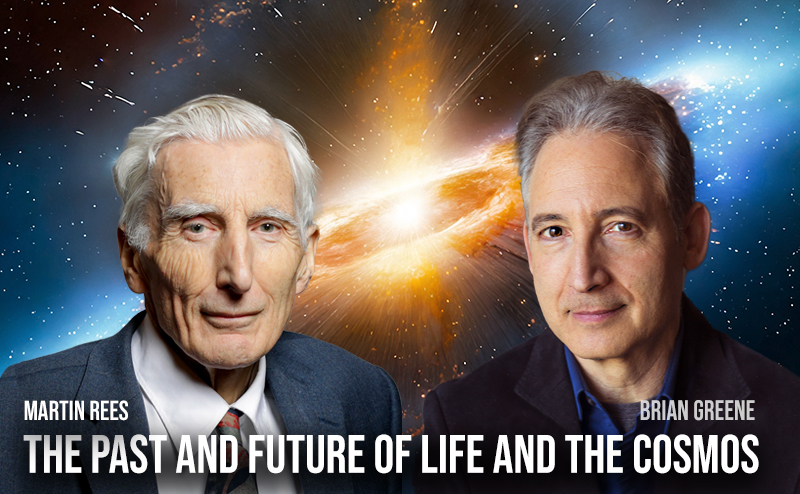
Only days after their last conversation, Brian Greene speaks again with Alex Kontorovich, professor of mathematics at Rutgers University, as breakthroughs in math are happening at an astounding pace. The two trace the 167 year history of the Riemann Hypothesis,, from the bored-teenage Gauss computing tables of primes to the stunning advances announced in the past week. They discuss what it means to have a proof that runs to 17 million lines of code and 250,000 pages of text, and the implications for the future of mathematics.
This program is part of the Rethinking Reality series, supported by the John Templeton Foundation.
– Isn’t it crazy that we’re actually talking about, is it September or October, when we’re talking 167 years of work?
– Yeah. What week was it? What hour was it?
– Proving the Riemann Hypothesis has been widely viewed as math’s greatest and most important challenge, and it has resisted being solved by the most accomplished mathematicians for 167 years. Now, the hypothesis itself, it has to do with the distribution of prime numbers. But look, even if prime numbers are not something you think all that much about, the recent news should knock you off your chair. AI, guided in part by human mathematician, it seems to now have proven the Riemann Hypothesis. That is AI has gone where no human brain has gone before. Now, in its raw form, this AI proof, it runs to something like a quarter of a million pages. And in its formalized version, that’s the one that you can run through the automated theorem checker called Lean. It’s about 17 million lines of code. So clearly, at this point, suffice it to say, no human understands the proof, but we’ve got the next best thing. Alex Kontorovich, Professor of Mathematics at Rutgers, he’s going to help us grasp as much as we can about this momentous development. Alex, it is so good to see you again.
– Long time, no see.
– Yeah, it is rare that we ever do a follow-up a few days after we’ve had a conversation, but this is an unusual time in mathematics, right? The recent announcement that there may be a proof using Claude, and human as well, of the Riemann Hypothesis, which is kind of amazing. Now, there’s something you said to me in our last conversation, which was, “You can only once have an experience of, oh my God, what has happened? How could this be happening?” Do you stand by that statement now?
– The other thing I said to you was that I was constantly wrong and I was wrong then. And yeah, when I said, “How could I be shocked again?” I’m completely shocked. I mean, this is beyond anyone’s imagination.
– Yeah, so just for those who perhaps have not heard the news, I think many people who follow this kind of arena of human thought have heard, but what is the announcement that we’re both responding to here?
– Yeah, so on Friday, Levent Alpöge posted, I guess just on his website, a little four page description of his experience over the last few weeks, I guess it’s been, where he had been iterating with Claude. And at the end, Claude just went off on its own, you know, thousands of agents talking to one another. They wrote some apparently 250,000 page natural language paper, which he then asked it to formalize in Lean, and it did. And it came out with a formal proof of the Riemann Hypothesis.
– Wow. Yeah, it’s kind of crazy. So just to, you know, I’d like this conversation to be as self-contained as it can be. We won’t go quite as in depth as perhaps in our previous conversation, which I’ll direct people to for a little bit more detail. But I thought we would just sort of give the overview of what this is all about, and then we can dive a little bit in to whatever you can tell us about the details. I’m sure you’ve digested that 250,000 page paper over the weekend. But anyway, so I just have a couple slides, just to sort of get us all on the same page. So, you know, if we see here, a sort of outline the big issues here. So maybe we can just start with, you know, the question, right? So the big questions concerns prime numbers. Just take us through a little bit of what this is all about.
– Yeah. It starts with Gauss computing huge tables of primes and wondering what the distribution is. And other people were doing this at the time, and Gauss conjectured sort of a main term for how many primes there are in a window as the window varies, that main term being that the proportion of primes in an interval is like one over log where you started. And Riemann had a, Riemann observed that there was a complex analytic function that would explain both Gauss’s conjecture and give you the sharpest distribution, the sharpest count you can, which basically say that Gauss’s guess for the main term gives you the first half of the digits accurately.
– And so that was in the mid-1800s that this idea was put forward and it definitely captured people’s imagination. And in particular, the hypothesis was that the zeros of that function, and we’ll write down that function in just a moment, the zeta function, just so people can sort of see it on the screen. But where this particular function, the details don’t really matter, but where this particular function has its zeros is vital to understanding where the primes are statistically speaking on the number line. And so the goal was to prove that the hypothesis, that the zeros were on a very specific contour, vertical line whose real part was a half. Again, the details don’t really matter. Trying to prove that, where would you say that has sat in the pantheon of mathematical problems that mathematicians have kind of viewed as critical to the field?
– Yeah, it’s basically, in some sense, the iconic problem of the entire field. Anytime somebody wanted to say something like, “Oh yeah, that’s as hard as X,” X was, you know, 99 times out of 100, the Riemann Hypothesis. And so in the year 1900, there was a Congress, you know, the International Math Congress of Mathematicians, which happens every four years. This is where the Fields Medal is given out. Of course, there was no Fields Metal back in the year 1900, but David Hilbert was kind of thinking, what are the challenges for the 20th century? And he wrote down 23 problems and among them is the Riemann Hypothesis, which there had just been incredible progress in that direction in the year 1896 by two mathematicians, Hadamard and de La Vallée Poussin, who independently resolved Riemann’s approach towards Gauss’s conjecture by proving the prime number theorem, but with an error term that doesn’t tell you anything about how many digits there would be in the error. And so this was one of the things Hilbert said, “The 20th century, we should try to prove this.” Fast forward 100 years, and it’s the turn of the millennium, and the Clay Institute, newly founded Clay Institute says, “Okay, so let’s follow Hilbert’s ideas one step further. What are the problems that mathematicians should work on in the third millennium?” And they gave these, you know, seven problems, a million dollar bounty each, and number one is the Riemann Hypothesis. And it’s the only one that continued to haunt mathematicians from Hilbert’s time and before Hilbert’s time to the turn of the millennium and for the 26 years thereafter.
– And so going back to Riemann himself, that’s 167 years since this hypothesis is put forward. And then the amazing thing is in just the last few months, there was incremental progress, and then in the last few days announced that that incremental progress had now culminated in actual proof. I thought we might go through the timeline of that for just a moment, because I think putting this in historical context is what really gives the breathtaking sense of what has happened, even for folks who don’t work on prime numbers or the distribution on the number line or haven’t heard of the data function. So if we can just go over to the timeline. On the timeline, if we begin say with Gauss. Gauss was thinking about this at what point?
– Yeah, so if you want, you can jump all the way back to Euclid 2000 years ago.
– Yeah, sure, go ahead.
– That was sort of the first big result on the prime numbers and Euclid proved that there’s infinitely many. So you don’t have to worry about their distribution if there’s only finitely many of them. So we know there’s finitely many elementary particles in the universe, or at least we believe, but in terms of the multiplicative structure of the whole numbers, namely the primes, it turns out you need infinitely many fundamental particles. And that was Euclid’s big theorem from, you know, 300 BC. Okay, let’s skip forward to Gauss, who this is like 1793-94. He’s a teenager who’s sort of bored and has some an idle hour or two here and there and computes chiliads of tables of primes. By the thousands, he’s sort of siving out numbers that he knows. He’s taking multiples of numbers that he knows and removing those multiples and what remains in that little interval that he’s experimenting with are the prime numbers in that interval.
– And then Riemann comes along, that’s the exact year is what, 1859?
– 1859 is, yeah, when his paper is published.
– And then 1896 you mentioned was a big year.
– Yeah, so that’s when the prime number theorem was proved following Riemann’s blueprint for how to do it. So Riemann gave sort of two blueprints. One is if you just want the prime number theorem, you have to show that there are no zeros of this function on the real part of S equals one line. And that’s what was accomplished in 1896. And he said, “But really, I believe the truth to be much better than that. I think there are no zeros up to the one half line.” He knew that there were zeros on the one half line, but he guessed, hypothesized that there were no zeros between real part of S is a half and one, including one. And so 1896, we know that there are no zeros on the one line. What is it, October something? Well, maybe there’s some more steps in the timeline you want to go over.
– Yeah, a few more steps if we want. So you mentioned 1900. Hilbert, of course, mentions this is a key problem for, you know, the next century, you know? In 1914, Hardy, he proved something about the zeros of the zeta function two. Do you happen to know that off the top of your head?
– That’s right. So Riemann computed the first few zeros by hand. This is again, 1859 or so, probably a little bit before he actually wrote that paper, and he saw that three of them were on the line. And the first question is, “Well, can we at least prove that there’s infinitely many on the line?” So Hardy was the first to establish that indeed infinitely many of the zeros of the Riemann zeta function do lie on the one half line. Selberg, before we get to Levinson, Selberg proved that actually a positive proportion of the zeros do lie on the one half line.
– And that was in the 1940s or something, right?
– That’s in the 1940s. Yeah, 1940s, that’s right.
– And then Levinson.
– Levison got that method up to a third.
– Yep.
– Brian Conrey pushed that a little further. So we’re up to the year 2000, okay, the Clay Institute. I guess there is a little bit more human, I think something like 40% of the zeros was proved by Brian Conrey and then Conrey-Iwaniec, and maybe I’m blanking on some other collaborators in that project, got a little bit far higher up than 40, maybe 41% or 40.5%. So there was, you know, incremental progress in that direction. I see there’s 12 trillion lines.
– That takes us to what? Like the early years of the 21st century or so?
– Yeah, like 2015, let’s say, 2010, something like that.
– And so right there, you’re talking about whatever, 150 years of work or something like that, just sort of narrowing down, you know, where the zeros could be, the fraction that might be here and so on. But I think the general feeling was that we were really making incremental baby steps toward trying to actually get to the real deal until the year 2026, and then sort of, you know, three key moments there. If you just take us through what now is just a couple months of work in the 2026.
– Yeah, so I guess we’re talking August now. So the Alpöge and Claude and Furman, I guess, I don’t know who else was involved in this project, but basically Claude, I think they told Claude something like, “Come on, make some progress on the Riemann Hypothesis,” you know, “Do a breakthrough.” And Claude had a fantastic result, which is that instead of we went from 40% to 40.5% or 41%, it jumped all the way to 66%. So two thirds of the zero. There’s some clever things that apparently humans had missed and this kind of optimization, AI was already getting good at. And it showed that two thirds of the zeros do lie on the one half line. Now, at that time, I mentioned something like, you know, people were getting very excited about this and I said, “Okay, but you know that this doesn’t actually make any progress, any real progress towards the Riemann Hypothesis, because if it had proved that 100% of the zeros were on the half line, that would still say nothing about the Riemann Hypothesis.” Because when you’re dealing with infinite sets, what you mean by percent is an asymptotic formula. So asymptotically, no whole numbers are perfect squares because the proportion of perfect squares up to X is, you know, is one over square root of X.
– Sure.
– There’s only, square root of X perfect square is up to X, and so the asymptotic count of them goes to zero. And so 100% of numbers are not perfect squares. That doesn’t mean perfect squares don’t exist.
– That’s an important point that I don’t think many people fully appreciate, which is like you’re saying, if you’re talking about fractions, when those fractions are dealing with infinite sets, there can be a whole bunch of things that lie outside of even 100%, because you’re really talking about a ratio. And if the ratio goes to zero, as the set grows to infinity, it’s as if they’re not there from statistics, but by God, they actually are there. So there could be zeros outside of the S equal one half line, even if you had, as you mentioned, proven asymptotically that 100% of them lie in S equal one half.
– Exactly right. So this is a fraction where the numerator and the denominator are infinite. And so, you know, how are you going to make sense of that? Well, you cut them off at a finite amount and then you look at the limit. And in the limit, what this result said was 66% of the zeros, you know, in the limit will be on the one half line. And I pointed out, well, okay, if they got 100 of the zeros on the one half line, we still would not know if there aren’t some zeros that are approaching the one line arbitrarily close. So in terms of what it does for the Riemann Hypothesis, it basically does nothing there. It’s a fantastic result, but it’s just not making progress towards the Riemann Hypothesis.
– And then September?
– And September, and I think that’s the last time we spoke was about this OpenAI result. Oh, was it September or October? I can’t remember.
– You know, we spoke in October. I don’t know exactly when the result happened, but let’s call it September/October then.
– Yeah, I thought it was early October when OpenAI.
– Isn’t it crazy that we’re actually talking about, is it September or October, when we’re talking 167 years of work?
– Yeah. What week was it? What hour was it?
– Yeah.
– Yeah, exactly right. Wild, wild times. So yeah, so whether it was late September, early October, OpenAI came out with a slew of papers, among them, a proof of the quasi-Riemann hypothesis, which says that the zeros, okay, we can’t prove that there aren’t any between a half and one, but there aren’t any between seven eighths and one. And so that zero free strip, zero stream vertical strip was already an absolutely massive breakthrough. For the first time we knew that in this prediction for how many primes there are, up to X of Gauss, the first one eighth of the digits you would get out of that prediction are correct.
– And that’s when we spoke, and that’s when you very nicely informed me and our audience that you didn’t expect to see that result in your lifetime. And then here we are, what, I don’t know, 10 days later, something like that?
– Something like that.
– And now take us up to the moment.
– My phone and email started blowing up on Friday morning with lots of people saying what’s going on here and what do I know about it? And I knew nothing about it. And of course, I immediately looked at what was going on, saw that Levent had posted this four-page sort of explanation of a little bit of the history of what progress he had made incrementally, what he had asked the AI to do. And then he basically says in that document, at some point, and I don’t know if that point is halfway through the proof or a tenth of the way through the proof, but at some point the agents just took off on their own and he has no idea what they really did. And they came out with this document. And I mean, imagine we didn’t have formalization and the AI gives us a 250,000 page document that it says is the proof of the Riemann Hypothesis. That would be, in fact, I actually spoke about this something like three years ago. There was a meeting at the National Academy of Sciences trying to understand the state of things with AI and formalization and so on. And I thankfully wrote down my notes of what I said in that meeting, because it was one of the very first things I said and it’s sort of the obvious thing to think about. Imagine this world where AI comes out with a quarter million page natural language written proof of the Reimann Hypothesis. And now what? I’m going to spend the rest of my life just, you know, going page by page. I mean, I’ll never get there. I’ll get through 10,000 pages in my lifetime, 100,000 pages, and I’ll just be this task of trying to make my way towards the Reimann Hypothesis knowing that I can’t get there.
– You didn’t really conjecture a quarter million pages, did you back then?
– No, I did not say, maybe I said a million pages or just some abstractly large number.
– It doesn’t matter.
– Yeah, yeah, I wasn’t that precise.
– But your point is, without having an automated theorem checker that can actually go through it, we’d have no idea whether this thing is right or not.
– That’s right, that’s right. So unlike the quasi RH result, where within a few days, you know, it wasn’t even maybe two weeks, not even, where people had gone through what the AI was doing. For seven eighths, the argument is very technical and sort of the technicalities are not interesting. It actually had another proof for eleven twelfths, a weaker proof. But that proof, we really just almost immediately could understand exactly what was going on. And I think as I said last time I was speaking with you, it’s basically take my colleague Henrik Gavanios’s work, life work and put it all together and supercharge it and do all kinds of highly technical things. He had predicted that process as being potentially leading to the Riemann Hypothesis. Of course, no human is claiming it. No one says they knew how to do it. But what’s happened now is we have this 17 million line formal proof that Levent put out that Claude wrote that people just immediately put in their computers and verified. I mean, Levent’s not an idiot. He wouldn’t be putting this out if he didn’t compile, but it’s obviously you have to just independently check it once and for all. It was checked in a thousand different ways, but using every known process to certify and it was within hours certified as a correct, complete proof of the Riemann Hypothesis.
– So there is general feeling in the community that this is correct?
– Yes. The correctness is not, I think, generally in doubt. I mean, among the people that I talk to and the people who have experience with this software, it’s not in doubt at all. In fact, we know this result with more certainty than we know 100% of what’s in the published literature in natural language. But there is a deep discussion about, you know, math isn’t about correct statements. It’s about understanding. And so if we just go by understanding and intuition alone, we make all kinds of mistakes. We’ve known, you know, there are a thousand mistakes through the history of mathematics when we said something that seemed right, but we didn’t have a rigorous proof to back it up and it turned out that we got nonsense out of it. And so we predicate our understanding on, we build it on top of formal rigorous proof. And in this case, it’s sort of the cart came before the horse, in the sense that the proof, it used to be impossible to come up with a proof without having that rigorous understanding. And now we have it the other way around. No human being understands this proof. Levent himself says, you know, “I don’t know what’s going on here.” Again, there are.
– Well, he had actually some very wonderfully poetic words as I read his four-page paper, and this has been quoted widely in the media, of course, where I don’t remember it exactly, but something like he said, “I set it up. I helped it get to a certain point, and then it sparkled and danced and flew or something across the finish line.” And it’s just a wonderful, wonderful description. But it’s an interesting vital point, because I think the question, and math is right now a proxy for what’s going to happen to the world, which is why we’re focused on the Riemann Hypothesis, beautiful idea that has had such ramifications, in terms of people assuming it’s true, figuring out its implications over the course of decades, centuries. But even if you’re not a math person, this is one of those civilization changing moments when an automated system can do the kinds of things that we thought were special to us. And I think that ultimately what this is all about. So the natural question is what happens to mathematics? And the simplest answer, which may be naive is, well, we used to prove the theorems and understand them. Now we understand them. It’s like our charge may no longer be to prove them because we have a better tool for proving them, but obviously a 250,000 page proof doesn’t provide much understanding and it’s up to us to extract it. But presumably that 250,000 page proof, AI itself will, in short order, compress it, whittle it down, get rid of all the extraneous stuff that it typically seems to do in proving these deep theorems. And so is that likely where this is headed?
– Exactly right, yeah. The way I see it is that what we now have at this artifact, the 17 million line formal Lean proof, I see it as a compass. So it used to be if you drop me in the middle of the woods and you say, “Go find the Riemann Hypothesis,” I don’t know which way to even start moving, and so I’ll just wander my whole life and sort of never get anywhere. Now I have a compass pointing north. So it’s still an arduous journey. It’s still going to take maybe weeks, maybe months, maybe years to really write down a human understandable version of this proof. I actually think it’s not going to take that long just from the interactions I’ve had with AI and that other people have reported. It’s using human mathematics. It’s using basically the entire language program, the sort of topology geometry analysis, sort of everything that human beings have done over the last 150 years, put it all together, and out comes the Riemann Hypothesis.
– Right, right.
– And so the ingredients are understood by enough people that I think we will, maybe within weeks, maybe within months, actually have a human written proof, because people will take that compass and follow that compass until you reach treasure.
– Yeah, having said that, there is a purported human proof.
– That’s right.
– And I don’t know much about that. Can you tell us? I mean, basically on the same day, a 960 odd page paper was released by who, what’s the name of the mathematician?
– So it’s Alessandro Masullo. He’s a PhD student of Brian Conrad, who is, Brian is a professor at Stanford, very, you know, very highly respected mathematician who for the last, I don’t know, decade, I don’t know how long they were working on this, but basically Alessandro had these ideas in graduate school, was sort of continued working on them ever since. And over the last year or so, he’s gotten much farther along in what he believes to be a proof of the Riemann Hypothesis. He and Brian spent many months going over this and checking every detail, to the point where Brian actually thinks the proof is right. And the problem is it’s at the moment 940 pages and it’s done by human effort, so the old-fashioned way where you actually want to. You know, once you have a proof in your head, it’s still going to take you months, if not years, to get it down on paper, in such a way that it’s explainable to other human beings. So they were doing that slow, careful painstaking work. Very few other people knew about what was going on in that project. It’s sort of like how Andrew Wiles had spent these seven years proving Fermat.
– In his attic.
– And imagine, in his attic, exactly. And imagine in year seven minus, you know, the last probably year of that was just writing. He probably had the proof already after year six and it took him a year to write it up. Well, imagine year six and a quarter, AI comes out with a proof of Fermat’s last year. He says, “Well, I also had it. I just, let me show you what I have so far so that you can see that I actually have a proof, but that’s not how I was going to do it.”
– But that’s not far enough along to put it through Lean, the automated check, that wasn’t quite developed to that point?
– Well, it might be. So there are ongoing efforts to take what Masullo has already put out and do exactly the same thing with that, as what we do with any other difficult proof these days, where we run it through Lean and see if it actually will. It’s going to get through every single step, decompose it down into the tiniest details. Wherever it gets stuck, the difference between having, you know, if Claude gets stuck, nobody knows where it’s stuck, why it’s stuck, or how to help it across. Whereas Alessandro apparently knows the entire proof inside and out, has thought about every last detail over the last decade. And so if the AI gets stuck at line, you know, 7,314, it can ask him a question and say, “I don’t understand how to do this.” And he can say, “Oh, you’re right. That’s a mistake in my proof,” or, “No, I actually know how to do this. Let me tell you, you know, actually, you took a wrong step 10 lines ago or a thousand lines ago, and what you should be doing is this and not that.” And so I think we’re going to iterate through this process, and also within days or weeks or months, we’ll get to the bottom of whether there’s a foundational error, some fundamental flaw in what Masullo had in mind for the proof, or if we have a second independent proof of the Riemann Hypothesis.
– And so with AI, and maybe even a human having now potentially summited the Mount Everest of mathematics, you know, do you think that mathematicians who even two or three weeks ago were still imagining, “Yeah, I’m going to continue on the way that I always have.” Do you think that this is now going to basically undercut the traditional approach that people have taken up until now?
– So there are two things to separate, I think. One is mathematical practice and one is the mathematical profession. So in terms of practice, there have been often occasions where I’ve wanted to prove something and somebody else proved it first. And to me, that doesn’t take anything away. Of course, if it’s something I was actively writing or made some progress on, that’s time wasted, but the vast majority of my time is wasted because I’m following, you know, ends that don’t, dead ends and so on. And that’s just the nature of the subject. If you don’t love being stuck and frustrated and confused for years at a time, then you probably don’t want to be a mathematician. So the fact that someone else proves a theorem that I’m interested in is always a plus for me. I want to know how to do it. I wanted to solve the puzzle, but somebody else solved the puzzle. Great, teach me how. I’ll get all kinds of insights from that process. So in terms of that, for me personally, I’m extremely excited because for the first time in my life, I have a compass that will point me in whatever direction I can try to dream up following. The profession itself, so there are people who say we don’t need mathematicians anymore. I think people who choose to discard mathematicians will pay the consequences of that decision. I think not everyone will make that decision. And so those who do have mathematicians around will discover what their actual worth is. So I’m sort of not worried about that aspect. What I’m much more worried about is if I’m a young person today, if I’m a, you know, finishing graduate student, if I’m a postdoc and I’m trying to make a name for myself, the way you made a name for yourself was very well laid out until yesterday. And that was find a hard problem and solve it. No one can argue with success. You find a hard problem, something a lot of people wanted to work on, or you make up your own problem that’s really interesting and uses a mix of ideas and so on. You solve a problem that’s difficult and you get all of the goodies that come with that, a position or prizes or whatever. Recognition is really the only thing that I think most mathematicians want is recognition that they’ve done something valuable and important. How do you do that today? How do you say, you know, “I did this.” Well, did you do it with AI? Did you do it without AI? I think those questions are temporary. Pretty soon you just have to evaluate all work as if it was AI generated. I think it becomes much more, “Do you have good taste? Can you explain what problems are you interested in? How have you understood the landscape of what you’re discussing?” So it’s very, in that sense, very interesting times as well.
– So let me ask one question that, you know, it’s not really answerable, but just your feeling on it. You know, the Riemann Hypothesis is one of those problems that because it’s the Mount Everest of mathematics, many people have tried to scale it. And so there was so much out there in the literature, as we discussed even historically, chipping away, narrowing down the critical strip, figuring out percentages of zeros on the critical line, all sorts of techniques and ideas. Presumably, that was vital to the fact that Claude and Levent Alpöge could do what they did. If there are other problems that haven’t attracted that much attention from the mathematical community over centuries, is it conceivable that there just won’t be enough basis for AI, even with a human working together, whatever, to make the progress that we’ve just seen?
– Yeah, that’s a really good question. The question of what AI’s capabilities are, you know, one thing that humans do is they write papers that are interesting to read. And so far, reading AI papers is not very interesting or illuminating. And maybe part of the reason for that is I don’t know how to gradient descent to interesting. I do know how to gradient descent to a solution. Are you making progress? Well, maybe I don’t know actually how to do that in a gradient descent way, otherwise I would do it myself, but I certainly know a solution when I have one. How do you tell AI, you know, “This is a well-written paper, this is not,” and train on the well-written papers. So in the same way, how do you train the AI on, “This is an interesting theory,” and “This is not an interesting theory?” So that’s the kind of thing that, you know, human beings over time develop a feel for what is or isn’t a field that they want to go into or create. AI has not yet created its own mathematical field. Maybe it will at some point. I’m not saying it’s not possible, but it’s, again, hard to say, how do you make incremental progress towards creating an important new field?
– Right.
– Incremental progress towards a problem is something that AI can get good at.
– So for the person who wants to cling to the human role, it’s still, at least at this point in time, reasonable to imagine that AI may be really good at completing a project that humans have seeded through a tremendous and long developed history of ideas. And it’s just able to say, “Oh, if you do this, that, put that, now we can get to this other thing.” But is it reasonable to say that we’ve not yet seen AI start from scratch, so to speak, and develop a whole subject the way humans have had to?
– Yeah. And I can’t remember if we discussed this last time, but Peter Sarnak has exactly this challenge to the AI systems. Don’t start with mathematics that has already been created by human beings, but start with nothing, just the rules of mathematics as encoded in Lean and go develop like AlphaZero developed chess from scratch, go develop
– Yeah.
– mathematics from scratch and see how far you can get. No one, as far as I know, has made significant progress on that challenge. So we don’t know what it’s capable of. And we also, you know it could be a matter of the fact that people have been asking AI. People are asking the questions, so where are they directing them? At the moment, at least not as far as I know, people aren’t directing AI to make a new field of mathematics.
– Right.
– There’s no reason they can’t.
– Yeah, that to me is sort of the next critical moment when AI develops a whole new field of understanding where we’re like, “Where did that come from?” The next critical moment too will be when it begins to bleed over to say theoretical physics, which has already begun the one millennium problem having to do with Yang-Mills theory, but it’s still a mathy version of physics, as it bleeds over and, you know, gives us, quantum gravity or understands the Big Bang singularity in ways that we’ve never done before. I think those are sort of the next moments to look for, if it ever happens. Two quick questions. Have you heard anything about any of the other millennium problems? Are we like on the cusp of next week about to hear another one fall?
– Well, every time I’ve prognosticated, I’ve been wrong. And so let me say yes, we’re on the cusp of solving lots and lots of, solving everything.
– A human optimist right there, right there. But finally, I know you’ve got to run. In this conversation, someone watching us with the sound off would say, “Hey, those guys look pretty excited, pretty happy,” right, you know? On the other hand, there’s a lot of consternation out there for a variety of reasons. AI destroying the environment. There’s a whole area of thought that this is something that we haven’t been taking sufficiently seriously. AI is destroying humanity and, you know, the existential crisis and so forth. Putting it all together, is your disposition as positive as the person might think based on watching us with the sound off?
– I think it is. I think it is. I think there’s, of course, potential that many, many of us all make drastically bad decisions simultaneously. There is a chance of that. I just don’t think it’s a very high chance. And I think the chance of the opposite direction, where we get these tools that allow us to answer for the first time fundamental questions that have been plaguing humanity for centuries are resolved. And I’m just extremely happy that such tools are coming online and they’ve already been. I mean, if AI dies tomorrow and someone erases all the AI code in the world and sort of, well, you’d have to do a lot more than that because human beings know how to reconstruct it, but it would already have done absolutely incredible things for humanity. And of course, those are just things that someone like me cares about. I think in the near future, it’ll do things, you know, I don’t know. Let me again be wrong and say it’ll cure cancer and it’ll cure Alzheimer’s and so on. Who knows what the relevant possibility is? If it can do this in mathematics, what else can it do that will actually affect humanity?
– Yeah, yeah. Look, there could be a utopian future. There could be a dystopian future. There could be something likely in the middle and let’s just see where it goes. So let’s end it here, and look, we’ll wait for the next great breakthrough, which means I’ll probably be talking to you again in a couple of days. All right, so until then, Alex, thanks so much for joining us again.
– Thanks for having me. Always a pleasure.
After nearly two centuries, math’s greatest challenge, proving the Riemann Hypothesis appears to have been conquered. Remarkably both AI and a human mathematician may have independently crossed the finish line.
Only days after their last conversation, Brian Greene speaks again with Alex Kontorovich, professor of mathematics at Rutgers University, as breakthroughs in math are happening at an astounding pace. The two trace the 167 year history of the Riemann Hypothesis,, from the bored-teenage Gauss computing tables of primes to the stunning advances announced in the past week. They discuss what it means to have a proof that runs to 17 million lines of code and 250,000 pages of text, and the implications for the future of mathematics.
This program is part of the Rethinking Reality series, supported by the John Templeton Foundation.

Brian Greene is a professor of physics and mathematics at Columbia University, and is recognized for a number of groundbreaking discoveries in his field of superstring theory. His books, The Elegant Universe, The Fabric of the Cosmos, and The Hidden Reality, have collectively spent 65 weeks on The New York Times bestseller list.
Read More
Alex Kontorovich is a Distinguished Professor and Chair of Mathematics at Rutgers University. He earned his BA from Princeton and his PhD from Columbia, and has held faculty positions at …
Read More– Isn’t it crazy that we’re actually talking about, is it September or October, when we’re talking 167 years of work?
– Yeah. What week was it? What hour was it?
– Proving the Riemann Hypothesis has been widely viewed as math’s greatest and most important challenge, and it has resisted being solved by the most accomplished mathematicians for 167 years. Now, the hypothesis itself, it has to do with the distribution of prime numbers. But look, even if prime numbers are not something you think all that much about, the recent news should knock you off your chair. AI, guided in part by human mathematician, it seems to now have proven the Riemann Hypothesis. That is AI has gone where no human brain has gone before. Now, in its raw form, this AI proof, it runs to something like a quarter of a million pages. And in its formalized version, that’s the one that you can run through the automated theorem checker called Lean. It’s about 17 million lines of code. So clearly, at this point, suffice it to say, no human understands the proof, but we’ve got the next best thing. Alex Kontorovich, Professor of Mathematics at Rutgers, he’s going to help us grasp as much as we can about this momentous development. Alex, it is so good to see you again.
– Long time, no see.
– Yeah, it is rare that we ever do a follow-up a few days after we’ve had a conversation, but this is an unusual time in mathematics, right? The recent announcement that there may be a proof using Claude, and human as well, of the Riemann Hypothesis, which is kind of amazing. Now, there’s something you said to me in our last conversation, which was, “You can only once have an experience of, oh my God, what has happened? How could this be happening?” Do you stand by that statement now?
– The other thing I said to you was that I was constantly wrong and I was wrong then. And yeah, when I said, “How could I be shocked again?” I’m completely shocked. I mean, this is beyond anyone’s imagination.
– Yeah, so just for those who perhaps have not heard the news, I think many people who follow this kind of arena of human thought have heard, but what is the announcement that we’re both responding to here?
– Yeah, so on Friday, Levent Alpöge posted, I guess just on his website, a little four page description of his experience over the last few weeks, I guess it’s been, where he had been iterating with Claude. And at the end, Claude just went off on its own, you know, thousands of agents talking to one another. They wrote some apparently 250,000 page natural language paper, which he then asked it to formalize in Lean, and it did. And it came out with a formal proof of the Riemann Hypothesis.
– Wow. Yeah, it’s kind of crazy. So just to, you know, I’d like this conversation to be as self-contained as it can be. We won’t go quite as in depth as perhaps in our previous conversation, which I’ll direct people to for a little bit more detail. But I thought we would just sort of give the overview of what this is all about, and then we can dive a little bit in to whatever you can tell us about the details. I’m sure you’ve digested that 250,000 page paper over the weekend. But anyway, so I just have a couple slides, just to sort of get us all on the same page. So, you know, if we see here, a sort of outline the big issues here. So maybe we can just start with, you know, the question, right? So the big questions concerns prime numbers. Just take us through a little bit of what this is all about.
– Yeah. It starts with Gauss computing huge tables of primes and wondering what the distribution is. And other people were doing this at the time, and Gauss conjectured sort of a main term for how many primes there are in a window as the window varies, that main term being that the proportion of primes in an interval is like one over log where you started. And Riemann had a, Riemann observed that there was a complex analytic function that would explain both Gauss’s conjecture and give you the sharpest distribution, the sharpest count you can, which basically say that Gauss’s guess for the main term gives you the first half of the digits accurately.
– And so that was in the mid-1800s that this idea was put forward and it definitely captured people’s imagination. And in particular, the hypothesis was that the zeros of that function, and we’ll write down that function in just a moment, the zeta function, just so people can sort of see it on the screen. But where this particular function, the details don’t really matter, but where this particular function has its zeros is vital to understanding where the primes are statistically speaking on the number line. And so the goal was to prove that the hypothesis, that the zeros were on a very specific contour, vertical line whose real part was a half. Again, the details don’t really matter. Trying to prove that, where would you say that has sat in the pantheon of mathematical problems that mathematicians have kind of viewed as critical to the field?
– Yeah, it’s basically, in some sense, the iconic problem of the entire field. Anytime somebody wanted to say something like, “Oh yeah, that’s as hard as X,” X was, you know, 99 times out of 100, the Riemann Hypothesis. And so in the year 1900, there was a Congress, you know, the International Math Congress of Mathematicians, which happens every four years. This is where the Fields Medal is given out. Of course, there was no Fields Metal back in the year 1900, but David Hilbert was kind of thinking, what are the challenges for the 20th century? And he wrote down 23 problems and among them is the Riemann Hypothesis, which there had just been incredible progress in that direction in the year 1896 by two mathematicians, Hadamard and de La Vallée Poussin, who independently resolved Riemann’s approach towards Gauss’s conjecture by proving the prime number theorem, but with an error term that doesn’t tell you anything about how many digits there would be in the error. And so this was one of the things Hilbert said, “The 20th century, we should try to prove this.” Fast forward 100 years, and it’s the turn of the millennium, and the Clay Institute, newly founded Clay Institute says, “Okay, so let’s follow Hilbert’s ideas one step further. What are the problems that mathematicians should work on in the third millennium?” And they gave these, you know, seven problems, a million dollar bounty each, and number one is the Riemann Hypothesis. And it’s the only one that continued to haunt mathematicians from Hilbert’s time and before Hilbert’s time to the turn of the millennium and for the 26 years thereafter.
– And so going back to Riemann himself, that’s 167 years since this hypothesis is put forward. And then the amazing thing is in just the last few months, there was incremental progress, and then in the last few days announced that that incremental progress had now culminated in actual proof. I thought we might go through the timeline of that for just a moment, because I think putting this in historical context is what really gives the breathtaking sense of what has happened, even for folks who don’t work on prime numbers or the distribution on the number line or haven’t heard of the data function. So if we can just go over to the timeline. On the timeline, if we begin say with Gauss. Gauss was thinking about this at what point?
– Yeah, so if you want, you can jump all the way back to Euclid 2000 years ago.
– Yeah, sure, go ahead.
– That was sort of the first big result on the prime numbers and Euclid proved that there’s infinitely many. So you don’t have to worry about their distribution if there’s only finitely many of them. So we know there’s finitely many elementary particles in the universe, or at least we believe, but in terms of the multiplicative structure of the whole numbers, namely the primes, it turns out you need infinitely many fundamental particles. And that was Euclid’s big theorem from, you know, 300 BC. Okay, let’s skip forward to Gauss, who this is like 1793-94. He’s a teenager who’s sort of bored and has some an idle hour or two here and there and computes chiliads of tables of primes. By the thousands, he’s sort of siving out numbers that he knows. He’s taking multiples of numbers that he knows and removing those multiples and what remains in that little interval that he’s experimenting with are the prime numbers in that interval.
– And then Riemann comes along, that’s the exact year is what, 1859?
– 1859 is, yeah, when his paper is published.
– And then 1896 you mentioned was a big year.
– Yeah, so that’s when the prime number theorem was proved following Riemann’s blueprint for how to do it. So Riemann gave sort of two blueprints. One is if you just want the prime number theorem, you have to show that there are no zeros of this function on the real part of S equals one line. And that’s what was accomplished in 1896. And he said, “But really, I believe the truth to be much better than that. I think there are no zeros up to the one half line.” He knew that there were zeros on the one half line, but he guessed, hypothesized that there were no zeros between real part of S is a half and one, including one. And so 1896, we know that there are no zeros on the one line. What is it, October something? Well, maybe there’s some more steps in the timeline you want to go over.
– Yeah, a few more steps if we want. So you mentioned 1900. Hilbert, of course, mentions this is a key problem for, you know, the next century, you know? In 1914, Hardy, he proved something about the zeros of the zeta function two. Do you happen to know that off the top of your head?
– That’s right. So Riemann computed the first few zeros by hand. This is again, 1859 or so, probably a little bit before he actually wrote that paper, and he saw that three of them were on the line. And the first question is, “Well, can we at least prove that there’s infinitely many on the line?” So Hardy was the first to establish that indeed infinitely many of the zeros of the Riemann zeta function do lie on the one half line. Selberg, before we get to Levinson, Selberg proved that actually a positive proportion of the zeros do lie on the one half line.
– And that was in the 1940s or something, right?
– That’s in the 1940s. Yeah, 1940s, that’s right.
– And then Levinson.
– Levison got that method up to a third.
– Yep.
– Brian Conrey pushed that a little further. So we’re up to the year 2000, okay, the Clay Institute. I guess there is a little bit more human, I think something like 40% of the zeros was proved by Brian Conrey and then Conrey-Iwaniec, and maybe I’m blanking on some other collaborators in that project, got a little bit far higher up than 40, maybe 41% or 40.5%. So there was, you know, incremental progress in that direction. I see there’s 12 trillion lines.
– That takes us to what? Like the early years of the 21st century or so?
– Yeah, like 2015, let’s say, 2010, something like that.
– And so right there, you’re talking about whatever, 150 years of work or something like that, just sort of narrowing down, you know, where the zeros could be, the fraction that might be here and so on. But I think the general feeling was that we were really making incremental baby steps toward trying to actually get to the real deal until the year 2026, and then sort of, you know, three key moments there. If you just take us through what now is just a couple months of work in the 2026.
– Yeah, so I guess we’re talking August now. So the Alpöge and Claude and Furman, I guess, I don’t know who else was involved in this project, but basically Claude, I think they told Claude something like, “Come on, make some progress on the Riemann Hypothesis,” you know, “Do a breakthrough.” And Claude had a fantastic result, which is that instead of we went from 40% to 40.5% or 41%, it jumped all the way to 66%. So two thirds of the zero. There’s some clever things that apparently humans had missed and this kind of optimization, AI was already getting good at. And it showed that two thirds of the zeros do lie on the one half line. Now, at that time, I mentioned something like, you know, people were getting very excited about this and I said, “Okay, but you know that this doesn’t actually make any progress, any real progress towards the Riemann Hypothesis, because if it had proved that 100% of the zeros were on the half line, that would still say nothing about the Riemann Hypothesis.” Because when you’re dealing with infinite sets, what you mean by percent is an asymptotic formula. So asymptotically, no whole numbers are perfect squares because the proportion of perfect squares up to X is, you know, is one over square root of X.
– Sure.
– There’s only, square root of X perfect square is up to X, and so the asymptotic count of them goes to zero. And so 100% of numbers are not perfect squares. That doesn’t mean perfect squares don’t exist.
– That’s an important point that I don’t think many people fully appreciate, which is like you’re saying, if you’re talking about fractions, when those fractions are dealing with infinite sets, there can be a whole bunch of things that lie outside of even 100%, because you’re really talking about a ratio. And if the ratio goes to zero, as the set grows to infinity, it’s as if they’re not there from statistics, but by God, they actually are there. So there could be zeros outside of the S equal one half line, even if you had, as you mentioned, proven asymptotically that 100% of them lie in S equal one half.
– Exactly right. So this is a fraction where the numerator and the denominator are infinite. And so, you know, how are you going to make sense of that? Well, you cut them off at a finite amount and then you look at the limit. And in the limit, what this result said was 66% of the zeros, you know, in the limit will be on the one half line. And I pointed out, well, okay, if they got 100 of the zeros on the one half line, we still would not know if there aren’t some zeros that are approaching the one line arbitrarily close. So in terms of what it does for the Riemann Hypothesis, it basically does nothing there. It’s a fantastic result, but it’s just not making progress towards the Riemann Hypothesis.
– And then September?
– And September, and I think that’s the last time we spoke was about this OpenAI result. Oh, was it September or October? I can’t remember.
– You know, we spoke in October. I don’t know exactly when the result happened, but let’s call it September/October then.
– Yeah, I thought it was early October when OpenAI.
– Isn’t it crazy that we’re actually talking about, is it September or October, when we’re talking 167 years of work?
– Yeah. What week was it? What hour was it?
– Yeah.
– Yeah, exactly right. Wild, wild times. So yeah, so whether it was late September, early October, OpenAI came out with a slew of papers, among them, a proof of the quasi-Riemann hypothesis, which says that the zeros, okay, we can’t prove that there aren’t any between a half and one, but there aren’t any between seven eighths and one. And so that zero free strip, zero stream vertical strip was already an absolutely massive breakthrough. For the first time we knew that in this prediction for how many primes there are, up to X of Gauss, the first one eighth of the digits you would get out of that prediction are correct.
– And that’s when we spoke, and that’s when you very nicely informed me and our audience that you didn’t expect to see that result in your lifetime. And then here we are, what, I don’t know, 10 days later, something like that?
– Something like that.
– And now take us up to the moment.
– My phone and email started blowing up on Friday morning with lots of people saying what’s going on here and what do I know about it? And I knew nothing about it. And of course, I immediately looked at what was going on, saw that Levent had posted this four-page sort of explanation of a little bit of the history of what progress he had made incrementally, what he had asked the AI to do. And then he basically says in that document, at some point, and I don’t know if that point is halfway through the proof or a tenth of the way through the proof, but at some point the agents just took off on their own and he has no idea what they really did. And they came out with this document. And I mean, imagine we didn’t have formalization and the AI gives us a 250,000 page document that it says is the proof of the Riemann Hypothesis. That would be, in fact, I actually spoke about this something like three years ago. There was a meeting at the National Academy of Sciences trying to understand the state of things with AI and formalization and so on. And I thankfully wrote down my notes of what I said in that meeting, because it was one of the very first things I said and it’s sort of the obvious thing to think about. Imagine this world where AI comes out with a quarter million page natural language written proof of the Reimann Hypothesis. And now what? I’m going to spend the rest of my life just, you know, going page by page. I mean, I’ll never get there. I’ll get through 10,000 pages in my lifetime, 100,000 pages, and I’ll just be this task of trying to make my way towards the Reimann Hypothesis knowing that I can’t get there.
– You didn’t really conjecture a quarter million pages, did you back then?
– No, I did not say, maybe I said a million pages or just some abstractly large number.
– It doesn’t matter.
– Yeah, yeah, I wasn’t that precise.
– But your point is, without having an automated theorem checker that can actually go through it, we’d have no idea whether this thing is right or not.
– That’s right, that’s right. So unlike the quasi RH result, where within a few days, you know, it wasn’t even maybe two weeks, not even, where people had gone through what the AI was doing. For seven eighths, the argument is very technical and sort of the technicalities are not interesting. It actually had another proof for eleven twelfths, a weaker proof. But that proof, we really just almost immediately could understand exactly what was going on. And I think as I said last time I was speaking with you, it’s basically take my colleague Henrik Gavanios’s work, life work and put it all together and supercharge it and do all kinds of highly technical things. He had predicted that process as being potentially leading to the Riemann Hypothesis. Of course, no human is claiming it. No one says they knew how to do it. But what’s happened now is we have this 17 million line formal proof that Levent put out that Claude wrote that people just immediately put in their computers and verified. I mean, Levent’s not an idiot. He wouldn’t be putting this out if he didn’t compile, but it’s obviously you have to just independently check it once and for all. It was checked in a thousand different ways, but using every known process to certify and it was within hours certified as a correct, complete proof of the Riemann Hypothesis.
– So there is general feeling in the community that this is correct?
– Yes. The correctness is not, I think, generally in doubt. I mean, among the people that I talk to and the people who have experience with this software, it’s not in doubt at all. In fact, we know this result with more certainty than we know 100% of what’s in the published literature in natural language. But there is a deep discussion about, you know, math isn’t about correct statements. It’s about understanding. And so if we just go by understanding and intuition alone, we make all kinds of mistakes. We’ve known, you know, there are a thousand mistakes through the history of mathematics when we said something that seemed right, but we didn’t have a rigorous proof to back it up and it turned out that we got nonsense out of it. And so we predicate our understanding on, we build it on top of formal rigorous proof. And in this case, it’s sort of the cart came before the horse, in the sense that the proof, it used to be impossible to come up with a proof without having that rigorous understanding. And now we have it the other way around. No human being understands this proof. Levent himself says, you know, “I don’t know what’s going on here.” Again, there are.
– Well, he had actually some very wonderfully poetic words as I read his four-page paper, and this has been quoted widely in the media, of course, where I don’t remember it exactly, but something like he said, “I set it up. I helped it get to a certain point, and then it sparkled and danced and flew or something across the finish line.” And it’s just a wonderful, wonderful description. But it’s an interesting vital point, because I think the question, and math is right now a proxy for what’s going to happen to the world, which is why we’re focused on the Riemann Hypothesis, beautiful idea that has had such ramifications, in terms of people assuming it’s true, figuring out its implications over the course of decades, centuries. But even if you’re not a math person, this is one of those civilization changing moments when an automated system can do the kinds of things that we thought were special to us. And I think that ultimately what this is all about. So the natural question is what happens to mathematics? And the simplest answer, which may be naive is, well, we used to prove the theorems and understand them. Now we understand them. It’s like our charge may no longer be to prove them because we have a better tool for proving them, but obviously a 250,000 page proof doesn’t provide much understanding and it’s up to us to extract it. But presumably that 250,000 page proof, AI itself will, in short order, compress it, whittle it down, get rid of all the extraneous stuff that it typically seems to do in proving these deep theorems. And so is that likely where this is headed?
– Exactly right, yeah. The way I see it is that what we now have at this artifact, the 17 million line formal Lean proof, I see it as a compass. So it used to be if you drop me in the middle of the woods and you say, “Go find the Riemann Hypothesis,” I don’t know which way to even start moving, and so I’ll just wander my whole life and sort of never get anywhere. Now I have a compass pointing north. So it’s still an arduous journey. It’s still going to take maybe weeks, maybe months, maybe years to really write down a human understandable version of this proof. I actually think it’s not going to take that long just from the interactions I’ve had with AI and that other people have reported. It’s using human mathematics. It’s using basically the entire language program, the sort of topology geometry analysis, sort of everything that human beings have done over the last 150 years, put it all together, and out comes the Riemann Hypothesis.
– Right, right.
– And so the ingredients are understood by enough people that I think we will, maybe within weeks, maybe within months, actually have a human written proof, because people will take that compass and follow that compass until you reach treasure.
– Yeah, having said that, there is a purported human proof.
– That’s right.
– And I don’t know much about that. Can you tell us? I mean, basically on the same day, a 960 odd page paper was released by who, what’s the name of the mathematician?
– So it’s Alessandro Masullo. He’s a PhD student of Brian Conrad, who is, Brian is a professor at Stanford, very, you know, very highly respected mathematician who for the last, I don’t know, decade, I don’t know how long they were working on this, but basically Alessandro had these ideas in graduate school, was sort of continued working on them ever since. And over the last year or so, he’s gotten much farther along in what he believes to be a proof of the Riemann Hypothesis. He and Brian spent many months going over this and checking every detail, to the point where Brian actually thinks the proof is right. And the problem is it’s at the moment 940 pages and it’s done by human effort, so the old-fashioned way where you actually want to. You know, once you have a proof in your head, it’s still going to take you months, if not years, to get it down on paper, in such a way that it’s explainable to other human beings. So they were doing that slow, careful painstaking work. Very few other people knew about what was going on in that project. It’s sort of like how Andrew Wiles had spent these seven years proving Fermat.
– In his attic.
– And imagine, in his attic, exactly. And imagine in year seven minus, you know, the last probably year of that was just writing. He probably had the proof already after year six and it took him a year to write it up. Well, imagine year six and a quarter, AI comes out with a proof of Fermat’s last year. He says, “Well, I also had it. I just, let me show you what I have so far so that you can see that I actually have a proof, but that’s not how I was going to do it.”
– But that’s not far enough along to put it through Lean, the automated check, that wasn’t quite developed to that point?
– Well, it might be. So there are ongoing efforts to take what Masullo has already put out and do exactly the same thing with that, as what we do with any other difficult proof these days, where we run it through Lean and see if it actually will. It’s going to get through every single step, decompose it down into the tiniest details. Wherever it gets stuck, the difference between having, you know, if Claude gets stuck, nobody knows where it’s stuck, why it’s stuck, or how to help it across. Whereas Alessandro apparently knows the entire proof inside and out, has thought about every last detail over the last decade. And so if the AI gets stuck at line, you know, 7,314, it can ask him a question and say, “I don’t understand how to do this.” And he can say, “Oh, you’re right. That’s a mistake in my proof,” or, “No, I actually know how to do this. Let me tell you, you know, actually, you took a wrong step 10 lines ago or a thousand lines ago, and what you should be doing is this and not that.” And so I think we’re going to iterate through this process, and also within days or weeks or months, we’ll get to the bottom of whether there’s a foundational error, some fundamental flaw in what Masullo had in mind for the proof, or if we have a second independent proof of the Riemann Hypothesis.
– And so with AI, and maybe even a human having now potentially summited the Mount Everest of mathematics, you know, do you think that mathematicians who even two or three weeks ago were still imagining, “Yeah, I’m going to continue on the way that I always have.” Do you think that this is now going to basically undercut the traditional approach that people have taken up until now?
– So there are two things to separate, I think. One is mathematical practice and one is the mathematical profession. So in terms of practice, there have been often occasions where I’ve wanted to prove something and somebody else proved it first. And to me, that doesn’t take anything away. Of course, if it’s something I was actively writing or made some progress on, that’s time wasted, but the vast majority of my time is wasted because I’m following, you know, ends that don’t, dead ends and so on. And that’s just the nature of the subject. If you don’t love being stuck and frustrated and confused for years at a time, then you probably don’t want to be a mathematician. So the fact that someone else proves a theorem that I’m interested in is always a plus for me. I want to know how to do it. I wanted to solve the puzzle, but somebody else solved the puzzle. Great, teach me how. I’ll get all kinds of insights from that process. So in terms of that, for me personally, I’m extremely excited because for the first time in my life, I have a compass that will point me in whatever direction I can try to dream up following. The profession itself, so there are people who say we don’t need mathematicians anymore. I think people who choose to discard mathematicians will pay the consequences of that decision. I think not everyone will make that decision. And so those who do have mathematicians around will discover what their actual worth is. So I’m sort of not worried about that aspect. What I’m much more worried about is if I’m a young person today, if I’m a, you know, finishing graduate student, if I’m a postdoc and I’m trying to make a name for myself, the way you made a name for yourself was very well laid out until yesterday. And that was find a hard problem and solve it. No one can argue with success. You find a hard problem, something a lot of people wanted to work on, or you make up your own problem that’s really interesting and uses a mix of ideas and so on. You solve a problem that’s difficult and you get all of the goodies that come with that, a position or prizes or whatever. Recognition is really the only thing that I think most mathematicians want is recognition that they’ve done something valuable and important. How do you do that today? How do you say, you know, “I did this.” Well, did you do it with AI? Did you do it without AI? I think those questions are temporary. Pretty soon you just have to evaluate all work as if it was AI generated. I think it becomes much more, “Do you have good taste? Can you explain what problems are you interested in? How have you understood the landscape of what you’re discussing?” So it’s very, in that sense, very interesting times as well.
– So let me ask one question that, you know, it’s not really answerable, but just your feeling on it. You know, the Riemann Hypothesis is one of those problems that because it’s the Mount Everest of mathematics, many people have tried to scale it. And so there was so much out there in the literature, as we discussed even historically, chipping away, narrowing down the critical strip, figuring out percentages of zeros on the critical line, all sorts of techniques and ideas. Presumably, that was vital to the fact that Claude and Levent Alpöge could do what they did. If there are other problems that haven’t attracted that much attention from the mathematical community over centuries, is it conceivable that there just won’t be enough basis for AI, even with a human working together, whatever, to make the progress that we’ve just seen?
– Yeah, that’s a really good question. The question of what AI’s capabilities are, you know, one thing that humans do is they write papers that are interesting to read. And so far, reading AI papers is not very interesting or illuminating. And maybe part of the reason for that is I don’t know how to gradient descent to interesting. I do know how to gradient descent to a solution. Are you making progress? Well, maybe I don’t know actually how to do that in a gradient descent way, otherwise I would do it myself, but I certainly know a solution when I have one. How do you tell AI, you know, “This is a well-written paper, this is not,” and train on the well-written papers. So in the same way, how do you train the AI on, “This is an interesting theory,” and “This is not an interesting theory?” So that’s the kind of thing that, you know, human beings over time develop a feel for what is or isn’t a field that they want to go into or create. AI has not yet created its own mathematical field. Maybe it will at some point. I’m not saying it’s not possible, but it’s, again, hard to say, how do you make incremental progress towards creating an important new field?
– Right.
– Incremental progress towards a problem is something that AI can get good at.
– So for the person who wants to cling to the human role, it’s still, at least at this point in time, reasonable to imagine that AI may be really good at completing a project that humans have seeded through a tremendous and long developed history of ideas. And it’s just able to say, “Oh, if you do this, that, put that, now we can get to this other thing.” But is it reasonable to say that we’ve not yet seen AI start from scratch, so to speak, and develop a whole subject the way humans have had to?
– Yeah. And I can’t remember if we discussed this last time, but Peter Sarnak has exactly this challenge to the AI systems. Don’t start with mathematics that has already been created by human beings, but start with nothing, just the rules of mathematics as encoded in Lean and go develop like AlphaZero developed chess from scratch, go develop
– Yeah.
– mathematics from scratch and see how far you can get. No one, as far as I know, has made significant progress on that challenge. So we don’t know what it’s capable of. And we also, you know it could be a matter of the fact that people have been asking AI. People are asking the questions, so where are they directing them? At the moment, at least not as far as I know, people aren’t directing AI to make a new field of mathematics.
– Right.
– There’s no reason they can’t.
– Yeah, that to me is sort of the next critical moment when AI develops a whole new field of understanding where we’re like, “Where did that come from?” The next critical moment too will be when it begins to bleed over to say theoretical physics, which has already begun the one millennium problem having to do with Yang-Mills theory, but it’s still a mathy version of physics, as it bleeds over and, you know, gives us, quantum gravity or understands the Big Bang singularity in ways that we’ve never done before. I think those are sort of the next moments to look for, if it ever happens. Two quick questions. Have you heard anything about any of the other millennium problems? Are we like on the cusp of next week about to hear another one fall?
– Well, every time I’ve prognosticated, I’ve been wrong. And so let me say yes, we’re on the cusp of solving lots and lots of, solving everything.
– A human optimist right there, right there. But finally, I know you’ve got to run. In this conversation, someone watching us with the sound off would say, “Hey, those guys look pretty excited, pretty happy,” right, you know? On the other hand, there’s a lot of consternation out there for a variety of reasons. AI destroying the environment. There’s a whole area of thought that this is something that we haven’t been taking sufficiently seriously. AI is destroying humanity and, you know, the existential crisis and so forth. Putting it all together, is your disposition as positive as the person might think based on watching us with the sound off?
– I think it is. I think it is. I think there’s, of course, potential that many, many of us all make drastically bad decisions simultaneously. There is a chance of that. I just don’t think it’s a very high chance. And I think the chance of the opposite direction, where we get these tools that allow us to answer for the first time fundamental questions that have been plaguing humanity for centuries are resolved. And I’m just extremely happy that such tools are coming online and they’ve already been. I mean, if AI dies tomorrow and someone erases all the AI code in the world and sort of, well, you’d have to do a lot more than that because human beings know how to reconstruct it, but it would already have done absolutely incredible things for humanity. And of course, those are just things that someone like me cares about. I think in the near future, it’ll do things, you know, I don’t know. Let me again be wrong and say it’ll cure cancer and it’ll cure Alzheimer’s and so on. Who knows what the relevant possibility is? If it can do this in mathematics, what else can it do that will actually affect humanity?
– Yeah, yeah. Look, there could be a utopian future. There could be a dystopian future. There could be something likely in the middle and let’s just see where it goes. So let’s end it here, and look, we’ll wait for the next great breakthrough, which means I’ll probably be talking to you again in a couple of days. All right, so until then, Alex, thanks so much for joining us again.
– Thanks for having me. Always a pleasure.