22,399 views | 01:00:35





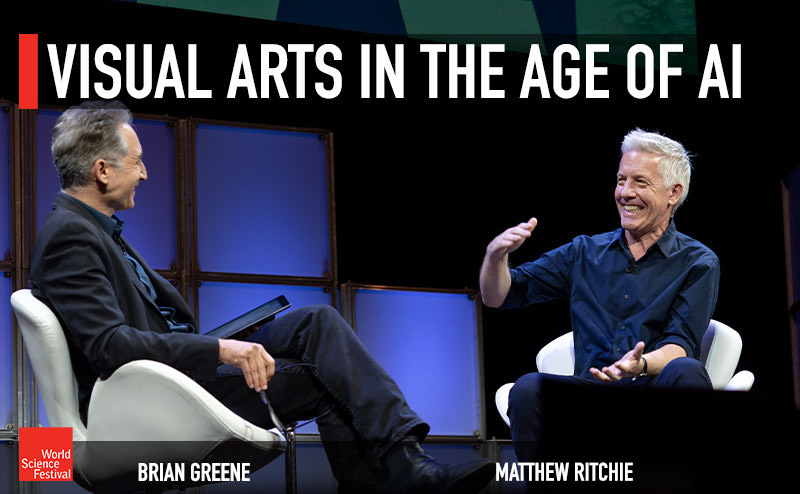


Can a machine be conscious? Brian Greene explains how AI raises one of the oldest puzzles in science and philosophy.
Your brain holds something like 100 trillion trillion atoms organized into billions of neurons, and every one of those particles obeys the same laws of physics as particles anywhere else. Yet nothing in those equations speaks to an inner world of awareness. Tracing the puzzle from past philosophical musings through present explorations, Brian explains why he suspects today’s AI systems are not conscious, why he cannot prove it, and why that uncertainty calls for humility.
– I do not think that any of today’s AI systems are conscious, but I also full well admit that I do not have an argument to back that up. And if I examine my own intuition, I inevitably realize it’s based at least in part on an unjustified sense that our consciousness is so mysterious, it is so deeply special that surely it can’t emerge from a machine that’s all about predicting the next word, the next token. But is that intuition misleading? It may be. Take a step back. Our conscious awareness does indeed come with obvious mysteries. I mean, how can it be that atoms and molecules when arranged in just the right way and carry out just the right processes can yield inner worlds of sights and sounds and thoughts and emotions? I mean, how can mindless particles come together to yield the experiences of mind? I mean, right, your brain, my brain, all brains, they’re, as far as we can tell, just like everything else, they’re just a collection of particles. I mean, in a human brain, something like a hundred trillion trillion atoms, each made of electrons and protons and neutrons organized into some 90-ish billion neurons that signal one another across trillions of connections, and every one of those particles and every one of those neurons obeys the laws of physics. When a sodium ion rushes across a membrane in the neuron of your visual cortex, it’s responding to electric fields just as that same ion would in a test tube in the laboratory. Again, as far as we can tell, there is no exemption. The particles in your head, they don’t get to break the rules just because they happen to be inside your head. Okay, so take a look at those laws, and when you write down the equations, you see quantities like mass and electric charge and spin and the strengths of forces and how various fields, they vary through space and time and so on. What you do not find is any mention of the redness of red or the taste of chocolate or the sadness, the ache of loss. The equations make no reference to inner worlds, to awareness, to what it feels like to be you. And yet, here we all are aware. Somehow particles blindly following equations that seemingly have no room for experience, they come together, and the lights turn on. The particles wake up. That’s the puzzle, and it’s not a new puzzle, right? I mean, it’s a puzzle that thinkers have tussled with for centuries. In the 1600s, this very puzzle drove Rene Descartes to conclude that mind and matter must be fundamentally different kinds of stuff. You’ve got physical stuff, and then you’ve got mental stuff. Later on, Gottfried Leibniz, he gave his own take by offering an illuminating thought experiment. “Imagine,” he says, “a machine that thinks and feels,” and now enlarge it to be the size of a mill so you could actually walk around inside. And if you do, all you’ll find are parts pushing and pulling on other parts, and none of that would seem to explain the existence of anything beyond what you can see, no indication of some kind of inner sensation that the mill as a whole is experiencing. And it was Thomas Huxley, this was years later, who wrote that consciousness arising from stimulating nerve tissue was “as unaccountable as a genie appearing “when Aladdin rubbed his lamp.” And it continues on to the modern age, right? Thomas Nagel, philosopher, he framed the puzzle in terms of explaining what it is like to be something. For instance, what is it like to be a bat? a question that seems to stand outside what even complete knowledge of a bat’s brain can possibly provide us. David Chalmers, he’s a philosopher who’s now at NYU. He gave the puzzle its modern name, calling it the hard problem of consciousness. But take note of what hard means here. It’s not hard in the everyday sense of being difficult. There are all sorts of difficult problems in trying to understand the brain. For example, how does a brain store a memory? How does an arrangement of particles store the experience of hearing a Beethoven symphony or the experience of a parent’s embrace? That’s surely a difficult problem, but we don’t call it a hard problem because even though science hasn’t fully cracked it, we can see, at least in principle, that the tools of science are capable of finding a solution. After all, right, your hard drive, which is also made of electrons and protons and neutrons, it stores images and sounds and text and so on. So at least we can imagine such particles storing memories in the brain too. But when it comes to consciousness, we just don’t understand how particles can make an inner world light up, and we don’t see a path for science, as we currently understand it, to provide the mechanism. That’s the sense in which the problem of consciousness is hard. And it’s not that people aren’t trying. Researchers have put forward all sorts of theories for the physical mechanism underlying consciousness such as integrated information theory and the global workspace theory. These are theories that we’ve discussed in previous World Science Festival programs. You can look them up. But in my view, none of them truly addresses how mindless particles come together to yield mindful experience. Now, those with a more spiritual perspective will say, “Of course science is failing “because consciousness involves something “beyond the physical.” Now, it’s not a direction I find convincing, but without an explanation from science, who knows? And that brings me to my main point. With so much uncertainty about what consciousness is and what’s required for it to arise, there is at least the possibility that consciousness is less mysterious than it seems. There is at least the possibility that consciousness may be just one of those emerging qualities that inevitably accompany certain varieties of information processing. I mean, a good, and it’s frequently used, but it’s a good analogy. Think of the wetness of water. No single water molecule is wet. Wetness emerges when an enormous number of molecules, they act together, and just about everyone agrees that wetness does not require some extra ingredient beyond the molecules themselves. So perhaps consciousness is kind of like that. It simply emerges when the physical conditions are right and the brain, carrying out its variety of information processing, is one such setting where the physical conditions are right for consciousness to emerge. But there may be many other physical systems very different from a biological brain in which the conditions may also be right for the emergence of consciousness. So could a sufficiently complex information processor built to predict the next word be one of these systems? Now, like most of you, my intuition is that it isn’t. My intuition is that Claude and ChatGPT, that they aren’t conscious, that a stochastic word predictor doesn’t have inner sensation, an inner world of awareness. But frankly, if we all weren’t biased by our own experiences, by our own conscious awareness, and we were showed a functioning human brain, how many of us would think that this wet three-pound gray chunk of meat could produce conscious awareness? My guess is that not many of us would expect that it could do that. So, bottom line, let’s not be too quick to judge that something is or isn’t conscious, and let’s not be too dogmatic about which things have inner awareness and which do not. And that’s especially true since, as far as we can tell, there’s no test, no diagnostic that can settle this definitively, right? You can’t be sure I’m conscious, nor can I be sure that you are conscious. So given that kind of uncertainty, that kind of ignorance, when it comes to granting that something is or isn’t conscious, a degree of humility is surely in order.
Can a machine be conscious? Brian Greene explains how AI raises one of the oldest puzzles in science and philosophy.
Your brain holds something like 100 trillion trillion atoms organized into billions of neurons, and every one of those particles obeys the same laws of physics as particles anywhere else. Yet nothing in those equations speaks to an inner world of awareness. Tracing the puzzle from past philosophical musings through present explorations, Brian explains why he suspects today’s AI systems are not conscious, why he cannot prove it, and why that uncertainty calls for humility.

Brian Greene is a professor of physics and mathematics at Columbia University, and is recognized for a number of groundbreaking discoveries in his field of superstring theory. His books, The Elegant Universe, The Fabric of the Cosmos, and The Hidden Reality, have collectively spent 65 weeks on The New York Times bestseller list.
Read More– I do not think that any of today’s AI systems are conscious, but I also full well admit that I do not have an argument to back that up. And if I examine my own intuition, I inevitably realize it’s based at least in part on an unjustified sense that our consciousness is so mysterious, it is so deeply special that surely it can’t emerge from a machine that’s all about predicting the next word, the next token. But is that intuition misleading? It may be. Take a step back. Our conscious awareness does indeed come with obvious mysteries. I mean, how can it be that atoms and molecules when arranged in just the right way and carry out just the right processes can yield inner worlds of sights and sounds and thoughts and emotions? I mean, how can mindless particles come together to yield the experiences of mind? I mean, right, your brain, my brain, all brains, they’re, as far as we can tell, just like everything else, they’re just a collection of particles. I mean, in a human brain, something like a hundred trillion trillion atoms, each made of electrons and protons and neutrons organized into some 90-ish billion neurons that signal one another across trillions of connections, and every one of those particles and every one of those neurons obeys the laws of physics. When a sodium ion rushes across a membrane in the neuron of your visual cortex, it’s responding to electric fields just as that same ion would in a test tube in the laboratory. Again, as far as we can tell, there is no exemption. The particles in your head, they don’t get to break the rules just because they happen to be inside your head. Okay, so take a look at those laws, and when you write down the equations, you see quantities like mass and electric charge and spin and the strengths of forces and how various fields, they vary through space and time and so on. What you do not find is any mention of the redness of red or the taste of chocolate or the sadness, the ache of loss. The equations make no reference to inner worlds, to awareness, to what it feels like to be you. And yet, here we all are aware. Somehow particles blindly following equations that seemingly have no room for experience, they come together, and the lights turn on. The particles wake up. That’s the puzzle, and it’s not a new puzzle, right? I mean, it’s a puzzle that thinkers have tussled with for centuries. In the 1600s, this very puzzle drove Rene Descartes to conclude that mind and matter must be fundamentally different kinds of stuff. You’ve got physical stuff, and then you’ve got mental stuff. Later on, Gottfried Leibniz, he gave his own take by offering an illuminating thought experiment. “Imagine,” he says, “a machine that thinks and feels,” and now enlarge it to be the size of a mill so you could actually walk around inside. And if you do, all you’ll find are parts pushing and pulling on other parts, and none of that would seem to explain the existence of anything beyond what you can see, no indication of some kind of inner sensation that the mill as a whole is experiencing. And it was Thomas Huxley, this was years later, who wrote that consciousness arising from stimulating nerve tissue was “as unaccountable as a genie appearing “when Aladdin rubbed his lamp.” And it continues on to the modern age, right? Thomas Nagel, philosopher, he framed the puzzle in terms of explaining what it is like to be something. For instance, what is it like to be a bat? a question that seems to stand outside what even complete knowledge of a bat’s brain can possibly provide us. David Chalmers, he’s a philosopher who’s now at NYU. He gave the puzzle its modern name, calling it the hard problem of consciousness. But take note of what hard means here. It’s not hard in the everyday sense of being difficult. There are all sorts of difficult problems in trying to understand the brain. For example, how does a brain store a memory? How does an arrangement of particles store the experience of hearing a Beethoven symphony or the experience of a parent’s embrace? That’s surely a difficult problem, but we don’t call it a hard problem because even though science hasn’t fully cracked it, we can see, at least in principle, that the tools of science are capable of finding a solution. After all, right, your hard drive, which is also made of electrons and protons and neutrons, it stores images and sounds and text and so on. So at least we can imagine such particles storing memories in the brain too. But when it comes to consciousness, we just don’t understand how particles can make an inner world light up, and we don’t see a path for science, as we currently understand it, to provide the mechanism. That’s the sense in which the problem of consciousness is hard. And it’s not that people aren’t trying. Researchers have put forward all sorts of theories for the physical mechanism underlying consciousness such as integrated information theory and the global workspace theory. These are theories that we’ve discussed in previous World Science Festival programs. You can look them up. But in my view, none of them truly addresses how mindless particles come together to yield mindful experience. Now, those with a more spiritual perspective will say, “Of course science is failing “because consciousness involves something “beyond the physical.” Now, it’s not a direction I find convincing, but without an explanation from science, who knows? And that brings me to my main point. With so much uncertainty about what consciousness is and what’s required for it to arise, there is at least the possibility that consciousness is less mysterious than it seems. There is at least the possibility that consciousness may be just one of those emerging qualities that inevitably accompany certain varieties of information processing. I mean, a good, and it’s frequently used, but it’s a good analogy. Think of the wetness of water. No single water molecule is wet. Wetness emerges when an enormous number of molecules, they act together, and just about everyone agrees that wetness does not require some extra ingredient beyond the molecules themselves. So perhaps consciousness is kind of like that. It simply emerges when the physical conditions are right and the brain, carrying out its variety of information processing, is one such setting where the physical conditions are right for consciousness to emerge. But there may be many other physical systems very different from a biological brain in which the conditions may also be right for the emergence of consciousness. So could a sufficiently complex information processor built to predict the next word be one of these systems? Now, like most of you, my intuition is that it isn’t. My intuition is that Claude and ChatGPT, that they aren’t conscious, that a stochastic word predictor doesn’t have inner sensation, an inner world of awareness. But frankly, if we all weren’t biased by our own experiences, by our own conscious awareness, and we were showed a functioning human brain, how many of us would think that this wet three-pound gray chunk of meat could produce conscious awareness? My guess is that not many of us would expect that it could do that. So, bottom line, let’s not be too quick to judge that something is or isn’t conscious, and let’s not be too dogmatic about which things have inner awareness and which do not. And that’s especially true since, as far as we can tell, there’s no test, no diagnostic that can settle this definitively, right? You can’t be sure I’m conscious, nor can I be sure that you are conscious. So given that kind of uncertainty, that kind of ignorance, when it comes to granting that something is or isn’t conscious, a degree of humility is surely in order.