82,605 views | 00:36:32





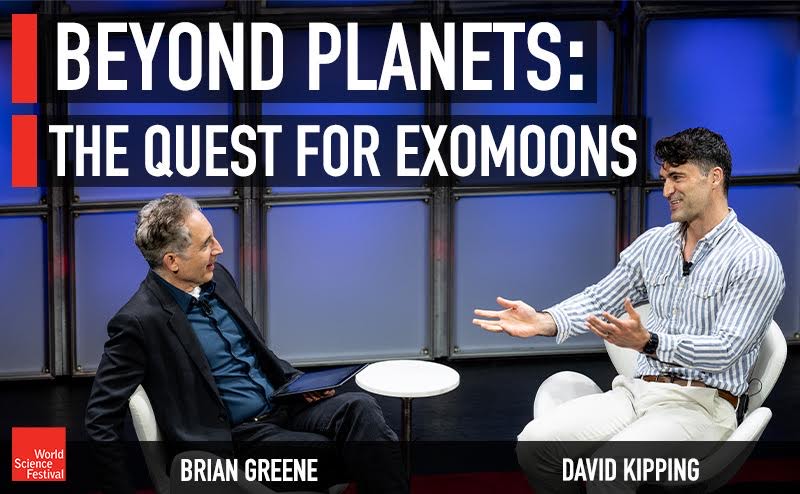
Did Einstein have any choice in formulating the general theory of relativity? Brian Greene speaks with Claudia de Rham, professor of theoretical physics at Imperial College London and a pioneer of massive gravity, a framework that asks what happens if the graviton, the particle thought to transmit the gravitational force, carries a tiny but nonzero mass.
They trace the idea from Fierz and Pauli in the 1930’s, through the no-go theorems of the 1970s that seemed to rule it out entirely, to the modern breakthrough showing the theory can be made mathematically consistent. Along the way they explore the bounds on the photon and graviton masses, why gravity gravitates, the puzzle of the cosmological constant, and whether massive gravity could explain the accelerating expansion of the universe. Plus, what Einstein himself would make of it all.
This program is part of the Rethinking Reality series, supported by the John Templeton Foundation.
– You know, even if you’re not a physicist, you kind of look at the equations and you can’t help but feel that in these few symbols there’s just such power and such beauty.
– Yeah, yeah.
– When one looks at massive gravity, you don’t quite get the same sense of beauty because of the additional sort of complexity of it. But is that merely a remnant of the way we express these ideas and one day, if this is true, our sense of beauty will acclimate to this being the truth and?
– I do think so. I think it’s a little bit like you look at a Picasso painting or something and it just always is so complicated and then you get used to some different kind of beauty. I’m not saying it’s like Picasso.
– Albert Einstein famously asked whether God had any choice in creating the universe. And by that, he pretty much meant did the universe have to be the way it is? Now, we don’t know the answer to that question, but we can actually turn it around and apply it to Albert Einstein’s work itself because you can ask, did Einstein’s most famous result, the general theory of relativity, did it have to be the way it is? Or did Einstein have any choice, even if perhaps you didn’t know about it, in the creation of the general theory of relativity? And that’s at least in part what we are going to talk about here today, variations on the theme of Einstein general relativity. And I’m pleased that I’m having this discussion with one of the people at the forefront of thinking on these ideas who’s really pushed Einstein about as far as Einstein can go. And that’s Claudia de Rham, Professor of Theoretical Physics at Imperial College. So thank you-
– Hello.
– So much for joining us.
– Thank you. Thanks.
– And so, Einstein general relativity, it’s of course a theory of gravity. And I thought I’d begin there because I think we share, and probably from an early age, at least in my case it was, I suspect for you too, I don’t know, some kind of deep affinity to the force of gravity.
– Right, right, right.
– Like, when I was young, even way back, there was something deeply mysterious about gravity that always captured my attention. Similar?
– Absolutely, yeah. It’s often teasing with us a little bit. It’s funny because some people feel gravity is this force you have to resist, but there’s a little bit of a game into it and trying to understand it. And that mystery in gravity is not just a mystery in how we can challenge it with our body. I think it’s, I mean, it is the first physical phenomenon we actually experience-
– Yes.
– As a human being. So I think there is this affinity with gravity, but there’s also that element that you learn from an early age that you can’t resist it, it’s there, whatever you do, it’s always gonna be there. It’s always gonna be present. And I guess that is part of the teasing aspect and the affinity as well in trying to play with it. And if it’s not gonna let go, then we’re gonna push it. We’re going to push it in one way or another. So there’s that physical aspect, but I guess there’s also understanding it as a theoretical physicist, understanding it at an abstract level, which I’m very appealed to.
– Yeah, yeah, yeah. Absolutely. So there’s something kind of primal.
– That’s right. That’s right. It is. It is, yeah.
– About the force of gravity. And of course, you know, many thinkers in one way or another throughout history thought about or grappled with the force of gravity. Of course, it was Isaac Newton was the first person to actually try to mathematize, you know, put equations to the force of gravity. And that’s what we still teach to high school kids around the world. But it was Einstein who came along and injected a radically new way of thinking about gravity. Kind of put it into the language of geometry. Now, of course, the subject quickly gets technical, but how, in just rough language, how do you think about what Einstein taught us about gravity?
– So I think already to get to Einstein, what Newton did was indeed mathematical and it wasn’t the full story, but I think there’s already an element there in understanding that it is a universal phenomenon. So it’s not just something we’re experiencing here on Earth, in the solar system, but being able to extrapolate that beyond the direct visible, beyond things that we have no control over, that I think already was the first step that then enabled Einstein to understand that it has an element to it which is not directly tangible, which is sort of encoded in the structural reality in one way or another. It’s something really, really profound that is unlike any other phenomenon. I think that’s really our beauty of Einstein, of understanding that it’s not about things pulling towards each other, it has to be something much deeper because of this universality that is shared by no other phenomenon in nature. So if you think of other forces in nature, it will discriminate between different elements and gravity is very different than that. So it has to be, it has to be encoded in really something which is independent of the elements themselves. Now, being able to extrapolate that and to bring it at the geometrical level, and not just at the geometrical level, but the geometrical level of the fabric of spacetime, that is in itself a leap of understanding, which I think I certainly would not have had.
– Yeah, no, it’s an astounding leap. And just to underscore your point, when it comes to say the electromagnetic force, it depends on the electric charge.
– That’s right, that’s right.
– The strength of the force, if the electric charges are bigger, there’s a bigger-
– That’s right.
– And if it’s a plus charge or a minus charge, the force can act in one way or the other. But for gravity, it’s a universal force axle.
– [Claudia] That’s right, that’s right.
– And so, there’s something compelling about an influence that seems to just permeate everything quite literally. And yes, the leap to think about gravity in terms of warps and curves in the fabric of spacetime is sort of beyond. You know, sometimes I teach the general theory of relativity and sometimes I teach into the physics department. Sometimes I teach it more from the math department, I sort of straddle both of those departments. It’s interesting because when I teach in the math department, I start with the differential geometry developed by the great mathematicians who were not thinking about gravity.
– Right, right.
– Gauss, and Riemann, and Lobachevsky are sort of the iconic names. And, you know, you write down all these incredibly complex-looking symbols with all these indices on it and it’s pure mathematics. And then at the very end of that course, like the last day I show how you can take this math and, lo and behold, you rearrange the terms and it gives you a description of the force of gravity whereas when I teach it in the physics department, I start with Newton and the problems of Newton, you know, instantaneous action at a distance. And I show that if you go to geometry, you can fix those problems. Where do you stand in that? Do you think of it more from the math to physics or the physics to math?
– It’s funny because I really think of it, nowadays, and that’s not the way I learned it and that’s not the way I used to teach it. But nowadays I think of it much more as a force like electromagnetism. And I’ll start with that. I start with a fundamental particle, the fundamental particle like the photon. And from that, you build a theory of electromagnetism and you can go the same way for gravity. And so, you start with a fundamental representation from a physics point of view in the same way as all of the other elements of the Sterman model of particle physics. So it’s really from the physics point of view, but as a representation that comes from the math side of things. And then from there, you actually see a lot of analogy between gravity and the other fundamental phenomenon in nature. And you also see why it’s so different. And so, why you need to have all of those very beautiful inner structure, but also a fundamental symmetry, which is not an external symmetry, is not something that you can actually see from the outside, but that symmetry, in the end, it has to be built in the fabric of spacetime. And that emerges from thinking of it at a particle level, at a field theory level to start with.
– Now, a particle level in some sense takes us to quantum mechanics.
– Yes, yeah.
– From the get-go. Because again, historically, as we all know, Maxwell wrote down these beautiful equations in the late 1800s describing electricity and magnetism and it was able to explain all the experiments. You move a magnet through a coil and you get the electrons to move and so forth. But there was no photon at that point.
– That’s right. That’s right.
– And so, when does the photon first make its appearance? I guess, was that the photoelectric effect, Einstein, 1905-ish probably?
– That’s right. That’s right. Yeah. Yeah.
– And so, that particle has been seen, right?
– Yeah.
– Now, you mentioned the graviton as sort of an analogy, the particle transmitting the gravitational force. We’ve never seen that particle.
– We have never seen it.
– And you think we ever will or is it?
– Well, I would hope so, one way or another. I think seeing, nowadays, we have different ways to see things, to feel things, to deduce things. So hopefully one day we will be able to have experimental proof of the quantum nature of gravity.
– Yeah. Are you convinced that gravity has to be quantum mechanical?
– Let me just say, I am convinced at the moment that there has been proposed no alternative, which are viable. So if we have a system which is quantum, for instance, electrons, which we know are quantum.
– Yeah.
– And we know they’re coupled to gravity, they can’t simply communicate with gravity without that system also being quantum. And there’s been alternatives in trying to understand gravity more as a condensed system, emergent system, but still, to preserve simple rules of probabilities, quantum probabilities, we need to have the level of communication between a quantum system and gravity to be also quantum. And so, there’s an element of gravity that has to be quantum. And in fact, that is in itself not a problem. We know, we do that for breakfast. We know every day how to treat gravity at the quantum level. What we don’t know for sure is how to treat it at the quantum level in very dense environment, in very curved environment, in very strong environment. But it’s true. When I talk about the graviton, it doesn’t mean that it has been observed. It doesn’t mean that it is necessarily there. But I can think of it in a classical sense or in the quantum sense and I can build my theory of gravity at the very least semi-classically from there on.
– And semi-classic means take the classical theory and just add some quantum influences but not blend them fully.
– That’s right. That’s right. That’s right. That’s right. That’s right. And if I think of a classical field theory, I can think of the representation of gravity in the same way as I would do for electromagnetism. And from there has to emerge all of the symmetries of gravity that we know. And what’s really, I think, beautiful is the way we typically teach it is to think of Einstein’s pillars of gravity. And we think of universality, we think of equivalence principle, we think of every observer is equivalent. And we build that as a pillar in the foundation of Einstein’s theory of general relativity. But in fact, we can actually do it the other way around. We don’t need that many assumptions, we just need to think of a fundamental force of nature that goes beyond what we would have for electromagnetism, that behaves as a slightly different field. And then from there emerges all of the symmetries that we know we need to have. And I think that’s really incredible because the equivalence and the equivalence between different observer is something which actually has to emerge for consistency. We have to be equivalent as opposed to setting this as a prerequisite for our models.
– And so, for that equivalence principle, again, just for people who are less familiar, the idea being there’s no preferred point of view in the universe.
– That’s right, that’s right.
– Whether you’re moving, even accelerating.
– That’s right, that’s right.
– You can view yourself as the center of the universe and interpret everything you see from your perspective. And that description should be as valid as anybody other’s description, which means that the equations have to have some kind of well-behaved way of transforming from one person’s perspective to another, to another person’s perspective. And Einstein actually built that in-
– That’s right. That’s right.
– To his equation. You’re saying you can actually get to that.
– You can get to that. That’s right. And there’s also an equivalence in not only in your perspective, but in how gravity has to affect everyone, including light, in a similar way. And that is not something you need to set that equivalence in how we will react to gravity. It will come out and therefore that geometrical interpretation of gravity sort of has to come out from that. Because it has to be encoded in something that is omnipresent for anything.
– And what’s omnipresent but space and time? Yes, yes, absolutely.
– That’s right.
– And so, if we go back to electromagnetism and the photon as sort of a interesting, well-understood case study. You know, one of the things that comes up whenever I teach special relativity where I don’t really talk about the photon initially. But sometimes I’m forced to talk about the photon because the students will often say, “So like, what’s so special about the speed of light?”
– Yes, yes.
– And the only answer that I find satisfying is to say, “Well, look, there are many speeds in the world, right? An electron can go at this or that speed and it can vary. A proton can go this or that speed, it can vary. The special thing about light is it’s communicated by a particle called the photon, which unlike the electron, unlike the proton, unlike the quarks, has no mass.”
– That’s right. That’s right.
– And that no mass quality is what picks out a universal speed.
– That’s right, that’s right.
– But that then does raise the question, do we really know that the photon has no mass?
– So in fact, it’s very possible that it could have a mass. And we know how to think of it and we know how to test that. And there are actually some constraints on the photon mass. We understand at a very high frequency, so very, very deep in the ultraviolet, then even if the photon had a small mass, it would still need to travel at the speed of light because that mass is irrelevant compared to that very high energy of the photon. But at much smaller frequencies, so more towards deep, deep, deep infrared, then it will have implications. And it will have implications on the magnetic fields in galaxies, for instance. And so, those are the best constraints.
– Yeah.
– On the photon mass. So we understand, in fact, very well how to think beyond our original assumption and how to think beyond what it would mean to have a universal speed of light from the get-go.
– And sorry, this is probably an unfair question, but do you know what the current limits are on the photon mass?
– I do believe it’s of the order of 10 to the minus 18 electron volts. Now, you need to translate that.
– Well, an electron volt is about 10 to the minus 36 kilograms.
– If you say so. I’m sure you’re right.
– I’m thinking that well. I know that 10 to the 19 GEV, so it’s 10 to the 28 electron volts, which is the plank mass.
– Yes, yes, yes.
– It’s 10 to the minus five grams. And so we get 10 to the minus 30, yeah, so yes. 10 to minus 36 kilogram. And so, you said 10 to the minus 18 electron volts?
– That’s right. That’s what it was a few years ago. It’s possible it’s gone down to 10 to the minus 20 now.
– Let’s take 20, just because it makes the calculation easy. So that’s about 10 to the minus 56 kilograms is the limit.
– Yeah, yeah, yeah.
– Roughly. Somebody will check us and then the comments will say, “Oh, you got all your .” But the point is this is really tiny.
– Yes. As an analogy, or to create a comparison, the lightest massive particle that we know are neutrinos and their masses we think are 10 to the minus three electron volts, something like that. So it’s something like 17 orders of magnitude below that. So it’s extremely, extremely light. But in string theory, in some models beyond general relativity or in all sorts of different considerations, they could be particles like axions or particles for dark matter, which mass could be even below that of that order of magnitude. So it is something that we are actually, that we, all of us are actually probing. And there’s possibilities to think about having elements in nature whose masses are so tiny.
– Yeah. Now, so Maxwell wrote down the equations for what we would call a massless photon, traditional electromagnetic theory. And in fact, just historically, it’s worth saying, you know, you probably have, but I should ask, have you ever looked at the original papers of Maxwell? Because the equations…
– Are not like anything.
– They’re a mess compared to the way we write them down in modern notations. So, you know, that’s just the way physics progresses. So we have a very clean way of expressing Maxwell’s equations. In fact, you know, you could do it on two little lines if you use the right notation. How hard is it to modify those equations to allow for a non-zero photon mass?
– Very easy.
– Yeah.
– Very easy. In fact, it’s so easy that there’s direct analogs. There are elements, forces in nature, which are a little bit like electromagnetism, but the field or the particle that carry that force has a mass. We know that. The weak force, the weak force is not very familiar to us because it’s weak. It’s a weak force. And the reason the weak force is weak is because the particles that carry it are a little bit like the photon, but they have a mass. And so, we can do that. We understand very well how to do that. We also understand very well how to have, for electromagnetism or for those kind of fundamental forces, we understand very well how to have a mechanism that goes and give a mass to those fundamental particle in a way that satisfies all of the laws of consistency that we enjoy having.
– Which ultimately came from Peter Higgs in some way, shape, or form.
– That’s right, that’s right. That’s right, that’s right.
– And so, one technical question that I want to ask, because obviously you can begin, we haven’t planned this, but you think you see where I’m going here. If you take the equations-
– Yeah.
– For electromagnetism that have a non-zero mass for the photon. And then you in effect have a dial that makes that mass smaller and smaller and smaller, does it nicely, smoothly go into exactly what Maxwell would’ve recognized?
– Okay, so there’s different ways to answer that question. The funny, the fundamental thing is when I say it’s very easy to give a mass, it’s very easy, but also it’s fundamentally very different because there’s a very nice symmetry which is there when the photon has no mass. And as soon as you give it this tiniest possible mass, that symmetry is no longer there. And you can dial things such that the symmetry is almost there, but there’s a difference between there and not there. There is a difference. And so, that difference actually means, concretely means if you think of the photon, if you think of electromagnetism, if it has no mass, then light travels at the speed of light in the vacuum. Whereas if it has a mass, in fact, it doesn’t travel at the speed of light. It travels as close as you want to the speed of light. And depending on the frequency, if you dial that mass down, it will get as close as you want to the actual speed of light in the vacuum if it were massless, but never quite. So there is a discrete difference, whether we want it or not. So at the mathematical level, at the symmetry level, at the representation level, at the particle level, the freedom you have in exploring a theory, there is a discrete difference. Now, does that matter from observations? That is something you can dial down so that from a observational point of view, from an experimental point of view, you can ask yourself, what would be the distinguishing features between the two? And classically, if you dial the mass down, it will end up being indistinguishable because, for instance, one observable would be how close to the speed of light in the vacuum would you be? And you would be as close as you want to it. Similarly, for instance, for magnetic field, what’s the distance in which they could be coherent? And the smallest the mass is, the larger that distance is. And therefore, you can actually dial things down and see no classical, experimental, and observational differences. However, once you start thinking about quantum effects, there are some non-trivial differences. And so, in fact, the anomaly that is there in electromagnetism will be discreetly different as compared to what would happen if the mass is there. And that’s because you have different ways to shake around a theory and, classically, they all learn into the same features, but at the quantum level, that additional freedom you have in how you shake things around makes a discrete difference.
– Yep. But the beautiful thing is that the math is all well-behaved.
– The math is beautifully behaved, yeah.
– So one has a complete mathematical control over the situation and then you can do whatever analysis-
– That’s right. That’s right.
– Strikes you as interesting.
– And that’s because we also have a Higgs mechanism that shows us how to go smoothly from a situation where it has no mass or a situation where it has mass.
– Right. And so, now, obviously, what they want to do is have a parallel discussion of Einstein’s version of this story, or your version of Einstein’s version of the story. Because again, as you said, we have the equations of electromagnetism. We have the photon is the particle communicating the force. We have the equations of Einstein, the gravitational field equations of general relativity. And we believe there’s a graviton that would play the analogous role. And in the traditional approach that Einstein wrote down, graviton’s massless.
– That’s right. That’s right.
– But you can ask yourself the same question. Now, number one, we’ve not detected gravitons, but indirectly we do have bounds on their masses. I don’t know what those bounds are. I don’t know if you happen to have those in mind.
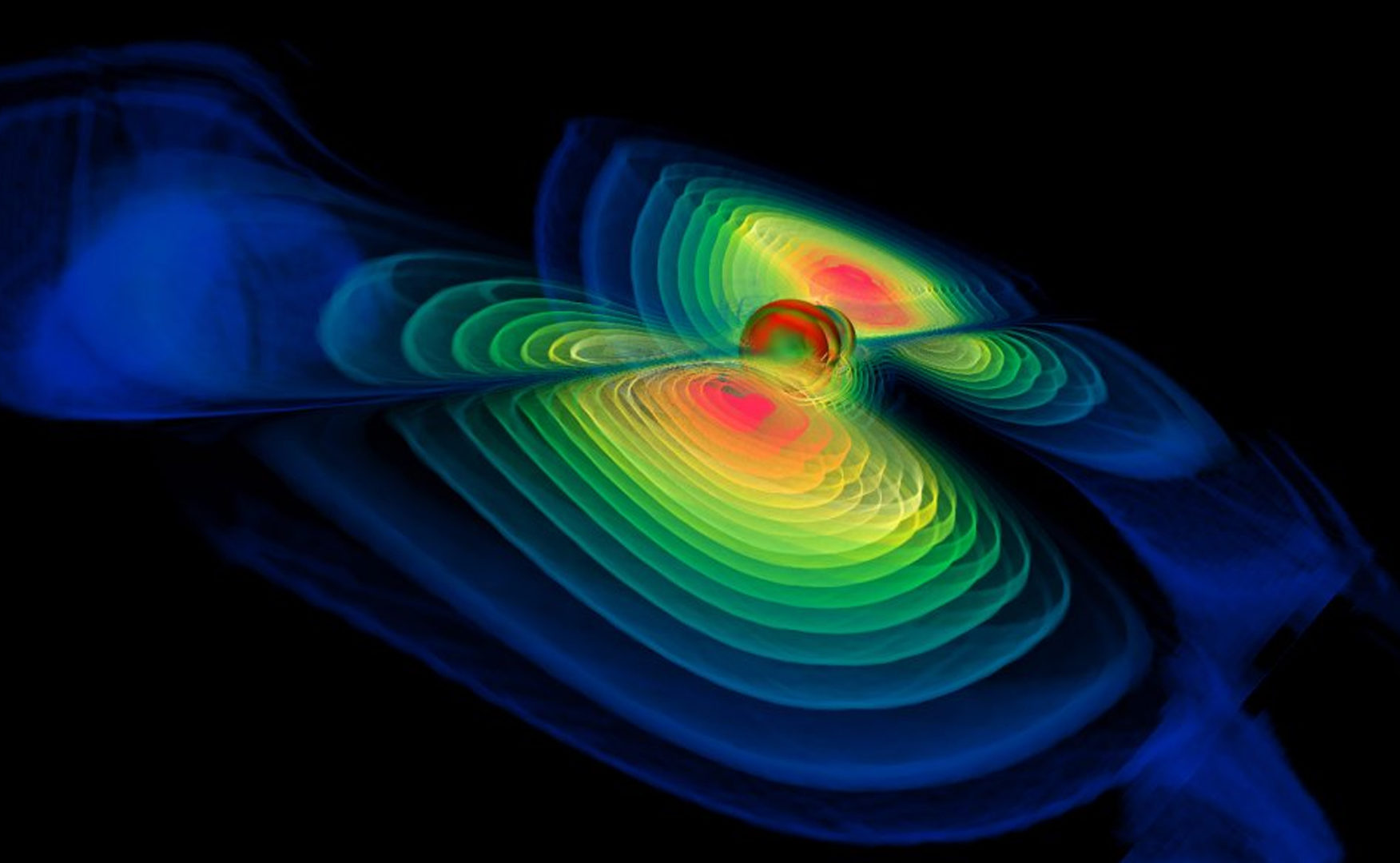
– Yes, so if you draw first from a direct analog from gravitational waves, let’s say, we understand the speed of gravitational waves in different ways. We understand also how that doesn’t change too much with respect to the frequency of the gravitational waves.
– Which if it was massive, the different frequencies could travel at different speeds.
– That’s right.
– And arrive here at different moments.
– That’s right, that’s right. That’s right. So from those constraints on gravitational waves, we have a bound on the mass, which is 10 to the minus 22 electron volts.
– So better than the bound.
– Better than we… And most of that bound comes from the very first detection of gravitational waves.
– The cleanest signal that we ever got, right?
– The cleanest. So the first time we saw a gravitational wave, we already were able to qualify the graviton in a better way that we were able to qualify the photon.
– After all these years.
– After all, it’s incredible.
– It is incredible.
– It is incredible. So you’re off to a good start.
– Yeah. And so, again, my conversion could be off, so I qualify that, but it’s something like 10 to the minus 58 kilograms.
– That’s right, that’s right.
– Bound on the mass of the graviton. Nevertheless, an interesting question might be, what if it does have some little, tiny mass?
– That’s right. That’s right. That’s right.
– Now, people have thought of that over the years. Do you have a feel for the early motivation? Was it just, “Hey, let’s just see what we can do,” or is there any-
– Yeah, so there’s different ways the story came in. So, but already Newton himself, when he thought about the universal law of gravitation, there’s a very natural question, which is what if it wasn’t that universal after all?
– Right.
– And so, this is not at all framed in the sense of a fundamental particle carrying the force of-
– Too early in our thinking.
– No, that was way too early. But already, that little tweak into that fundamental symmetry was in people’s mind because it’s a very natural question. But when people started thinking about gravity more like the other fundamental forces of nature, Pauli and Fierz already in 1939, just as a systematic classification of what the different representations could be, what could nature do, really?
– [Brian] Yeah.
– They started thinking about you have a representation for a photon, what would happen if it was massive. And then they started doing the same thing for gravity. You have a representation for gravitation waves or for the graviton, what will happen if it were massive? And already there, already at that point, they realized that it was an order of magnitude more challenging to think of it that the-
– Compared to photons.
– Compared to photons, yeah, that the number of possibilities in how things could go wrong was exponentially large. And that’s not just because you’re dealing with spacetime, but also because you can start shaking around the graviton in many different ways. So perhaps for the photon, you can think of as soon as you give it a mass, then it doesn’t need to propagate at the speed of light anymore. In fact, it cannot longer propagate at the speed of light. And so you can think of it as an additional freedom in how it goes back and forth along the line of propagation. You have an additional way to think about it. You have an additional channel of communication through electromagnetism. Now, as soon as you do that for gravity, you can think of the same thing. And so, if gravitational waves could have a mass, if they don’t need to propagate quite at the speed of light anymore, you can have also this possibility opening up. But now for gravity, what it means is that you have ways to shake things around that are encoded in the fabric of spacetime. And therefore you can shake things around in a way that will go back and forth in time. And now you can automatically see that there’s something you want to be really careful with that. It’s not just an external phenomenon, an external force where you can play with it and see what the consequences are, you’re actually playing with time. And that feels a little bit like playing with God. You’re actually playing with things that you need starting to be extremely careful about.
– Yeah.
– And so, already then, in 1939, Fierz and Pauli realized that it will have to be very tricky and you have to be careful.
– And did Einstein, I don’t know, did he weigh in at all on any of this?
– I don’t think so because those investigations were quite different. First of all-
– They’re more for the particle physics and the things.
– So first of all, despite what the story tells us now, Einstein never really believed in gravitational waves.
– True. Very on the fence about it.
– Yeah, he was very on the fence about it. He almost published a paper wanting to say that they could not exist, that they were just a mathematical artifact with no physical implications. So for him, I can’t speak for him obviously, but the idea of thinking of gravity as having a mass is coming much more from the gravitational wave perspective and from that representation perspective. Whereas for him, the symmetries were really the pillars of the representation. And you have to give that up to start with and then rebuild it from scratch. And so, I would have thought that this is not at all the way he would have though about it.
– Yeah, I mean, it may surprise people who are less familiar with the details of the subject when we say, and I think most of us agree that Einstein perhaps didn’t fully understand Einstein’s own equations, right? I mean, because they’re so subtle.
– They are very subtle, they are very subtle. I think what is fair to say is that some elements of it, even for Einstein himself, it was confusing. And that’s why it was so important to have different perspective. And Robertson is one of the ones that actually explained some of the subtleties to Einstein and convince him that gravitational waves were not just a mathematical subtlety in the way to represent things, but they actually were real and they had consequences.
– Yeah, yeah. And so, way back in the ’30s, as you say, people began from one perspective to think about what it might be like if the graviton, I don’t know if they used that language, but if there was a mass associated with the disturbance of the gravitational field.
– That’s right.
– As people began to then dig in even further, more systematically, again, you’ll know the history much better than I do, but by the ’60s or call it 1970s or so, it seemed to be the going lore that it was just inconsistent-
– That’s right. That’s right.
– To add a mass.
– That’s right. That’s right. So maybe before we go there, let me just say that before that, there was already ideas about extra dimensions.
– Ah.
– Which I think are important.
– I didn’t know we were going there, but now you’re talking my language, so.
– So just like we live in a world of three-dimensional space, one dimension of time, I can’t think about the possibility of having extra-dimensional space. I would love to think of the possibility of having extra dimension of time.
– It’s a little harder.
– But we’re probably not going to go there.
– Yeah.
– But if I think of gravity with extra dimension of space, and I don’t want those extra dimension to be too visible to me, otherwise we would have seen them, then I need to compactify them or I need to find a way to make them sufficiently small so that I don’t see them. But then from my own perspective, what it will look like is a theory of Einstein gravity and then also excitations of what can happen along the extra dimension. And that in fact corresponds to copies of gravity, but those copies of gravity have a mass. So from that perspective already throughout the ’30s, there was the idea, not the idea of gravity having a mass, but in addition to gravity, there could be copies of it, an infinite number of copies of it, each one carrying a little bit of a mass. Now, this is quite different in comparison to thinking of our theory of gravity from the outset having a mass. But from a mathematical point of view, you can already start trying to see if you can draw a parallel between the two. There’s a big difference, though, if the fundamental copy of gravity that we experience already has a mass, the difference there is that we already need to understand how to fold in all of the symmetries which are the pillar of Einstein’s theory of general relativity, which are very well understood. And those symmetries are what prevents having all of those excitations, for instance, going back and forth in time. Or all the ways in which we can think of gravitational waves. So, perhaps one way to think of what could happen if I think of gravitational waves, the ones we have observed, there are two kind of polarizations, I don’t know if people have heard, there are plus and cross polarizations. We have observed those gravitational waves. But gravitational waves are a fluctuation in the fabric of spacetime. And so, in principle, we can think of having fluctuations along different type of directions. Also along the line of propagation of the gravitation waves or gravitational waves which would scale things up and down. So that would be beautiful. And there are tests for those kind of fluctuations. What it means in practice is that if you think of communicating through gravity, that’s not the way we think of things, but we communicate through light. And so, I can think of what if I wanted to communicate through gravity? And in fact, we communicate through gravity with the moon, for instance. And we do that with the sun. We do with one another to a very small extent. But we do to some extent. If there’s other ways, other channels of communication with gravity there as well, it would mean that in some situations, the effect of gravity would be different as compared to general relativity, and different not by an amount which seems to be small and smaller when I dial that mass of the graviton to be small as would happen for electromagnetism, but because this is a much more subtle effect in gravity, it’s actually by an amount which at the time in the 1970s seemed to be always different by an order of one, by a discreet, observable number. So in the ’70s came what is now called as the van Dam-Veltman and Zakharov discontinuity, vDVZ discontinuity, which tells you that if you think of Einstein’s theory of general relativity not just at the gravitational wave level, but really at the fully-fledged gravitational theory where you have a Newtonian limit in one case, where you have all sorts of other bending of light observations in the other case, then as soon as you include a mass, no matter how small it is, because you actually do something quite dramatic in how you break the internal structure, the internal beauty, the internal symmetry of the theory, then it doesn’t matter, it doesn’t matter if you break something, you can try to glue it back together, you would always see that it has been broken. It has been broken. Its internal structure and stability is quite different. And so, you need to make peace with that. So in the 1970s, they realized that there seemed to be an order one difference which was in fact incompatible with observations as soon as you gave the graviton the smallest possible mass.
– So the gravitational force would simply be different.
– It would be different. So it would be different for different system. So if you compare how the bending of light would be around the sun, you can make it consistent with our observations, but then that would mean that if you drop an apple on Earth, then it would be an order magnitude of one different as compared to what even Newtonian gravity tells us.
– Yeah. Now that’s strange, right? I mean-
– That is strange.
– I mean, you and I, I mean, I of course know exactly what you’re referring to in terms of breaking the symmetry, which previously in the massless theory just allowed you to kind of rotate away this additional influence.
– Right, right.
– And once you can’t rotate it anymore, the influence is there.
– That’s right. That’s right. That’s right.
– But it’s so, intuitively, hard to picture.
– Yes, that’s right. And it still bugs me.
– Yeah. Because, I mean, this mass, like we say, could be 10 to the minus 60 kilograms or something.
– That’s right. That’s right. So who is to tell when too small is zero? What is the difference? There’s a point where it goes beyond any, not even any potential detectability, but it’s beyond even the observable universe. It’s beyond any notion of reality. So who is to say what’s the difference between something which is so small I can never, ever tell the difference and something which is zero? And yet, in some cases, nature tells us that it is different.
– Yeah.
– It is different. However, that’s not completely the end of the story.
– Right.
– There’s many, many more subtleties in there. I don’t know how far, how deep into it-
– Well, I’d love to, I’d love to get to a point where you and your collaborators have this beautiful idea for how to make this mathematical theory as sensible as the massive version of the photon. Like, when did you start to think about that yourself?
– I started thinking about it in around 2004-2005. And that was related to cosmology, in fact, that was related to the vacuum energy problem, the cosmological constant problem. So we can go into that.
– Yeah, I’d love to, yeah.
– And maybe, let me tell you a little bit more about the story in the ’70s.
– Please.
– Because there’s different layers in there, which are beautiful, in fact. And it’s incredible because in a very short amount of time, within months, different kind of realizations were being made. And it’s almost like at the very beginning of general relativity where the theory is postulating and black holes came out very quickly after.
– Yeah, within one year, I guess, yeah.
– Yeah. So for massive gravity, that discontinuity was understood in 1970. And just within a month, Weinstein realized that, in fact, that wasn’t quite the end of the story because this discontinuity is present when you’re trying to think of the theory a little bit too simplistically. But in fact, what happens when the graviton has no mass is that the interactions become very, very strong. So maybe to draw an analogy, we all heard of black holes and we all heard that the gravitational field is quite strong in the vicinity of black holes. So if you have a mass, it doesn’t matter how large that mass is, if you are very far away from that mass, then in fact, Newtonian gravity is a very good approximation. And then you can have corrections to Newtonian gravity. But you are in what we call the weak field approximation. And it’s a very good. And we can go a long way just looking at weak field approximation. In fact, in the whole of the solar system, the weak field approximation is excellent. And that’s all we really use. Even to think of the differences coming from the advance of the perihelion of Mercury, around the sun from general relativity. We can do that in the weak field approximation, just work beautifully. But if we go closer and closer to a mass, there is a point if the mass is itself encapsulated in a sufficiently small region or space where the weak field approximation is no longer valid and you are actually in a situation where gravity likes to interact with itself.
– Right.
– And that’s something very special about gravity which is required for the consistency of Einstein’s theory of general relativity. And that’s why black holes are inevitable in Einstein’s theory of general relativity. It’s not just an artifact. It’s not just an anomaly. They’re actually inevitable. Those self-interactions, the fact that it likes to play with itself to interact with itself is built into the theory of general relativity, is built into the symmetry pattern of general relativity in a way that is not present for electromagnetism. And that’s a critical difference.
– Right, so gravity gravitates.
– That’s right.
– Whereas light itself does not-
– That’s right.
– Create an electromagnetic field that back reacts to itself.
– Exactly. Exactly. And that in itself is built-in, again, in the equivalence principle. That full gravity, everything interacts with gravity, including itself.
– Gravity, yeah.
– And so, it’s a curse. It’s a benefit, but it’s a curse. It’s something so beautiful and then it affects itself, and I would say that’s a bit of a tangent, but I would say it means that black holes do exist and it is the existence of black holes that also show that, at some point, Einstein’s theory of general relativity is failing. So that’s a bit of a tension, but it’s something fundamentally different about general relativity. So, we are used to the fact that in full gravity, because it gravitates, itself, it has an effect on itself, there is some region where the weak field approximation is no longer valid. And so, in a theory of, as soon as you give the graviton a mass, we can assume, and now that’s what people thought to start with, that region where it interacts with itself, it gravitates with itself was the same as compared to Einstein’s theory of general relativity. But what was realized by Weinstein in 1970 already was that, in fact, that’s not the case. As you down the mass of the graviton, the additional ways in which you can tweak the theory around, they gravitate on themselves, just on themselves in a much stronger way than just the standard general relativity ways of working with a theory. And the equivalent of the horizon of a black hole, what we would call let’s say the Schwarzschild radius for people that are used to that, but just the size, the horizon of a black hole. There’s a similar one in the case where the graviton has a mass. So you can think of a black hole, you can think of any object in fact, you can think of this cup, for instance. In itself, it’s lucky enough to have a Schwarzschild radius, its horizon inside itself. So there isn’t a point for this cup of water where I’m going to need to worry too much about falling into its own black hole. But it also has, if it was in a theory of whether graviton has a mass, another radius associated with it, which is related to the graviton mass.
– Right.
– And that critical difference is that this radius becomes infinitely large as you dial down the graviton to be small and smaller.
– It’s like inversely proportional to the mass.
– That’s right.
– Mass goes to zero, the scale goes big.
– And that may seem like it will make the theory completely intractable, but actually what it does is that the additional ways in which you can, the additional channels of communication for gravity if you add a mass, as the mass goes to zero, they become so strongly interacting that they just separate themselves out. It’s like you’re working, you glue yourself. They are gluing yourself to the point where they can no longer move and you can no longer see them. We say that they are decoupled. There’s another sector out there, which mind its completely own business as you dial the graviton mass to zero. And that in itself is quite a stunning realization by Weinstein. And that he realized in a theory which wasn’t complete, but just understanding that those kind of phenomenon, which is unprecedented, would happen as soon as you gave it a mass. So that in itself shows you that it’s a whole different story as soon as you give it a infinitely small mass. And yet, the outcome can be that, observationally and experimentally, you get the same thing when the mass is dialed down to infinitely small values as compared to no mass. And that is something as physicists, it’s much easier to make peace with because we like this idea of continuity. We like the idea that there should be a point where the mass is so small that I can’t tell the difference. And so, that’s what nature is telling us that, but with an underlying story, which is really extremely complicated.
– Right. So, the short summary is for non-zero mass, the theory mathematically looks radically different.
– It really, yes.
– But you dial that mass down and the radically different part compared to Einstein kind of migrates off to the side and can be ignored and you recover Einstein.
– Exactly. Exactly.
– In that limit. Now, there’s still the quantum mechanical story.
– That’s right. That’s right.
– And that proved a little bit more-
– Exactly.
– Intractable.
– That’s right. So then in 1972, Boulware and Deser started exactly trying to understand how that makes sense more quantum-mechanically or even classically in terms of the stability of such a mechanism to occur. It’s for one thing to tell a story. It’s for another thing to actually understand how that works, how consistent it is, and whether there’s a mechanism like the Higgs mechanism that would enable you to go from one to another smoothly. And then they realized at the time that at least with what they could consider, the way to encode this separation, you could never do it in a way without also including those fluctuation going back and forth in time. And that quantum-mechanically simply is directly related to what we call a breaking of unitarity. If you go back and forth in time, it looks like energy becoming positive and negative. And so you can play with energy at will. And you can have system which have infinitely large energy, and system which have infinitely negatively large energy. And so, nothing prevents you from actually infinitely exciting the very fabric of spacetime at no cost.
– Right.
– This is something you don’t really want to have. This is not-
– So it looks like the theory just isn’t going to work.
– That’s right. If that quality-
– That’s right.
– That so-called degree of freedom.
– That’s right.
– Remains in the theory. And for a long time, people thought that was that.
– That’s right. So there were what we call no-go theorems exactly saying that it won’t work. So Boulware and Deser were the first one to really formalize that and then classifying the different ways you could think about it and showing that for every possibility, it simply would not work.
– And in some sense, that’s very nice, right? Because it makes the story much simpler, right? It basically, going back to my initial question, it suggested Einstein had no choice.
– That’s right. That’s right.
– It had to be what Einstein wrote down.
– Yes.
– And then others come along and complicate the story.
– Yes, yes. And so, in fact, I’m completely with you. And when I started working on this, we wanted to explore that because of different reasons. But I came to the conclusion myself that indeed it would not work, and I was set up to write a paper showing yet in a different way why we really always had to land onto Einstein’s theory of general relativity, which I think for part of the story is still true, but there’s layers of subtleties in that. So, but throughout since the ’70s, every time people consider the possibility of thinking of it in a slightly different classification or thinking of how you can think of the stability of the theory, there’s different ways to address it, as people, quantum field theory became more and more developed throughout the years, every time they formulated the same no-go in a different language, but still with the same conclusion. So I think it’s fair to say, for a while that was the accepted resolution. And in fact, in 1998, what has happened is completely different, but observations on the expansion of the universe proved or converged with different kind of observation on the fact that the expansion of the universe was accelerating, which is a well-known fact by now. That in itself should not be surprising, but it sort of revitalized a different kind of story, which is the cosmological constant problem. Einstein himself, when he came up with Einstein’s theory of general relativity, he had already thought that there could be a cosmological constant there.
– And that’s like a kind of diffused energy filling space that yields a repulsive push, explaining perhaps why things are moving away ever more quickly.
– That’s right. That’s right. Exactly. So Einstein, when he introduced it, he introduced it because at the time they thought the universe was static. It seemed like it was static before it was observed that it was expanding. And that was puzzling because you would see that galaxies would just attract each other. So he introduced that, understanding that he has some sort of negative pressure being able to push things away, and so to-
– Balancing things out.
– To balance things out. And then he realized that while he can balance things out at one specific, in one specific way, in one specific point, it’s not gonna work all the time.
– Kick the universe a little bit and either-
– That’s right.
– Expand or collapse.
– That’s right. That’s right. And let me just say that, because this is often quite puzzling, how you can have a constant energy density filling all over the universe and leading to an expansion of the universe, which is even accelerated. So that means that you have it and space expands at an accelerated rate, and therefore because the energy density is constant, you have more of that energy. And so, the energy of the universe is increasing and increasing. Where is it coming from?
– Good. So what’s the answer?
– Well, energy is not conservative.
– Ah, that blows people’s minds right there.
– Yes, yeah. So I always say-
– Wait, so what did they teach us in high school?
– That’s why I say invest in dark energy, invest in the cosmological constant. Just wait a few billion years and that’s really gonna be where all the energy of the universe will be in. Just need to be patient. So, I think there’s definite alternatives for why our observations are the way they are, but all observations nowadays converge on the fact that the expansion of the universe is accelerating and we need to explain it when one way or another. The cosmological constant is still very much the cleanest, I would say, the cleanest solution. And in fact, I would say it’s so clean and it’s so natural that particle physics or the quantum world give us a very natural candidate for that. When Einstein introduced the cosmological constant, he introduced it at the classical level. He was never-
– Just a number in his equations.
– Just a number, that’s right. And you can do that. But nowadays, we understand so much more, even very much how to reconciliate general relativity with quantum mechanics, quantum field theory at the very least in a weak field approximation, that we can do very well. And already in the weak field approximation we can see that the quantum field of the Sterman model, for instance, of particle physics, the electrons, the Higgs nowadays, we would have expected them to lead to a energy in the vacuum. And if you don’t have gravity, that energy in the vacuum is much of a muchness because it’s nothing you can actually probe it with. But because, again, of the beauty, but the curse of gravity is that everything gravitates. And so, we would have expected this quantum vacuum energy to gravitate. But how much we don’t know for sure, but it’s already unsettling to see that we need to, something needs to be accelerating the expansion of the universe, that looks very much like a cosmological constant. And on the other hand, we have this vacuum energy of quantum fields that looks exactly like a cosmological constant we would expect. And so, are those two things the same or not? And we don’t quite know how to reconciliate them both.
– And numerically, they’re not quite reconciled with a pretty radical difference.
– That’s right, that’s right. So, it’s subtle there as well because some calculations tell us it’s infinite, which of course is not. But I think within the most restrictive ways to think about how to make sense of it, you would expect it to scale like the mass of the particles themselves. And so, at the very least to go like the mass of the heaviest particle that we know of, maybe the top quark, or the Higgs mass. Those are particles we know exist, it’s not something I’m just inventing, we know they exist. And so, it’s not completely crazy to think that at the very least they should contribute to the quantum vacuum energy. If not, I need to explain why not. And in fact, if I just take the contribution of the Higgs field and I compare its contribution to the vacuum energy with the amount of vacuum energy I would need to explain the acceleration of the universe, I have 56 orders of magnitude discrepancy. So that means that just the Higgs itself gives a contribution, which would mean the universe would be accelerating at an incredibly faster rate, to the point that space between you and I, of course we’re in a bounded system, but otherwise space between you and I would be expanding at such an accelerated pace that we wouldn’t be able to see each other anymore.
– It’s unclear that our bodies would even hold together. So there’s definitely a mismatch if one tries to explain. And presumably, that was part of your motivation for looking for new solutions to what could yield the accelerated expansion.
– [Claudia] That’s right.
– And I gather that took you to begin to think about massive gravity.
– That’s right. That’s right. That’s right. So that was exactly the idea that maybe to one, there’s different ways to explore resolutions to this question.
– Sure.
– I think that’s fair to say it’s an open question and there are different ways to address it. One way to address it is to try to understand why this quantum vacuum energy is not as large as we expected, which is I think probably the right way to go. But there’s another way to think about it is whether this quantum vacuum energy, the way it gravitates is actually not so universal anymore. Maybe we’re reaching the point where this universality of gravity is finally touching to an end. It’s finally coming to an end.
– So the idea then would be it’s universal on sufficiently small scales where small could be almost to the edge of the observable universe.
– That’s right. That’s right.
– But you’re saying when we get there and beyond, maybe it’s not-
– That’s right.
– The same as it is as we experience.
– Exactly. And so, we would just be starting to probe the breakdown of this universality. In fact, I would say it’s even more complicated, but it’s more beautiful than that because it’s not just distance, it’s not just space, it’s always space and time. And in that case, really what matters is time. Because in the very beginning of the universe, you may think, well, to start with, the universe would actually be very small if it was dominated by such a huge quantum vacuum energy. But when the universe has been in our state for a long enough period of time, then it starts relaxing, then the effect of such an energy for a long period of time is like a long period of distance, and you start seeing that that universality doesn’t hold for a long enough period of time.
– Right.
– So that would be roughly the idea. There’s a relaxation mechanism where to start with, that large vacuum energy would actually have gravitated as one would have expected, and that would have led to a very small observable universe because it really would have accelerated very fast. And so, the distance you could actually observe would be small if it’s expanding too fast. But if you wait long enough for a period of time, which is comparable to the inverse of the mass, then the effect starts weakening. This universality, I think it’s easier to think of it in space, but it works in time as well. This universality is reaching a limit. And so, after a while, the effect of this vacuum energy is no longer there or it slightly decays. And so, that would be the idea.
– Right.
– And so, the universe appears to be the way it is for us right now because it’s old enough. It’s old enough that it has relaxed, it has literally relaxed, calmed down a little bit, and stopped being so influenced by this energy.
– And so, the mass then of the graviton.
– That’s right.
– In this way of thinking about things.
– [Claudia] Yeah.
– I gather would be itself inversely proportional to the size-
– Exactly.
– Of the universe.
– The size of the universe-
– So what sort of mass, like, so we know the, you know, obs and cosmological observations.
– That’s right.
– How big would the graviton mass be with this as your driving consideration?
– 10 to the minus 33 electron volts.
– 10 to the minus 1/3. So well smaller than any bound that we have from gravitational wave physics, even 10 orders of magnitude.
– That’s right. That’s right.
– So this a observationally, experimentally-viable approach?
– Yes. That’s a tricky question because to answer it fully, I shouldn’t just rely on gravitational waves, I should also rely on the behavior of gravity in so many different systems, on cosmology, we also know how structure has formed and how galaxies and clusters of galaxies are gravitationally-bounded together. So to answer that question, I actually need to have a fully-fledged theory of gravity, which is not pathological, which doesn’t have those problems that Boulware and Deser, and all of the other no-go.
– The extra gravitational degree of freedom, backward and forward in time.
– That’s right.
– And is that what drove you to start really looking at the foundations of this?
– That’s right. That’s right. That’s right. So in fact, when I started looking at it, I was completely convinced by all of those no-go and therefore my party line was we had to go to extra dimensions for it to work out. For one, because we know extra dimension gives us some models of gravity which are built in a level of mass, and that mass is not just intrinsic to gravity, but it’s actually intrinsic to the extra dimension. And so, that’s a better way to think of how to dial things up and down, it’s easier to think of extra dimension be larger or smaller. And it’s not just that. As I do that, I can also confine gravity more on the world we live in or less. So we seem to have more of a handle on this. And in fact, I was set up to show that even using extra dimension, it wouldn’t be working.
– So you were sort of trying to rule this idea out.
– That’s right. That’s right. That’s right. Which may still be the case, but-
– For different reasons.
– But for different reasons, that’s right. So there was a beautiful model based on extra dimension and if we want from a effective perspective in our world, this universatility to be slightly broken, it has to be implemented within extra dimensions as well in a way or another. And we can do that by thinking that we’re living in a particular place in those extra dimensions. So I was playing around with some of those models and the big surprise is that the no-gos that had been developed and the way to think about it, even though they were for four dimensions, some version of them should still be applicable to the higher dimensional models that I was working with. And in parallel, Gregory Gabadadze was also working with those, in fact, and only from each other. And he was finding the same thing that in fact they didn’t apply. There was somehow those extra dimension, they had some internal structure which was really inherited from general relativity itself, now in higher dimension. So the beauty of gravity is still there. The symmetry of general relativity is still there but in higher dimension. And that internal structure, mathematical structure in higher dimension is precisely what protected those model from the no-go arguments that had been developed. So it’s not that I was going along and really tried to prove anyone wrong, but really Einstein’s theory of general relativity itself gave us the answer and showed us that there was a way to circumvent the arguments done before.
– Right.
– And the way he does that is, again, within the beauty of the interactions of gravity in that, it’s not just that it interacts with itself, the way it interacts with itself with the extra dimension is really crucial. So it’s not just the self-interactions of gravity and how it gravitates, but also how it gravitates with the other modes had to be fully taken to account. And once you did that, you realized that those consideration hadn’t been fully explored in the past.
– Even in the past, the no-go theorems and the fundamentals-
– That’s right. That’s right. That’s right.
– And so, after all of this analysis then, where would you say that you come out? I mean, do you now have confidence that there is a fully mathematically-consistent version of Einstein general relativity where the graviton does have a mass?
– Okay, yeah. So from a mathematical perspective, I think that we have come a long way in many ways. So yes, I am convinced that, mathematically, there is a way to think of Einstein’s theory of general relativity with self-interactions that will give the graviton a mass, that mathematically is correct. Also, what I think is really beautiful is still within a structure, we can see that the dynamics of gravity itself, the graviton itself has to be identical to Einstein’s theory of general relativity, even if the symmetry is not present. So the presence of the mass from the outset, that’s what we wanted. We want the presence of the mass to break this universality because we wanted that cosmological constant of, that cosmological energy not to gravitate in the same way. And so, it does break the symmetry and yet, for some of the dynamics of the theory, particularly for what standard gravitation ways are concerned, we see that from there emerges exactly the same structure as what Einstein’s theory of general relativity had proposed, built from symmetries, but for us, the symmetries on that sector emerge from it. So I think that’s really nice. Now, when it comes to whether this is an actual realistic description of the world, of reality, that I really cannot answer because it’s the level of subtleties that come in, on the one hand, we want them. We want this symmetry to be broken. We want things not to be as simple. Things are not simple in general relativity, but we can base ourself on a lot of symmetry. For instance, black holes have a purely spherically symmetric symmetry and from there comes the static element to it. That doesn’t work at all in the same way in a theory of massive gravity because that extra sector interacts with itself in a very non-trivial way. We need that. We want that. We don’t want black holes. We don’t want cosmology to be as simple, as local, as perfect as it would be in Einstein’s theory of general relativity. Otherwise, the answer would be the same. So we have achieved the fact that it’s not the same. That’s for sure, it’s not the same. We can’t consider cosmology, which has the same beautiful, homogeneous and isotropic structure as it would be in Einstein’s theory of general relativity. But because we know it doesn’t, it also makes it far less tractable. And therefore, finding analytics, finding solutions that we can write with pen and paper we know is impossible. We need to do that numerically.
– So how far are you in that program? Have you been?
– Yes. So in the past few years, in fact, with Toby Wiseman and at Imperial and other collaborators, we have been deriving some new numerical solutions which, for instance, shows gravitational collapse in those that are massive gravity, in which cases it’s consistent, in which case it’s not consistent. For instance, a very nice result that we just had was even in gravitational collapse or in any other kind of configuration, we can follow the gravitational waves in any kind of non-trivial background and they always travel at a speed of light. So that some of the-
– Even in massive gravity.
– Even in massive gravity, yes. And that is extremely non-trivial because the way those interact in some situations is untractable, is even untractable numerically, and yet we can extract some feature of it which tells us that no matter what the mass is, it will be exactly the same as in general relativity.
– I see.
– So, these are excellent news. What we would love to do now is to being able to understand what is the analog of black hole solutions and-
– Which is where I was gonna go. How far are you in-
– There’s still a long way to go, I would say.
– Like, presumably, this will have no impact on things like the questions of singularities, because it’s the total opposite end of the-
– That’s right. That’s right. So I can say a little bit more about that in a bit. But a priori has nothing to do with it because it’s a completely different spectrum.
– We’re looking at modification of-
– Small versus big.
– That’s right. That’s right. But let me answer that question still, though, because the way it works out is that this separate sector interact with itself in such a dense way that we actually are forced to understand the strong coupling of gravity in a sub-sector of it. And in a sub-sector, which is actually a simpler one, not what the standard gravitation one would be. So to some extent, it is possible that better understanding how to complete it in a quantum gravitational point of view for that just as sub-sector could give us some indication of what could happen for the general relativity sector because the problems that we have with typical singularities in general relativity in some sense come up much earlier before a simpler subpart of the model. So it may be just a pathology that we should discard and try to get rid of, but it also is an opportunity to use this as a lab, as a way to challenge some of the issues that we know we already have in general relativity. It’s not why the theory is introduced, it’s not what we would have expected in the first place, but we are sort of forced to deal with it. Now, for black hole solutions we have, so we know, and that we have no-gos, other people have no-gos, that you can’t have the same kind of black hole solutions as you would have in general relativity, not necessarily because they will look different from an observable point of view, but because at the very least, you need to understand the non-trivial dynamics of the additional mode, the additional, the actual stuff that is there in that theory. And, in particular, you know that this additional stuff needs to be time-dependent and needs to have some non-trivial interactions. And so, we are at that level where we can see numerically, for instance, we consider flat space, for instance, and we add a little lump of matter there, and then we follow it gravitational collapse under its own weight. And we are at a level where we can see how that subsector mind its own business to the point where we have to stop numerically because we’re sort of reaching out the singularity for that sub-sector. But the gravitational, the standard gravitational sector then decouples from it and provides us something which looks much more like what we would have expected from a general relativity perspective.
– Like a Schwarzschild black hole or rotating?
– No, for now, the numerical solutions that we do are spherically symmetric to start with, so we wouldn’t see the rotation. But I am convinced that as soon as you allow for that possibility, it will want to do this very naturally, yeah.
– And what about, I mean, sort of the obvious, well, two questions maybe as a preamble, how well does this achieve what motivated you in the first place? You know, to give some-
– Yes, yeah, yeah, yeah. That’s also, that’s part of the same answer. To be able to answer that question, I need to have, I need to be able to follow the cosmological evolution of the universe. And so, the first part of the answer, which is it’s not the same as exactly the same as in general relativity is definitely there, which is not the answer you’re after because what I can tell you is that it’s gonna be much more complicated and following the whole cosmological history of the universe with this non-trivial dynamics of the additional degrees of freedom is non-trivial. To some extent, understanding how this gets captured for black hole, it will be easily translatable to what happens for cosmology, we have to the same thing when we have a symmetry, the breaking of spacetime symmetry, then we can follow the sector through. However, for cosmology, what we can do instead is work in a situation where you have general relativity and then you capture those additional, this additional sector as in fact massive, almost massive photons, almost massive, I’m going to call them back to field.
– Sure.
– With a very non-trivial set of interactions which have interaction inherited from that theory of massive gravity in a way where unitarity consistency is not necessarily visible on individual subsector, but is there as a fully-fledged situation. And there we can see that we can have this kind of relaxation mechanism. We need to capture the non-trivial dynamics in that additional sector and have gravity separate from that. But we can see that relaxation where you can have a potentially large cosmological constant being there, and it gets eaten. It’s like an airbag. That shock get absorbed by those additional degrees of freedom, those additional mode in such a way that they decouple for sufficiently long period of time from the standard dynamics. So some of that we can see. We can follow through as well the standard fluctuations through the universe to understand that we would get, for instance-
– The CMB type thing?
– The same, yeah. The CMB that is quite easy to get the same thing because that’s so early in the universe where it’s so dense that that effect, the effect of the mass is negligible. But there’s still a long way to go, there’s still really being able to come to exact solutions where we could see, for instance, the whole structure formation through universe and being at a stage where we can compare that for future observations like Euclid. We’re not there yet.
– Right.
– Yeah.
– Would you say that there are any promising observational signatures that you can point to now?
– So one of the things which is quite nice is that it doesn’t just tweak one part of the theory, it’s actually because our whole structure is so tied together, what would be much more of a smoking gun is if you start seeing a small modification in the dispersional relation of gravitational waves at very low frequency going towards LISA, for instance. But also that scale being-
– This is the gravitational rainbow that you poetically have described.
– That’s right. That’s right. But then that scale also being linked to a small modification of structure formation. Any single slight modification in the observations could be very well, very easily described by just adding another anything, a dynamical dark energy, for instance, adding something else in the cosmological paradigm. But if you actually need to add something which scale is consistent throughout a whole spectrum of different observations, then it would be much more converging towards a fair massive gravity. But the cleanest is always gravitational waves because this is about the weak field regime.
– That’s right.
– And so, being able to observe gravitational waves on much larger distances, ideally from the very beginning of the universe, that would be the best.
– And so, final question. I mean, actually coming back to how we began. So now because of the work of you and your collaborators and other groups too, of course, we now have confidence that it makes sense to at least talk about a generalization of general relativity where the graviton has this tiny non-zero mass. It’s always hard to speculate, but what do you think Einstein would say if you presented to him this family of theories of which his is only one where the mass is equal to zero?
– I think he would hate it. I’m pretty sure. Because, well, I think he should like it because, again, in the end, the structure of gravity is being preserved.
– Yeah.
– And so, you don’t need to rely on any assumption at all, it’s just given to you. For me, this is really beautiful. I think he would hate the fact. And he wasn’t a big fan of quantum mechanics in the first place. I don’t think he would like to think of general relativity from a quantum field perspective in the first place, which this is very much. Putting that aside, I don’t think, for him, he would like to contemplate the possibility that you start with, you don’t start with those pillars with the same kind of symmetries. This was very much built into everything that came along. So I doubt he would think that these are within the same family in the same way as we think of it. We think of it as slightly breaking that symmetry and how this merged into the same family. But if that symmetry is all you want to have, then anything else is just a distraction, I would believe.
– Right. And so, I said that was the last question. This will be the last question, sorry. So along the same lines, one of the compelling qualities of general relativity is, you know, even if you’re not a physicist, you kind of look at the equations and you can’t help but feel that in these few symbols, there’s just such power and such beauty.
– Yeah, yeah.
– When one looks at massive gravity, and again, tell me if you feel differently, you don’t quite get the same sense of beauty because of the additional sort of complexity of it, but is that merely a remnant of the way we express these ideas? And one day, if this is true, our sense of beauty will acclimate to this being the truth and-
– I do think so. I think it’s a little bit like you look at a Picasso painting or something. To start with, it’s so complicated and then you get used to some different kind of beauty. I’m not saying it’s like Picasso by any stretch of imagination. I still think also that we’re not quite there yet. There’s been a lot of accidents which I never though would happen.
– Yeah.
– And when there are so many accidents, things actually work out against all odds, it really signals the fact that we are actually not approaching it from the best perspective. And I still think this is the case. I still think that it’s not just an accident that it works out in the end and it didn’t need to. It’s not based on a symmetry per se, so I can’t just say from the face of it because what comes on the right will be canceled with what comes on the left, and therefore it has to be so beautifully perfect. It’s not like that. It’s just sort of magically cancel out, which is ugly. And you have to actually work at it. But the fact that it, in fact, works out, to my mind tells me that either there’s another way to think about it, or if not, we’re gonna need to learn from it to see what else is possible. One thing he has taught us is even for other kind of theories, he has taught us how to set things around following the same kind of pattern to enable possibilities, to enable interactions, to enable a way in which things could communicate and interact with each other in a way that we didn’t think was possible before. So it is teaching us something.
– [Brian] For sure.
– But I think still not in the most elegant way so far.
– Well, look, you know, it’s a wonderful collection of ideas and whether you call it massive gravity or Picasso Einstein theory, you know, I just wish you best of luck in developing it further. Thank you so much, Claudia.
– Thank you. Thanks, pleasure.
Did Einstein have any choice in formulating the general theory of relativity? Brian Greene speaks with Claudia de Rham, professor of theoretical physics at Imperial College London and a pioneer of massive gravity, a framework that asks what happens if the graviton, the particle thought to transmit the gravitational force, carries a tiny but nonzero mass.
They trace the idea from Fierz and Pauli in the 1930’s, through the no-go theorems of the 1970s that seemed to rule it out entirely, to the modern breakthrough showing the theory can be made mathematically consistent. Along the way they explore the bounds on the photon and graviton masses, why gravity gravitates, the puzzle of the cosmological constant, and whether massive gravity could explain the accelerating expansion of the universe. Plus, what Einstein himself would make of it all.
This program is part of the Rethinking Reality series, supported by the John Templeton Foundation.

Brian Greene is a professor of physics and mathematics at Columbia University, and is recognized for a number of groundbreaking discoveries in his field of superstring theory. His books, The Elegant Universe, The Fabric of the Cosmos, and The Hidden Reality, have collectively spent 65 weeks on The New York Times bestseller list.
Read More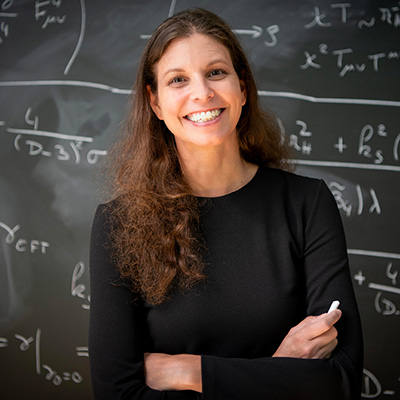
Claudia de Rham is professor of theoretical physics in the Abdus Salam Centre for Theoretical Physics at Imperial, where she is also the Director. Her research challenges our understanding of …
Read More– You know, even if you’re not a physicist, you kind of look at the equations and you can’t help but feel that in these few symbols there’s just such power and such beauty.
– Yeah, yeah.
– When one looks at massive gravity, you don’t quite get the same sense of beauty because of the additional sort of complexity of it. But is that merely a remnant of the way we express these ideas and one day, if this is true, our sense of beauty will acclimate to this being the truth and?
– I do think so. I think it’s a little bit like you look at a Picasso painting or something and it just always is so complicated and then you get used to some different kind of beauty. I’m not saying it’s like Picasso.
– Albert Einstein famously asked whether God had any choice in creating the universe. And by that, he pretty much meant did the universe have to be the way it is? Now, we don’t know the answer to that question, but we can actually turn it around and apply it to Albert Einstein’s work itself because you can ask, did Einstein’s most famous result, the general theory of relativity, did it have to be the way it is? Or did Einstein have any choice, even if perhaps you didn’t know about it, in the creation of the general theory of relativity? And that’s at least in part what we are going to talk about here today, variations on the theme of Einstein general relativity. And I’m pleased that I’m having this discussion with one of the people at the forefront of thinking on these ideas who’s really pushed Einstein about as far as Einstein can go. And that’s Claudia de Rham, Professor of Theoretical Physics at Imperial College. So thank you-
– Hello.
– So much for joining us.
– Thank you. Thanks.
– And so, Einstein general relativity, it’s of course a theory of gravity. And I thought I’d begin there because I think we share, and probably from an early age, at least in my case it was, I suspect for you too, I don’t know, some kind of deep affinity to the force of gravity.
– Right, right, right.
– Like, when I was young, even way back, there was something deeply mysterious about gravity that always captured my attention. Similar?
– Absolutely, yeah. It’s often teasing with us a little bit. It’s funny because some people feel gravity is this force you have to resist, but there’s a little bit of a game into it and trying to understand it. And that mystery in gravity is not just a mystery in how we can challenge it with our body. I think it’s, I mean, it is the first physical phenomenon we actually experience-
– Yes.
– As a human being. So I think there is this affinity with gravity, but there’s also that element that you learn from an early age that you can’t resist it, it’s there, whatever you do, it’s always gonna be there. It’s always gonna be present. And I guess that is part of the teasing aspect and the affinity as well in trying to play with it. And if it’s not gonna let go, then we’re gonna push it. We’re going to push it in one way or another. So there’s that physical aspect, but I guess there’s also understanding it as a theoretical physicist, understanding it at an abstract level, which I’m very appealed to.
– Yeah, yeah, yeah. Absolutely. So there’s something kind of primal.
– That’s right. That’s right. It is. It is, yeah.
– About the force of gravity. And of course, you know, many thinkers in one way or another throughout history thought about or grappled with the force of gravity. Of course, it was Isaac Newton was the first person to actually try to mathematize, you know, put equations to the force of gravity. And that’s what we still teach to high school kids around the world. But it was Einstein who came along and injected a radically new way of thinking about gravity. Kind of put it into the language of geometry. Now, of course, the subject quickly gets technical, but how, in just rough language, how do you think about what Einstein taught us about gravity?
– So I think already to get to Einstein, what Newton did was indeed mathematical and it wasn’t the full story, but I think there’s already an element there in understanding that it is a universal phenomenon. So it’s not just something we’re experiencing here on Earth, in the solar system, but being able to extrapolate that beyond the direct visible, beyond things that we have no control over, that I think already was the first step that then enabled Einstein to understand that it has an element to it which is not directly tangible, which is sort of encoded in the structural reality in one way or another. It’s something really, really profound that is unlike any other phenomenon. I think that’s really our beauty of Einstein, of understanding that it’s not about things pulling towards each other, it has to be something much deeper because of this universality that is shared by no other phenomenon in nature. So if you think of other forces in nature, it will discriminate between different elements and gravity is very different than that. So it has to be, it has to be encoded in really something which is independent of the elements themselves. Now, being able to extrapolate that and to bring it at the geometrical level, and not just at the geometrical level, but the geometrical level of the fabric of spacetime, that is in itself a leap of understanding, which I think I certainly would not have had.
– Yeah, no, it’s an astounding leap. And just to underscore your point, when it comes to say the electromagnetic force, it depends on the electric charge.
– That’s right, that’s right.
– The strength of the force, if the electric charges are bigger, there’s a bigger-
– That’s right.
– And if it’s a plus charge or a minus charge, the force can act in one way or the other. But for gravity, it’s a universal force axle.
– [Claudia] That’s right, that’s right.
– And so, there’s something compelling about an influence that seems to just permeate everything quite literally. And yes, the leap to think about gravity in terms of warps and curves in the fabric of spacetime is sort of beyond. You know, sometimes I teach the general theory of relativity and sometimes I teach into the physics department. Sometimes I teach it more from the math department, I sort of straddle both of those departments. It’s interesting because when I teach in the math department, I start with the differential geometry developed by the great mathematicians who were not thinking about gravity.
– Right, right.
– Gauss, and Riemann, and Lobachevsky are sort of the iconic names. And, you know, you write down all these incredibly complex-looking symbols with all these indices on it and it’s pure mathematics. And then at the very end of that course, like the last day I show how you can take this math and, lo and behold, you rearrange the terms and it gives you a description of the force of gravity whereas when I teach it in the physics department, I start with Newton and the problems of Newton, you know, instantaneous action at a distance. And I show that if you go to geometry, you can fix those problems. Where do you stand in that? Do you think of it more from the math to physics or the physics to math?
– It’s funny because I really think of it, nowadays, and that’s not the way I learned it and that’s not the way I used to teach it. But nowadays I think of it much more as a force like electromagnetism. And I’ll start with that. I start with a fundamental particle, the fundamental particle like the photon. And from that, you build a theory of electromagnetism and you can go the same way for gravity. And so, you start with a fundamental representation from a physics point of view in the same way as all of the other elements of the Sterman model of particle physics. So it’s really from the physics point of view, but as a representation that comes from the math side of things. And then from there, you actually see a lot of analogy between gravity and the other fundamental phenomenon in nature. And you also see why it’s so different. And so, why you need to have all of those very beautiful inner structure, but also a fundamental symmetry, which is not an external symmetry, is not something that you can actually see from the outside, but that symmetry, in the end, it has to be built in the fabric of spacetime. And that emerges from thinking of it at a particle level, at a field theory level to start with.
– Now, a particle level in some sense takes us to quantum mechanics.
– Yes, yeah.
– From the get-go. Because again, historically, as we all know, Maxwell wrote down these beautiful equations in the late 1800s describing electricity and magnetism and it was able to explain all the experiments. You move a magnet through a coil and you get the electrons to move and so forth. But there was no photon at that point.
– That’s right. That’s right.
– And so, when does the photon first make its appearance? I guess, was that the photoelectric effect, Einstein, 1905-ish probably?
– That’s right. That’s right. Yeah. Yeah.
– And so, that particle has been seen, right?
– Yeah.
– Now, you mentioned the graviton as sort of an analogy, the particle transmitting the gravitational force. We’ve never seen that particle.
– We have never seen it.
– And you think we ever will or is it?
– Well, I would hope so, one way or another. I think seeing, nowadays, we have different ways to see things, to feel things, to deduce things. So hopefully one day we will be able to have experimental proof of the quantum nature of gravity.
– Yeah. Are you convinced that gravity has to be quantum mechanical?
– Let me just say, I am convinced at the moment that there has been proposed no alternative, which are viable. So if we have a system which is quantum, for instance, electrons, which we know are quantum.
– Yeah.
– And we know they’re coupled to gravity, they can’t simply communicate with gravity without that system also being quantum. And there’s been alternatives in trying to understand gravity more as a condensed system, emergent system, but still, to preserve simple rules of probabilities, quantum probabilities, we need to have the level of communication between a quantum system and gravity to be also quantum. And so, there’s an element of gravity that has to be quantum. And in fact, that is in itself not a problem. We know, we do that for breakfast. We know every day how to treat gravity at the quantum level. What we don’t know for sure is how to treat it at the quantum level in very dense environment, in very curved environment, in very strong environment. But it’s true. When I talk about the graviton, it doesn’t mean that it has been observed. It doesn’t mean that it is necessarily there. But I can think of it in a classical sense or in the quantum sense and I can build my theory of gravity at the very least semi-classically from there on.
– And semi-classic means take the classical theory and just add some quantum influences but not blend them fully.
– That’s right. That’s right. That’s right. That’s right. That’s right. And if I think of a classical field theory, I can think of the representation of gravity in the same way as I would do for electromagnetism. And from there has to emerge all of the symmetries of gravity that we know. And what’s really, I think, beautiful is the way we typically teach it is to think of Einstein’s pillars of gravity. And we think of universality, we think of equivalence principle, we think of every observer is equivalent. And we build that as a pillar in the foundation of Einstein’s theory of general relativity. But in fact, we can actually do it the other way around. We don’t need that many assumptions, we just need to think of a fundamental force of nature that goes beyond what we would have for electromagnetism, that behaves as a slightly different field. And then from there emerges all of the symmetries that we know we need to have. And I think that’s really incredible because the equivalence and the equivalence between different observer is something which actually has to emerge for consistency. We have to be equivalent as opposed to setting this as a prerequisite for our models.
– And so, for that equivalence principle, again, just for people who are less familiar, the idea being there’s no preferred point of view in the universe.
– That’s right, that’s right.
– Whether you’re moving, even accelerating.
– That’s right, that’s right.
– You can view yourself as the center of the universe and interpret everything you see from your perspective. And that description should be as valid as anybody other’s description, which means that the equations have to have some kind of well-behaved way of transforming from one person’s perspective to another, to another person’s perspective. And Einstein actually built that in-
– That’s right. That’s right.
– To his equation. You’re saying you can actually get to that.
– You can get to that. That’s right. And there’s also an equivalence in not only in your perspective, but in how gravity has to affect everyone, including light, in a similar way. And that is not something you need to set that equivalence in how we will react to gravity. It will come out and therefore that geometrical interpretation of gravity sort of has to come out from that. Because it has to be encoded in something that is omnipresent for anything.
– And what’s omnipresent but space and time? Yes, yes, absolutely.
– That’s right.
– And so, if we go back to electromagnetism and the photon as sort of a interesting, well-understood case study. You know, one of the things that comes up whenever I teach special relativity where I don’t really talk about the photon initially. But sometimes I’m forced to talk about the photon because the students will often say, “So like, what’s so special about the speed of light?”
– Yes, yes.
– And the only answer that I find satisfying is to say, “Well, look, there are many speeds in the world, right? An electron can go at this or that speed and it can vary. A proton can go this or that speed, it can vary. The special thing about light is it’s communicated by a particle called the photon, which unlike the electron, unlike the proton, unlike the quarks, has no mass.”
– That’s right. That’s right.
– And that no mass quality is what picks out a universal speed.
– That’s right, that’s right.
– But that then does raise the question, do we really know that the photon has no mass?
– So in fact, it’s very possible that it could have a mass. And we know how to think of it and we know how to test that. And there are actually some constraints on the photon mass. We understand at a very high frequency, so very, very deep in the ultraviolet, then even if the photon had a small mass, it would still need to travel at the speed of light because that mass is irrelevant compared to that very high energy of the photon. But at much smaller frequencies, so more towards deep, deep, deep infrared, then it will have implications. And it will have implications on the magnetic fields in galaxies, for instance. And so, those are the best constraints.
– Yeah.
– On the photon mass. So we understand, in fact, very well how to think beyond our original assumption and how to think beyond what it would mean to have a universal speed of light from the get-go.
– And sorry, this is probably an unfair question, but do you know what the current limits are on the photon mass?
– I do believe it’s of the order of 10 to the minus 18 electron volts. Now, you need to translate that.
– Well, an electron volt is about 10 to the minus 36 kilograms.
– If you say so. I’m sure you’re right.
– I’m thinking that well. I know that 10 to the 19 GEV, so it’s 10 to the 28 electron volts, which is the plank mass.
– Yes, yes, yes.
– It’s 10 to the minus five grams. And so we get 10 to the minus 30, yeah, so yes. 10 to minus 36 kilogram. And so, you said 10 to the minus 18 electron volts?
– That’s right. That’s what it was a few years ago. It’s possible it’s gone down to 10 to the minus 20 now.
– Let’s take 20, just because it makes the calculation easy. So that’s about 10 to the minus 56 kilograms is the limit.
– Yeah, yeah, yeah.
– Roughly. Somebody will check us and then the comments will say, “Oh, you got all your .” But the point is this is really tiny.
– Yes. As an analogy, or to create a comparison, the lightest massive particle that we know are neutrinos and their masses we think are 10 to the minus three electron volts, something like that. So it’s something like 17 orders of magnitude below that. So it’s extremely, extremely light. But in string theory, in some models beyond general relativity or in all sorts of different considerations, they could be particles like axions or particles for dark matter, which mass could be even below that of that order of magnitude. So it is something that we are actually, that we, all of us are actually probing. And there’s possibilities to think about having elements in nature whose masses are so tiny.
– Yeah. Now, so Maxwell wrote down the equations for what we would call a massless photon, traditional electromagnetic theory. And in fact, just historically, it’s worth saying, you know, you probably have, but I should ask, have you ever looked at the original papers of Maxwell? Because the equations…
– Are not like anything.
– They’re a mess compared to the way we write them down in modern notations. So, you know, that’s just the way physics progresses. So we have a very clean way of expressing Maxwell’s equations. In fact, you know, you could do it on two little lines if you use the right notation. How hard is it to modify those equations to allow for a non-zero photon mass?
– Very easy.
– Yeah.
– Very easy. In fact, it’s so easy that there’s direct analogs. There are elements, forces in nature, which are a little bit like electromagnetism, but the field or the particle that carry that force has a mass. We know that. The weak force, the weak force is not very familiar to us because it’s weak. It’s a weak force. And the reason the weak force is weak is because the particles that carry it are a little bit like the photon, but they have a mass. And so, we can do that. We understand very well how to do that. We also understand very well how to have, for electromagnetism or for those kind of fundamental forces, we understand very well how to have a mechanism that goes and give a mass to those fundamental particle in a way that satisfies all of the laws of consistency that we enjoy having.
– Which ultimately came from Peter Higgs in some way, shape, or form.
– That’s right, that’s right. That’s right, that’s right.
– And so, one technical question that I want to ask, because obviously you can begin, we haven’t planned this, but you think you see where I’m going here. If you take the equations-
– Yeah.
– For electromagnetism that have a non-zero mass for the photon. And then you in effect have a dial that makes that mass smaller and smaller and smaller, does it nicely, smoothly go into exactly what Maxwell would’ve recognized?
– Okay, so there’s different ways to answer that question. The funny, the fundamental thing is when I say it’s very easy to give a mass, it’s very easy, but also it’s fundamentally very different because there’s a very nice symmetry which is there when the photon has no mass. And as soon as you give it this tiniest possible mass, that symmetry is no longer there. And you can dial things such that the symmetry is almost there, but there’s a difference between there and not there. There is a difference. And so, that difference actually means, concretely means if you think of the photon, if you think of electromagnetism, if it has no mass, then light travels at the speed of light in the vacuum. Whereas if it has a mass, in fact, it doesn’t travel at the speed of light. It travels as close as you want to the speed of light. And depending on the frequency, if you dial that mass down, it will get as close as you want to the actual speed of light in the vacuum if it were massless, but never quite. So there is a discrete difference, whether we want it or not. So at the mathematical level, at the symmetry level, at the representation level, at the particle level, the freedom you have in exploring a theory, there is a discrete difference. Now, does that matter from observations? That is something you can dial down so that from a observational point of view, from an experimental point of view, you can ask yourself, what would be the distinguishing features between the two? And classically, if you dial the mass down, it will end up being indistinguishable because, for instance, one observable would be how close to the speed of light in the vacuum would you be? And you would be as close as you want to it. Similarly, for instance, for magnetic field, what’s the distance in which they could be coherent? And the smallest the mass is, the larger that distance is. And therefore, you can actually dial things down and see no classical, experimental, and observational differences. However, once you start thinking about quantum effects, there are some non-trivial differences. And so, in fact, the anomaly that is there in electromagnetism will be discreetly different as compared to what would happen if the mass is there. And that’s because you have different ways to shake around a theory and, classically, they all learn into the same features, but at the quantum level, that additional freedom you have in how you shake things around makes a discrete difference.
– Yep. But the beautiful thing is that the math is all well-behaved.
– The math is beautifully behaved, yeah.
– So one has a complete mathematical control over the situation and then you can do whatever analysis-
– That’s right. That’s right.
– Strikes you as interesting.
– And that’s because we also have a Higgs mechanism that shows us how to go smoothly from a situation where it has no mass or a situation where it has mass.
– Right. And so, now, obviously, what they want to do is have a parallel discussion of Einstein’s version of this story, or your version of Einstein’s version of the story. Because again, as you said, we have the equations of electromagnetism. We have the photon is the particle communicating the force. We have the equations of Einstein, the gravitational field equations of general relativity. And we believe there’s a graviton that would play the analogous role. And in the traditional approach that Einstein wrote down, graviton’s massless.
– That’s right. That’s right.
– But you can ask yourself the same question. Now, number one, we’ve not detected gravitons, but indirectly we do have bounds on their masses. I don’t know what those bounds are. I don’t know if you happen to have those in mind.
– Yes, so if you draw first from a direct analog from gravitational waves, let’s say, we understand the speed of gravitational waves in different ways. We understand also how that doesn’t change too much with respect to the frequency of the gravitational waves.
– Which if it was massive, the different frequencies could travel at different speeds.
– That’s right.
– And arrive here at different moments.
– That’s right, that’s right. That’s right. So from those constraints on gravitational waves, we have a bound on the mass, which is 10 to the minus 22 electron volts.
– So better than the bound.
– Better than we… And most of that bound comes from the very first detection of gravitational waves.
– The cleanest signal that we ever got, right?
– The cleanest. So the first time we saw a gravitational wave, we already were able to qualify the graviton in a better way that we were able to qualify the photon.
– After all these years.
– After all, it’s incredible.
– It is incredible.
– It is incredible. So you’re off to a good start.
– Yeah. And so, again, my conversion could be off, so I qualify that, but it’s something like 10 to the minus 58 kilograms.
– That’s right, that’s right.
– Bound on the mass of the graviton. Nevertheless, an interesting question might be, what if it does have some little, tiny mass?
– That’s right. That’s right. That’s right.
– Now, people have thought of that over the years. Do you have a feel for the early motivation? Was it just, “Hey, let’s just see what we can do,” or is there any-
– Yeah, so there’s different ways the story came in. So, but already Newton himself, when he thought about the universal law of gravitation, there’s a very natural question, which is what if it wasn’t that universal after all?
– Right.
– And so, this is not at all framed in the sense of a fundamental particle carrying the force of-
– Too early in our thinking.
– No, that was way too early. But already, that little tweak into that fundamental symmetry was in people’s mind because it’s a very natural question. But when people started thinking about gravity more like the other fundamental forces of nature, Pauli and Fierz already in 1939, just as a systematic classification of what the different representations could be, what could nature do, really?
– [Brian] Yeah.
– They started thinking about you have a representation for a photon, what would happen if it was massive. And then they started doing the same thing for gravity. You have a representation for gravitation waves or for the graviton, what will happen if it were massive? And already there, already at that point, they realized that it was an order of magnitude more challenging to think of it that the-
– Compared to photons.
– Compared to photons, yeah, that the number of possibilities in how things could go wrong was exponentially large. And that’s not just because you’re dealing with spacetime, but also because you can start shaking around the graviton in many different ways. So perhaps for the photon, you can think of as soon as you give it a mass, then it doesn’t need to propagate at the speed of light anymore. In fact, it cannot longer propagate at the speed of light. And so you can think of it as an additional freedom in how it goes back and forth along the line of propagation. You have an additional way to think about it. You have an additional channel of communication through electromagnetism. Now, as soon as you do that for gravity, you can think of the same thing. And so, if gravitational waves could have a mass, if they don’t need to propagate quite at the speed of light anymore, you can have also this possibility opening up. But now for gravity, what it means is that you have ways to shake things around that are encoded in the fabric of spacetime. And therefore you can shake things around in a way that will go back and forth in time. And now you can automatically see that there’s something you want to be really careful with that. It’s not just an external phenomenon, an external force where you can play with it and see what the consequences are, you’re actually playing with time. And that feels a little bit like playing with God. You’re actually playing with things that you need starting to be extremely careful about.
– Yeah.
– And so, already then, in 1939, Fierz and Pauli realized that it will have to be very tricky and you have to be careful.
– And did Einstein, I don’t know, did he weigh in at all on any of this?
– I don’t think so because those investigations were quite different. First of all-
– They’re more for the particle physics and the things.
– So first of all, despite what the story tells us now, Einstein never really believed in gravitational waves.
– True. Very on the fence about it.
– Yeah, he was very on the fence about it. He almost published a paper wanting to say that they could not exist, that they were just a mathematical artifact with no physical implications. So for him, I can’t speak for him obviously, but the idea of thinking of gravity as having a mass is coming much more from the gravitational wave perspective and from that representation perspective. Whereas for him, the symmetries were really the pillars of the representation. And you have to give that up to start with and then rebuild it from scratch. And so, I would have thought that this is not at all the way he would have though about it.
– Yeah, I mean, it may surprise people who are less familiar with the details of the subject when we say, and I think most of us agree that Einstein perhaps didn’t fully understand Einstein’s own equations, right? I mean, because they’re so subtle.
– They are very subtle, they are very subtle. I think what is fair to say is that some elements of it, even for Einstein himself, it was confusing. And that’s why it was so important to have different perspective. And Robertson is one of the ones that actually explained some of the subtleties to Einstein and convince him that gravitational waves were not just a mathematical subtlety in the way to represent things, but they actually were real and they had consequences.
– Yeah, yeah. And so, way back in the ’30s, as you say, people began from one perspective to think about what it might be like if the graviton, I don’t know if they used that language, but if there was a mass associated with the disturbance of the gravitational field.
– That’s right.
– As people began to then dig in even further, more systematically, again, you’ll know the history much better than I do, but by the ’60s or call it 1970s or so, it seemed to be the going lore that it was just inconsistent-
– That’s right. That’s right.
– To add a mass.
– That’s right. That’s right. So maybe before we go there, let me just say that before that, there was already ideas about extra dimensions.
– Ah.
– Which I think are important.
– I didn’t know we were going there, but now you’re talking my language, so.
– So just like we live in a world of three-dimensional space, one dimension of time, I can’t think about the possibility of having extra-dimensional space. I would love to think of the possibility of having extra dimension of time.
– It’s a little harder.
– But we’re probably not going to go there.
– Yeah.
– But if I think of gravity with extra dimension of space, and I don’t want those extra dimension to be too visible to me, otherwise we would have seen them, then I need to compactify them or I need to find a way to make them sufficiently small so that I don’t see them. But then from my own perspective, what it will look like is a theory of Einstein gravity and then also excitations of what can happen along the extra dimension. And that in fact corresponds to copies of gravity, but those copies of gravity have a mass. So from that perspective already throughout the ’30s, there was the idea, not the idea of gravity having a mass, but in addition to gravity, there could be copies of it, an infinite number of copies of it, each one carrying a little bit of a mass. Now, this is quite different in comparison to thinking of our theory of gravity from the outset having a mass. But from a mathematical point of view, you can already start trying to see if you can draw a parallel between the two. There’s a big difference, though, if the fundamental copy of gravity that we experience already has a mass, the difference there is that we already need to understand how to fold in all of the symmetries which are the pillar of Einstein’s theory of general relativity, which are very well understood. And those symmetries are what prevents having all of those excitations, for instance, going back and forth in time. Or all the ways in which we can think of gravitational waves. So, perhaps one way to think of what could happen if I think of gravitational waves, the ones we have observed, there are two kind of polarizations, I don’t know if people have heard, there are plus and cross polarizations. We have observed those gravitational waves. But gravitational waves are a fluctuation in the fabric of spacetime. And so, in principle, we can think of having fluctuations along different type of directions. Also along the line of propagation of the gravitation waves or gravitational waves which would scale things up and down. So that would be beautiful. And there are tests for those kind of fluctuations. What it means in practice is that if you think of communicating through gravity, that’s not the way we think of things, but we communicate through light. And so, I can think of what if I wanted to communicate through gravity? And in fact, we communicate through gravity with the moon, for instance. And we do that with the sun. We do with one another to a very small extent. But we do to some extent. If there’s other ways, other channels of communication with gravity there as well, it would mean that in some situations, the effect of gravity would be different as compared to general relativity, and different not by an amount which seems to be small and smaller when I dial that mass of the graviton to be small as would happen for electromagnetism, but because this is a much more subtle effect in gravity, it’s actually by an amount which at the time in the 1970s seemed to be always different by an order of one, by a discreet, observable number. So in the ’70s came what is now called as the van Dam-Veltman and Zakharov discontinuity, vDVZ discontinuity, which tells you that if you think of Einstein’s theory of general relativity not just at the gravitational wave level, but really at the fully-fledged gravitational theory where you have a Newtonian limit in one case, where you have all sorts of other bending of light observations in the other case, then as soon as you include a mass, no matter how small it is, because you actually do something quite dramatic in how you break the internal structure, the internal beauty, the internal symmetry of the theory, then it doesn’t matter, it doesn’t matter if you break something, you can try to glue it back together, you would always see that it has been broken. It has been broken. Its internal structure and stability is quite different. And so, you need to make peace with that. So in the 1970s, they realized that there seemed to be an order one difference which was in fact incompatible with observations as soon as you gave the graviton the smallest possible mass.
– So the gravitational force would simply be different.
– It would be different. So it would be different for different system. So if you compare how the bending of light would be around the sun, you can make it consistent with our observations, but then that would mean that if you drop an apple on Earth, then it would be an order magnitude of one different as compared to what even Newtonian gravity tells us.
– Yeah. Now that’s strange, right? I mean-
– That is strange.
– I mean, you and I, I mean, I of course know exactly what you’re referring to in terms of breaking the symmetry, which previously in the massless theory just allowed you to kind of rotate away this additional influence.
– Right, right.
– And once you can’t rotate it anymore, the influence is there.
– That’s right. That’s right. That’s right.
– But it’s so, intuitively, hard to picture.
– Yes, that’s right. And it still bugs me.
– Yeah. Because, I mean, this mass, like we say, could be 10 to the minus 60 kilograms or something.
– That’s right. That’s right. So who is to tell when too small is zero? What is the difference? There’s a point where it goes beyond any, not even any potential detectability, but it’s beyond even the observable universe. It’s beyond any notion of reality. So who is to say what’s the difference between something which is so small I can never, ever tell the difference and something which is zero? And yet, in some cases, nature tells us that it is different.
– Yeah.
– It is different. However, that’s not completely the end of the story.
– Right.
– There’s many, many more subtleties in there. I don’t know how far, how deep into it-
– Well, I’d love to, I’d love to get to a point where you and your collaborators have this beautiful idea for how to make this mathematical theory as sensible as the massive version of the photon. Like, when did you start to think about that yourself?
– I started thinking about it in around 2004-2005. And that was related to cosmology, in fact, that was related to the vacuum energy problem, the cosmological constant problem. So we can go into that.
– Yeah, I’d love to, yeah.
– And maybe, let me tell you a little bit more about the story in the ’70s.
– Please.
– Because there’s different layers in there, which are beautiful, in fact. And it’s incredible because in a very short amount of time, within months, different kind of realizations were being made. And it’s almost like at the very beginning of general relativity where the theory is postulating and black holes came out very quickly after.
– Yeah, within one year, I guess, yeah.
– Yeah. So for massive gravity, that discontinuity was understood in 1970. And just within a month, Weinstein realized that, in fact, that wasn’t quite the end of the story because this discontinuity is present when you’re trying to think of the theory a little bit too simplistically. But in fact, what happens when the graviton has no mass is that the interactions become very, very strong. So maybe to draw an analogy, we all heard of black holes and we all heard that the gravitational field is quite strong in the vicinity of black holes. So if you have a mass, it doesn’t matter how large that mass is, if you are very far away from that mass, then in fact, Newtonian gravity is a very good approximation. And then you can have corrections to Newtonian gravity. But you are in what we call the weak field approximation. And it’s a very good. And we can go a long way just looking at weak field approximation. In fact, in the whole of the solar system, the weak field approximation is excellent. And that’s all we really use. Even to think of the differences coming from the advance of the perihelion of Mercury, around the sun from general relativity. We can do that in the weak field approximation, just work beautifully. But if we go closer and closer to a mass, there is a point if the mass is itself encapsulated in a sufficiently small region or space where the weak field approximation is no longer valid and you are actually in a situation where gravity likes to interact with itself.
– Right.
– And that’s something very special about gravity which is required for the consistency of Einstein’s theory of general relativity. And that’s why black holes are inevitable in Einstein’s theory of general relativity. It’s not just an artifact. It’s not just an anomaly. They’re actually inevitable. Those self-interactions, the fact that it likes to play with itself to interact with itself is built into the theory of general relativity, is built into the symmetry pattern of general relativity in a way that is not present for electromagnetism. And that’s a critical difference.
– Right, so gravity gravitates.
– That’s right.
– Whereas light itself does not-
– That’s right.
– Create an electromagnetic field that back reacts to itself.
– Exactly. Exactly. And that in itself is built-in, again, in the equivalence principle. That full gravity, everything interacts with gravity, including itself.
– Gravity, yeah.
– And so, it’s a curse. It’s a benefit, but it’s a curse. It’s something so beautiful and then it affects itself, and I would say that’s a bit of a tangent, but I would say it means that black holes do exist and it is the existence of black holes that also show that, at some point, Einstein’s theory of general relativity is failing. So that’s a bit of a tension, but it’s something fundamentally different about general relativity. So, we are used to the fact that in full gravity, because it gravitates, itself, it has an effect on itself, there is some region where the weak field approximation is no longer valid. And so, in a theory of, as soon as you give the graviton a mass, we can assume, and now that’s what people thought to start with, that region where it interacts with itself, it gravitates with itself was the same as compared to Einstein’s theory of general relativity. But what was realized by Weinstein in 1970 already was that, in fact, that’s not the case. As you down the mass of the graviton, the additional ways in which you can tweak the theory around, they gravitate on themselves, just on themselves in a much stronger way than just the standard general relativity ways of working with a theory. And the equivalent of the horizon of a black hole, what we would call let’s say the Schwarzschild radius for people that are used to that, but just the size, the horizon of a black hole. There’s a similar one in the case where the graviton has a mass. So you can think of a black hole, you can think of any object in fact, you can think of this cup, for instance. In itself, it’s lucky enough to have a Schwarzschild radius, its horizon inside itself. So there isn’t a point for this cup of water where I’m going to need to worry too much about falling into its own black hole. But it also has, if it was in a theory of whether graviton has a mass, another radius associated with it, which is related to the graviton mass.
– Right.
– And that critical difference is that this radius becomes infinitely large as you dial down the graviton to be small and smaller.
– It’s like inversely proportional to the mass.
– That’s right.
– Mass goes to zero, the scale goes big.
– And that may seem like it will make the theory completely intractable, but actually what it does is that the additional ways in which you can, the additional channels of communication for gravity if you add a mass, as the mass goes to zero, they become so strongly interacting that they just separate themselves out. It’s like you’re working, you glue yourself. They are gluing yourself to the point where they can no longer move and you can no longer see them. We say that they are decoupled. There’s another sector out there, which mind its completely own business as you dial the graviton mass to zero. And that in itself is quite a stunning realization by Weinstein. And that he realized in a theory which wasn’t complete, but just understanding that those kind of phenomenon, which is unprecedented, would happen as soon as you gave it a mass. So that in itself shows you that it’s a whole different story as soon as you give it a infinitely small mass. And yet, the outcome can be that, observationally and experimentally, you get the same thing when the mass is dialed down to infinitely small values as compared to no mass. And that is something as physicists, it’s much easier to make peace with because we like this idea of continuity. We like the idea that there should be a point where the mass is so small that I can’t tell the difference. And so, that’s what nature is telling us that, but with an underlying story, which is really extremely complicated.
– Right. So, the short summary is for non-zero mass, the theory mathematically looks radically different.
– It really, yes.
– But you dial that mass down and the radically different part compared to Einstein kind of migrates off to the side and can be ignored and you recover Einstein.
– Exactly. Exactly.
– In that limit. Now, there’s still the quantum mechanical story.
– That’s right. That’s right.
– And that proved a little bit more-
– Exactly.
– Intractable.
– That’s right. So then in 1972, Boulware and Deser started exactly trying to understand how that makes sense more quantum-mechanically or even classically in terms of the stability of such a mechanism to occur. It’s for one thing to tell a story. It’s for another thing to actually understand how that works, how consistent it is, and whether there’s a mechanism like the Higgs mechanism that would enable you to go from one to another smoothly. And then they realized at the time that at least with what they could consider, the way to encode this separation, you could never do it in a way without also including those fluctuation going back and forth in time. And that quantum-mechanically simply is directly related to what we call a breaking of unitarity. If you go back and forth in time, it looks like energy becoming positive and negative. And so you can play with energy at will. And you can have system which have infinitely large energy, and system which have infinitely negatively large energy. And so, nothing prevents you from actually infinitely exciting the very fabric of spacetime at no cost.
– Right.
– This is something you don’t really want to have. This is not-
– So it looks like the theory just isn’t going to work.
– That’s right. If that quality-
– That’s right.
– That so-called degree of freedom.
– That’s right.
– Remains in the theory. And for a long time, people thought that was that.
– That’s right. So there were what we call no-go theorems exactly saying that it won’t work. So Boulware and Deser were the first one to really formalize that and then classifying the different ways you could think about it and showing that for every possibility, it simply would not work.
– And in some sense, that’s very nice, right? Because it makes the story much simpler, right? It basically, going back to my initial question, it suggested Einstein had no choice.
– That’s right. That’s right.
– It had to be what Einstein wrote down.
– Yes.
– And then others come along and complicate the story.
– Yes, yes. And so, in fact, I’m completely with you. And when I started working on this, we wanted to explore that because of different reasons. But I came to the conclusion myself that indeed it would not work, and I was set up to write a paper showing yet in a different way why we really always had to land onto Einstein’s theory of general relativity, which I think for part of the story is still true, but there’s layers of subtleties in that. So, but throughout since the ’70s, every time people consider the possibility of thinking of it in a slightly different classification or thinking of how you can think of the stability of the theory, there’s different ways to address it, as people, quantum field theory became more and more developed throughout the years, every time they formulated the same no-go in a different language, but still with the same conclusion. So I think it’s fair to say, for a while that was the accepted resolution. And in fact, in 1998, what has happened is completely different, but observations on the expansion of the universe proved or converged with different kind of observation on the fact that the expansion of the universe was accelerating, which is a well-known fact by now. That in itself should not be surprising, but it sort of revitalized a different kind of story, which is the cosmological constant problem. Einstein himself, when he came up with Einstein’s theory of general relativity, he had already thought that there could be a cosmological constant there.
– And that’s like a kind of diffused energy filling space that yields a repulsive push, explaining perhaps why things are moving away ever more quickly.
– That’s right. That’s right. Exactly. So Einstein, when he introduced it, he introduced it because at the time they thought the universe was static. It seemed like it was static before it was observed that it was expanding. And that was puzzling because you would see that galaxies would just attract each other. So he introduced that, understanding that he has some sort of negative pressure being able to push things away, and so to-
– Balancing things out.
– To balance things out. And then he realized that while he can balance things out at one specific, in one specific way, in one specific point, it’s not gonna work all the time.
– Kick the universe a little bit and either-
– That’s right.
– Expand or collapse.
– That’s right. That’s right. And let me just say that, because this is often quite puzzling, how you can have a constant energy density filling all over the universe and leading to an expansion of the universe, which is even accelerated. So that means that you have it and space expands at an accelerated rate, and therefore because the energy density is constant, you have more of that energy. And so, the energy of the universe is increasing and increasing. Where is it coming from?
– Good. So what’s the answer?
– Well, energy is not conservative.
– Ah, that blows people’s minds right there.
– Yes, yeah. So I always say-
– Wait, so what did they teach us in high school?
– That’s why I say invest in dark energy, invest in the cosmological constant. Just wait a few billion years and that’s really gonna be where all the energy of the universe will be in. Just need to be patient. So, I think there’s definite alternatives for why our observations are the way they are, but all observations nowadays converge on the fact that the expansion of the universe is accelerating and we need to explain it when one way or another. The cosmological constant is still very much the cleanest, I would say, the cleanest solution. And in fact, I would say it’s so clean and it’s so natural that particle physics or the quantum world give us a very natural candidate for that. When Einstein introduced the cosmological constant, he introduced it at the classical level. He was never-
– Just a number in his equations.
– Just a number, that’s right. And you can do that. But nowadays, we understand so much more, even very much how to reconciliate general relativity with quantum mechanics, quantum field theory at the very least in a weak field approximation, that we can do very well. And already in the weak field approximation we can see that the quantum field of the Sterman model, for instance, of particle physics, the electrons, the Higgs nowadays, we would have expected them to lead to a energy in the vacuum. And if you don’t have gravity, that energy in the vacuum is much of a muchness because it’s nothing you can actually probe it with. But because, again, of the beauty, but the curse of gravity is that everything gravitates. And so, we would have expected this quantum vacuum energy to gravitate. But how much we don’t know for sure, but it’s already unsettling to see that we need to, something needs to be accelerating the expansion of the universe, that looks very much like a cosmological constant. And on the other hand, we have this vacuum energy of quantum fields that looks exactly like a cosmological constant we would expect. And so, are those two things the same or not? And we don’t quite know how to reconciliate them both.
– And numerically, they’re not quite reconciled with a pretty radical difference.
– That’s right, that’s right. So, it’s subtle there as well because some calculations tell us it’s infinite, which of course is not. But I think within the most restrictive ways to think about how to make sense of it, you would expect it to scale like the mass of the particles themselves. And so, at the very least to go like the mass of the heaviest particle that we know of, maybe the top quark, or the Higgs mass. Those are particles we know exist, it’s not something I’m just inventing, we know they exist. And so, it’s not completely crazy to think that at the very least they should contribute to the quantum vacuum energy. If not, I need to explain why not. And in fact, if I just take the contribution of the Higgs field and I compare its contribution to the vacuum energy with the amount of vacuum energy I would need to explain the acceleration of the universe, I have 56 orders of magnitude discrepancy. So that means that just the Higgs itself gives a contribution, which would mean the universe would be accelerating at an incredibly faster rate, to the point that space between you and I, of course we’re in a bounded system, but otherwise space between you and I would be expanding at such an accelerated pace that we wouldn’t be able to see each other anymore.
– It’s unclear that our bodies would even hold together. So there’s definitely a mismatch if one tries to explain. And presumably, that was part of your motivation for looking for new solutions to what could yield the accelerated expansion.
– [Claudia] That’s right.
– And I gather that took you to begin to think about massive gravity.
– That’s right. That’s right. That’s right. So that was exactly the idea that maybe to one, there’s different ways to explore resolutions to this question.
– Sure.
– I think that’s fair to say it’s an open question and there are different ways to address it. One way to address it is to try to understand why this quantum vacuum energy is not as large as we expected, which is I think probably the right way to go. But there’s another way to think about it is whether this quantum vacuum energy, the way it gravitates is actually not so universal anymore. Maybe we’re reaching the point where this universality of gravity is finally touching to an end. It’s finally coming to an end.
– So the idea then would be it’s universal on sufficiently small scales where small could be almost to the edge of the observable universe.
– That’s right. That’s right.
– But you’re saying when we get there and beyond, maybe it’s not-
– That’s right.
– The same as it is as we experience.
– Exactly. And so, we would just be starting to probe the breakdown of this universality. In fact, I would say it’s even more complicated, but it’s more beautiful than that because it’s not just distance, it’s not just space, it’s always space and time. And in that case, really what matters is time. Because in the very beginning of the universe, you may think, well, to start with, the universe would actually be very small if it was dominated by such a huge quantum vacuum energy. But when the universe has been in our state for a long enough period of time, then it starts relaxing, then the effect of such an energy for a long period of time is like a long period of distance, and you start seeing that that universality doesn’t hold for a long enough period of time.
– Right.
– So that would be roughly the idea. There’s a relaxation mechanism where to start with, that large vacuum energy would actually have gravitated as one would have expected, and that would have led to a very small observable universe because it really would have accelerated very fast. And so, the distance you could actually observe would be small if it’s expanding too fast. But if you wait long enough for a period of time, which is comparable to the inverse of the mass, then the effect starts weakening. This universality, I think it’s easier to think of it in space, but it works in time as well. This universality is reaching a limit. And so, after a while, the effect of this vacuum energy is no longer there or it slightly decays. And so, that would be the idea.
– Right.
– And so, the universe appears to be the way it is for us right now because it’s old enough. It’s old enough that it has relaxed, it has literally relaxed, calmed down a little bit, and stopped being so influenced by this energy.
– And so, the mass then of the graviton.
– That’s right.
– In this way of thinking about things.
– [Claudia] Yeah.
– I gather would be itself inversely proportional to the size-
– Exactly.
– Of the universe.
– The size of the universe-
– So what sort of mass, like, so we know the, you know, obs and cosmological observations.
– That’s right.
– How big would the graviton mass be with this as your driving consideration?
– 10 to the minus 33 electron volts.
– 10 to the minus 1/3. So well smaller than any bound that we have from gravitational wave physics, even 10 orders of magnitude.
– That’s right. That’s right.
– So this a observationally, experimentally-viable approach?
– Yes. That’s a tricky question because to answer it fully, I shouldn’t just rely on gravitational waves, I should also rely on the behavior of gravity in so many different systems, on cosmology, we also know how structure has formed and how galaxies and clusters of galaxies are gravitationally-bounded together. So to answer that question, I actually need to have a fully-fledged theory of gravity, which is not pathological, which doesn’t have those problems that Boulware and Deser, and all of the other no-go.
– The extra gravitational degree of freedom, backward and forward in time.
– That’s right.
– And is that what drove you to start really looking at the foundations of this?
– That’s right. That’s right. That’s right. So in fact, when I started looking at it, I was completely convinced by all of those no-go and therefore my party line was we had to go to extra dimensions for it to work out. For one, because we know extra dimension gives us some models of gravity which are built in a level of mass, and that mass is not just intrinsic to gravity, but it’s actually intrinsic to the extra dimension. And so, that’s a better way to think of how to dial things up and down, it’s easier to think of extra dimension be larger or smaller. And it’s not just that. As I do that, I can also confine gravity more on the world we live in or less. So we seem to have more of a handle on this. And in fact, I was set up to show that even using extra dimension, it wouldn’t be working.
– So you were sort of trying to rule this idea out.
– That’s right. That’s right. That’s right. Which may still be the case, but-
– For different reasons.
– But for different reasons, that’s right. So there was a beautiful model based on extra dimension and if we want from a effective perspective in our world, this universatility to be slightly broken, it has to be implemented within extra dimensions as well in a way or another. And we can do that by thinking that we’re living in a particular place in those extra dimensions. So I was playing around with some of those models and the big surprise is that the no-gos that had been developed and the way to think about it, even though they were for four dimensions, some version of them should still be applicable to the higher dimensional models that I was working with. And in parallel, Gregory Gabadadze was also working with those, in fact, and only from each other. And he was finding the same thing that in fact they didn’t apply. There was somehow those extra dimension, they had some internal structure which was really inherited from general relativity itself, now in higher dimension. So the beauty of gravity is still there. The symmetry of general relativity is still there but in higher dimension. And that internal structure, mathematical structure in higher dimension is precisely what protected those model from the no-go arguments that had been developed. So it’s not that I was going along and really tried to prove anyone wrong, but really Einstein’s theory of general relativity itself gave us the answer and showed us that there was a way to circumvent the arguments done before.
– Right.
– And the way he does that is, again, within the beauty of the interactions of gravity in that, it’s not just that it interacts with itself, the way it interacts with itself with the extra dimension is really crucial. So it’s not just the self-interactions of gravity and how it gravitates, but also how it gravitates with the other modes had to be fully taken to account. And once you did that, you realized that those consideration hadn’t been fully explored in the past.
– Even in the past, the no-go theorems and the fundamentals-
– That’s right. That’s right. That’s right.
– And so, after all of this analysis then, where would you say that you come out? I mean, do you now have confidence that there is a fully mathematically-consistent version of Einstein general relativity where the graviton does have a mass?
– Okay, yeah. So from a mathematical perspective, I think that we have come a long way in many ways. So yes, I am convinced that, mathematically, there is a way to think of Einstein’s theory of general relativity with self-interactions that will give the graviton a mass, that mathematically is correct. Also, what I think is really beautiful is still within a structure, we can see that the dynamics of gravity itself, the graviton itself has to be identical to Einstein’s theory of general relativity, even if the symmetry is not present. So the presence of the mass from the outset, that’s what we wanted. We want the presence of the mass to break this universality because we wanted that cosmological constant of, that cosmological energy not to gravitate in the same way. And so, it does break the symmetry and yet, for some of the dynamics of the theory, particularly for what standard gravitation ways are concerned, we see that from there emerges exactly the same structure as what Einstein’s theory of general relativity had proposed, built from symmetries, but for us, the symmetries on that sector emerge from it. So I think that’s really nice. Now, when it comes to whether this is an actual realistic description of the world, of reality, that I really cannot answer because it’s the level of subtleties that come in, on the one hand, we want them. We want this symmetry to be broken. We want things not to be as simple. Things are not simple in general relativity, but we can base ourself on a lot of symmetry. For instance, black holes have a purely spherically symmetric symmetry and from there comes the static element to it. That doesn’t work at all in the same way in a theory of massive gravity because that extra sector interacts with itself in a very non-trivial way. We need that. We want that. We don’t want black holes. We don’t want cosmology to be as simple, as local, as perfect as it would be in Einstein’s theory of general relativity. Otherwise, the answer would be the same. So we have achieved the fact that it’s not the same. That’s for sure, it’s not the same. We can’t consider cosmology, which has the same beautiful, homogeneous and isotropic structure as it would be in Einstein’s theory of general relativity. But because we know it doesn’t, it also makes it far less tractable. And therefore, finding analytics, finding solutions that we can write with pen and paper we know is impossible. We need to do that numerically.
– So how far are you in that program? Have you been?
– Yes. So in the past few years, in fact, with Toby Wiseman and at Imperial and other collaborators, we have been deriving some new numerical solutions which, for instance, shows gravitational collapse in those that are massive gravity, in which cases it’s consistent, in which case it’s not consistent. For instance, a very nice result that we just had was even in gravitational collapse or in any other kind of configuration, we can follow the gravitational waves in any kind of non-trivial background and they always travel at a speed of light. So that some of the-
– Even in massive gravity.
– Even in massive gravity, yes. And that is extremely non-trivial because the way those interact in some situations is untractable, is even untractable numerically, and yet we can extract some feature of it which tells us that no matter what the mass is, it will be exactly the same as in general relativity.
– I see.
– So, these are excellent news. What we would love to do now is to being able to understand what is the analog of black hole solutions and-
– Which is where I was gonna go. How far are you in-
– There’s still a long way to go, I would say.
– Like, presumably, this will have no impact on things like the questions of singularities, because it’s the total opposite end of the-
– That’s right. That’s right. So I can say a little bit more about that in a bit. But a priori has nothing to do with it because it’s a completely different spectrum.
– We’re looking at modification of-
– Small versus big.
– That’s right. That’s right. But let me answer that question still, though, because the way it works out is that this separate sector interact with itself in such a dense way that we actually are forced to understand the strong coupling of gravity in a sub-sector of it. And in a sub-sector, which is actually a simpler one, not what the standard gravitation one would be. So to some extent, it is possible that better understanding how to complete it in a quantum gravitational point of view for that just as sub-sector could give us some indication of what could happen for the general relativity sector because the problems that we have with typical singularities in general relativity in some sense come up much earlier before a simpler subpart of the model. So it may be just a pathology that we should discard and try to get rid of, but it also is an opportunity to use this as a lab, as a way to challenge some of the issues that we know we already have in general relativity. It’s not why the theory is introduced, it’s not what we would have expected in the first place, but we are sort of forced to deal with it. Now, for black hole solutions we have, so we know, and that we have no-gos, other people have no-gos, that you can’t have the same kind of black hole solutions as you would have in general relativity, not necessarily because they will look different from an observable point of view, but because at the very least, you need to understand the non-trivial dynamics of the additional mode, the additional, the actual stuff that is there in that theory. And, in particular, you know that this additional stuff needs to be time-dependent and needs to have some non-trivial interactions. And so, we are at that level where we can see numerically, for instance, we consider flat space, for instance, and we add a little lump of matter there, and then we follow it gravitational collapse under its own weight. And we are at a level where we can see how that subsector mind its own business to the point where we have to stop numerically because we’re sort of reaching out the singularity for that sub-sector. But the gravitational, the standard gravitational sector then decouples from it and provides us something which looks much more like what we would have expected from a general relativity perspective.
– Like a Schwarzschild black hole or rotating?
– No, for now, the numerical solutions that we do are spherically symmetric to start with, so we wouldn’t see the rotation. But I am convinced that as soon as you allow for that possibility, it will want to do this very naturally, yeah.
– And what about, I mean, sort of the obvious, well, two questions maybe as a preamble, how well does this achieve what motivated you in the first place? You know, to give some-
– Yes, yeah, yeah, yeah. That’s also, that’s part of the same answer. To be able to answer that question, I need to have, I need to be able to follow the cosmological evolution of the universe. And so, the first part of the answer, which is it’s not the same as exactly the same as in general relativity is definitely there, which is not the answer you’re after because what I can tell you is that it’s gonna be much more complicated and following the whole cosmological history of the universe with this non-trivial dynamics of the additional degrees of freedom is non-trivial. To some extent, understanding how this gets captured for black hole, it will be easily translatable to what happens for cosmology, we have to the same thing when we have a symmetry, the breaking of spacetime symmetry, then we can follow the sector through. However, for cosmology, what we can do instead is work in a situation where you have general relativity and then you capture those additional, this additional sector as in fact massive, almost massive photons, almost massive, I’m going to call them back to field.
– Sure.
– With a very non-trivial set of interactions which have interaction inherited from that theory of massive gravity in a way where unitarity consistency is not necessarily visible on individual subsector, but is there as a fully-fledged situation. And there we can see that we can have this kind of relaxation mechanism. We need to capture the non-trivial dynamics in that additional sector and have gravity separate from that. But we can see that relaxation where you can have a potentially large cosmological constant being there, and it gets eaten. It’s like an airbag. That shock get absorbed by those additional degrees of freedom, those additional mode in such a way that they decouple for sufficiently long period of time from the standard dynamics. So some of that we can see. We can follow through as well the standard fluctuations through the universe to understand that we would get, for instance-
– The CMB type thing?
– The same, yeah. The CMB that is quite easy to get the same thing because that’s so early in the universe where it’s so dense that that effect, the effect of the mass is negligible. But there’s still a long way to go, there’s still really being able to come to exact solutions where we could see, for instance, the whole structure formation through universe and being at a stage where we can compare that for future observations like Euclid. We’re not there yet.
– Right.
– Yeah.
– Would you say that there are any promising observational signatures that you can point to now?
– So one of the things which is quite nice is that it doesn’t just tweak one part of the theory, it’s actually because our whole structure is so tied together, what would be much more of a smoking gun is if you start seeing a small modification in the dispersional relation of gravitational waves at very low frequency going towards LISA, for instance. But also that scale being-
– This is the gravitational rainbow that you poetically have described.
– That’s right. That’s right. But then that scale also being linked to a small modification of structure formation. Any single slight modification in the observations could be very well, very easily described by just adding another anything, a dynamical dark energy, for instance, adding something else in the cosmological paradigm. But if you actually need to add something which scale is consistent throughout a whole spectrum of different observations, then it would be much more converging towards a fair massive gravity. But the cleanest is always gravitational waves because this is about the weak field regime.
– That’s right.
– And so, being able to observe gravitational waves on much larger distances, ideally from the very beginning of the universe, that would be the best.
– And so, final question. I mean, actually coming back to how we began. So now because of the work of you and your collaborators and other groups too, of course, we now have confidence that it makes sense to at least talk about a generalization of general relativity where the graviton has this tiny non-zero mass. It’s always hard to speculate, but what do you think Einstein would say if you presented to him this family of theories of which his is only one where the mass is equal to zero?
– I think he would hate it. I’m pretty sure. Because, well, I think he should like it because, again, in the end, the structure of gravity is being preserved.
– Yeah.
– And so, you don’t need to rely on any assumption at all, it’s just given to you. For me, this is really beautiful. I think he would hate the fact. And he wasn’t a big fan of quantum mechanics in the first place. I don’t think he would like to think of general relativity from a quantum field perspective in the first place, which this is very much. Putting that aside, I don’t think, for him, he would like to contemplate the possibility that you start with, you don’t start with those pillars with the same kind of symmetries. This was very much built into everything that came along. So I doubt he would think that these are within the same family in the same way as we think of it. We think of it as slightly breaking that symmetry and how this merged into the same family. But if that symmetry is all you want to have, then anything else is just a distraction, I would believe.
– Right. And so, I said that was the last question. This will be the last question, sorry. So along the same lines, one of the compelling qualities of general relativity is, you know, even if you’re not a physicist, you kind of look at the equations and you can’t help but feel that in these few symbols, there’s just such power and such beauty.
– Yeah, yeah.
– When one looks at massive gravity, and again, tell me if you feel differently, you don’t quite get the same sense of beauty because of the additional sort of complexity of it, but is that merely a remnant of the way we express these ideas? And one day, if this is true, our sense of beauty will acclimate to this being the truth and-
– I do think so. I think it’s a little bit like you look at a Picasso painting or something. To start with, it’s so complicated and then you get used to some different kind of beauty. I’m not saying it’s like Picasso by any stretch of imagination. I still think also that we’re not quite there yet. There’s been a lot of accidents which I never though would happen.
– Yeah.
– And when there are so many accidents, things actually work out against all odds, it really signals the fact that we are actually not approaching it from the best perspective. And I still think this is the case. I still think that it’s not just an accident that it works out in the end and it didn’t need to. It’s not based on a symmetry per se, so I can’t just say from the face of it because what comes on the right will be canceled with what comes on the left, and therefore it has to be so beautifully perfect. It’s not like that. It’s just sort of magically cancel out, which is ugly. And you have to actually work at it. But the fact that it, in fact, works out, to my mind tells me that either there’s another way to think about it, or if not, we’re gonna need to learn from it to see what else is possible. One thing he has taught us is even for other kind of theories, he has taught us how to set things around following the same kind of pattern to enable possibilities, to enable interactions, to enable a way in which things could communicate and interact with each other in a way that we didn’t think was possible before. So it is teaching us something.
– [Brian] For sure.
– But I think still not in the most elegant way so far.
– Well, look, you know, it’s a wonderful collection of ideas and whether you call it massive gravity or Picasso Einstein theory, you know, I just wish you best of luck in developing it further. Thank you so much, Claudia.
– Thank you. Thanks, pleasure.