3,385 views | 01:29:34







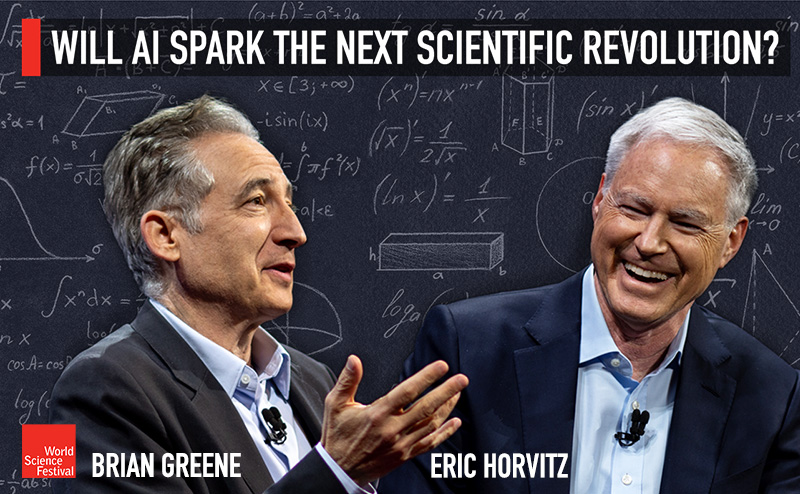

Brian Greene sits down with theoretical physicist Rafael Bousso to explore some of the deepest puzzles in modern physics. Their conversation centers on the black hole information paradox, one of the most important challenges in theoretical physics. If quantum mechanics says information can never be destroyed, how can black holes, once thought to erase everything that falls into them, be reconciled with that principle? Bousso discusses recent ideas suggesting that black holes may return information to the universe, raising the possibility that the smooth event horizon predicted by general relativity may give way to new physics such as “firewalls.” Along the way, Greene and Bousso reflect on how physicists think about theory, evidence, and discovery. The discussion also touches on the multiverse, the limits of current experiments, and how artificial intelligence may influence the future of scientific research. This conversation offers a window into the frontier of modern physics, where black holes, quantum theory, and gravity converge in the search for a deeper understanding of the universe.
This program is part of the Rethinking Reality series, supported by the John Templeton Foundation.
You don’t have a lot of patience for people who worry about what’s real. You should just go forward and calculate and try to understand things concretely from that perspective. But ultimately, would you not put the goal as trying to understand what’s real and what’s really out there?
Of course. It’s just that my definition of what is real is what we can verify with experiments. Now, we could spend forever time discussing whether these experiments are real, and that to me is a meaningless discussion.
Hey everyone. Welcome to today’s conversation. I’m so pleased to welcome back Raphael Bousso, who is the chancellor chair in physics at University of California Berkeley. A friend of mine. I’m proud to call him a friend. I’ve known him for, I don’t know, 30 years, something like that, and always enjoy having conversations with him. So welcome, Raphael.
Thanks, Brian, for having me back.
Absolutely. And it is in fact back. You were with us in a one-on-one live conversation that we did, I don’t know, maybe 10, 11, 12 months ago, something like that. I can’t remember the exact date. It generated a lot of interest, a lot of response from the audience, which motivated me the other day to ask you to come back so that you could address some of the questions that people asked, some of the things that we discussed, but perhaps we didn’t go as far as we might. And so if it’s okay with you, I would just jump in and give that a whirl.
One of the things that we discussed last we were together… And look, for the audience, we’ll try to fill in a little bit of background so that even if you missed the first conversation, you can still get a lot out of this one. But you had noted, Raphael, that you were impressed, I think as many of us are, that quantum mechanics doesn’t have any cracks in it. It really works and it’s not some obvious thing that is in need of repairing, but some of the audience asked whether the quantum measurement problem should be characterized as a crack. It’s been with us for a long time. How do you go from the probabilities of the math to the definite reality of experience? Are we downplaying that too much if we don’t consider it as a possible crack?
I don’t want to discourage anyone from thinking about it. I think it’s arguably something that feels incomplete. We would like to understand it better. It’s not a crack in the same way, I would argue, as we might say general relativity has cracks or other theories in the past had pathologies to them where we could just see the theory break down on its own terms. You would follow it to some bitter end and there, like in general activity, for example, you see that there are singularities, and a little bit before you get to those singularities, you have sharp arguments that the theory as formulated by Einstein should just not even be approximately valid.
I think we discussed last time, so there might even be arguments that it breaks down a lot earlier than that, but the point is just that you have a place where you can go, that you can identify very sharply where you can say, “Here, the theory does not make sense.” So I would say the measurement problem isn’t like that. It’s not that… We use quantum mechanics all the time. The measurement problem isn’t stopping us from using it. We make great predictions and verify them and so on. So you can’t argue that the theory is just always wrong. And it’s not like you can go to some particular place where you can then say, “Oh, now quantum mechanic stops making sense because of the measurement problem.” At least I’m not aware of such an argument.
I would think of it more as a confusion, maybe an incompleteness. I think people disagree. I think I’m not prepared to have a strong opinion on that, which it is, how big of a gap should we think this really is, but it’s not a crisis in the same sense as like, “Oh, deep inside a black hole, we need something other than general alternative.”
Yeah. I don’t want to belabor the point too much, but what do you think about some people who think about this issue and say, “Well, maybe we shouldn’t call quantum mechanics a theory in the usual sense that we use that word because the missing piece from quantum measurement means that we can’t really talk about how the theory describes the world as we experience it”? And that’s usually what a theory is meant to do. There’s that transition stage where you and I and all working physicists, we know what we do. We say, implicitly, we go from the probabilistic predictions to some definite outcome and all we need to do is talk about the frequency of getting one result or another. And we’re happy that those frequencies are Born out by observation. But some would say it’s not even a theory without giving the full set of steps from the mathematical description to the thing that you actually measure in the laboratory.
Does that resonate with you at all or you think that’s just pushing it too far?
I feel that’s pushing it too far. At least my point of view would be that in physics, what we call a theory is a set of rules which by themselves don’t need to have a justification that allow us to make quantitative predictions that we can then test and experiments. I don’t see this rule, the Born rule, for example, that you have been alluding to, I think without naming it, that the fact that quantum mechanics allows us to make probabilistic predictions that we have to check by repeating experiments many times and seeing if the outcomes start being according to the theory, like if you throw dice and after a long while, you’d want every number to come up about the same number of times. Predictions like that, that’s how we test the theory, and the rule that lets us make these probabilistic predictions is at the heart of what I think people call the measurement problem.
I think the issue here is not whether imposing such a rule as part of the instructions for how the theory works somehow doesn’t make it a theory. I feel that would be just like criticizing any other theory for one of its seemingly arbitrary ingredients that nevertheless do the magic trick of then predicting correctly what experiments see. I guess I would think of this question of the Born rule as one where people feel like it should come out of something else. It shouldn’t be the last word. It should maybe either come out of the other axioms or fundamental ingredients of quantum mechanics, or we should perhaps one day arrive at a deeper understanding of where this rule comes from rather than just having it in our list of instructions. But I would say that’s the sense in which it might be an incompleteness. You could do better, you could go deeper, but that was true for most of our theories, that we ended up doing better and going deeper and that didn’t mean they were not theories.
Yeah, yeah. And of course, then it’s also a matter of picking one of the many results that the Born rule only describes probabilistically, why did you get one as opposed to any other? And of course, the many world’s approaches that you don’t get one, you get many of them, just in different realities. But there is a long history of people trying to see if the Born rule could be derived from the rest of the axioms in the theory.
Sidney Coleman had an approach, famous physicist from Harvard, that many of us grew up with in learning his way of thinking about the world. He had an approach of trying to argue that the dominant result that an observer would find would follow the Born rule so long as you looked at the other actions of quantum mechanics and pushed it all forward. Have you seen anything that you feel is promising? That approach ultimately did not work. It came close, but it seemed to assume the result is part of its analysis, so it really was circular. What do you think? Is it promising that we’ll one day be able to start with the smaller set of axioms and come to the realization that the square of the wave function, the probability wave should give rise to these frequencies in experiments?
I guess I have to give you a sociological answer to that.
Sure. Yeah, yeah.
I think it’s not a subject on which I’m currently particularly engaged in trying to… I don’t go to work and try to derive the Born rule from the other axioms of quantum mechanics, at least not on a typical day. And so I could tell you that, first of all, I agree with your… I have the same impression that people have tried this, that none of those attempts really feel like you can sink your teeth in it and everything holds together and it’s not circular. I feel like a lot of these attempts, they feel more like consistency checks, that the Born rule doesn’t run into any kind of contradictions with itself or the rest of quantum mechanics. And that’s a valuable thing to know and to check, but I agree with your impression that it hasn’t actually been done.
I would love to see some progress on this issue, but just speaking for myself… As scientists, we always have to pick what is an important problem, but also a problem where we think we’re capable of making progress, and there are maybe concrete ideas around maybe there’s a sharp paradox somewhere that we can try to resolve or there’s no ways of thinking about a particular issues that have perhaps grown out of a different field of physics and that we can learn from. And then we decide, okay, this is what I’m going to spend my time on because that’s how I know I can be productive, as opposed to just sitting for seven years in front of my desk and going, “Huh, I wonder how the Born rule comes about.”
And so this is probably an important problem. It is just, in my assessment, not one that I feel I’m likely to make progress on if I devoted all my time to it.
Yeah, yeah, for sure. Another remark that you made that got our audience talking among themselves, you said that you don’t have a lot of patience for people who worry about what’s real. You should just go forward and calculate and try to understand things concretely from that perspective, but do you really feel that way? In other words, maybe another way of saying it is you do physics, presumably, you love it, you enjoy trying to understand things about the natural world and so forth, but ultimately, would you not put the goal as trying to understand what’s real and what’s really out there? Maybe not in the midst of one’s work, but the overall goal of our project to be that?
Of course. It’s just that I think there’s a tautology involved in that statement. My definition of what is real is what we can verify with experiments. And my definition of a good theory would be one which explains as many of these experiments as possible, with as few ingredients as possible, as accurately as possible. And those three criteria are literally also what defines progress in science. When we unify theories, usually what happens is we describe more things more accurately with fewer ingredients. Now we could spend forever time discussing whether these ingredients are real, somehow in addition or on top of the fact that they explain all these experiments, and that to me is a meaningless discussion. I have no idea what that even is supposed to mean.
And moreover, we set ourselves up for failure and for succumbing to post-modernist blabber, when we insist that the particular concepts or notions that currently are dominant in our theories are somehow real and the final thing. That has never yet happened in physics. The greatest breakthroughs in science, let’s take Newton’s discovery, that the heavens and the terrestrial phenomena are the same thing, which is just unbelievable. He comes up with this idea of a gravitational force that explains how the apple falls and how the planets move. And that force, first of all, it’s some mathematical construct. It’s a trick for doing calculations. You could’ve complained back then that Newton had no idea what this force really is.
Worse than that, we now have a different theory in which gravity isn’t a force, and which nevertheless, despite the fact that we’re using this completely different language where it’s the curvature of space and time, and these things are dynamical, and we’re on a stage that distorts itself, amazingly, the predictions for experiments, at least the ones that Newton had access to, are the same, almost exactly the same. They’re a little more accurate, but Newton couldn’t make those distinctions. So the force isn’t the thing that was real about what Newton did. What was real about what Newton did was that he was able to explain the motions of the planets and how an apple falls, and we’re still sending rockets around to all sorts of places in the solar system and using those equations, and they were great.
So that’s why I’m resistant to this notion of real as something that has a meaning independent of experiments say it.
Right. But it certainly affects the story that you tell, the narrative that you tell, right? So in Newton’s days, the narrative would’ve been invoking that notion of a gravitational force. And then after Einstein, the narrative that we tell, it’s a very different story in terms of warps and curves and space and time.
Do you buy into the narrative as telling you something real about the world? Or do you say the narrative is simply the story, in a given temporal epoch, that’s the best way of describing the data, and that’s as far as you’d be willing to go?
Well, let’s take the planets.
Yeah, sure.
Let’s go all the way back to the ancients and they were looking at these dots in the sky. They didn’t even know what those dots are. They didn’t know these things were rocks or balls of gas or something. They had absolutely no idea. They were just dots in the sky, and they still found it fascinating to try to account for where those dots were at any given night and come up with schemes for predicting where they are, and they actually did pretty well. And if they-
… were predicting where they are, and they actually did pretty well. And if they hadn’t made some stupid mistakes, they would’ve done fabulously well. And then later you discover that these things are rocks and balls of gas. It doesn’t change the fact that they still move in the sky in that way, that even the ancients had a pretty good descriptions off. It doesn’t change the world, the observations you make, that now you have a new language for this. Oh, these are rocks and balls of gas going around the sun. Now, when Newton came up with this force, now we understand a little bit better why they go around the sun. We can actually calculate some corrections to, let’s say, not just the ancient ideas like the Ptolemaic system, but also Kepler’s laws. We can take into account that Jupiter, I don’t know, has its own gravitational attraction and distorts the planetary orbits a little bit and so on.
We can explain more phenomena, but it doesn’t change the fact that these are still dots and it’s moving around in the sky. Sure. So I feel like our understanding of the world is enriched by these new languages. And then when we think of gravity as curvature of space-time, my understanding of the world is enriched by the fact that I now understand that also galaxies moving away from each other, the universe expanding, black holes and so on, that those phenomena exist and that we’re able to describe them. And that when we do that, we can do it in a language which can still explain how the planets move and how the apple falls and everything is under one roof. I find that incredibly satisfying and I find it even more satisfying. And that’s what I think got me into science, how not obvious it is, how nature works.
It’s not obvious and it’s not obvious in a way where you can’t just sit in your armchair and say, “Oh, I feel like nature should work this or that way.” It’s blood, sweat, and tears, you have to do a lot of experiments. And sometimes you get dragged kicking and screaming to a description that works better. And that in this, I think fairly objective sense, is better. It describes more things with fewer ingredients more accurately. And that’s what gets me up in the morning, not whether this or that force is real or whether I really think that space-time is the final word.
Sure.
Yeah.
No, I totally agree. And I never lose the feeling of wonder that the human brain, which evolved for very specific purpose to survive in the ancestral world, to get the next meal, to get shelter and so on, somehow is capable of finding these non-obvious patterns in the workings of nature and codifying them in mathematical laws. That to me is just stupendous that we should all be deeply proud of ourselves that we’re able to do that at all. But carrying on with the theme of gravity, another thing that you emphasized last time we spoke was this idea of gravity as the oracle, this capacity of gravity to give insight into questions that, at first sight, you wouldn’t think gravity should be able to give you insight into, especially things that have some quantum influence as part of them. Can you just quickly remind us of that notion of gravity being able to do that?
And I don’t know if there’s a specific example that you like to use to make it as concrete as possible, or gravity gives you insight that you wouldn’t have thought it should be able to do.
Yeah. I think we talked about this quite a bit last time, and so I apologize for maybe repeating myself.
No, not at all. Not at all.
[inaudible 00:20:57] exactly what examples I gave. But I think at least in hindsight, the first and most striking example was this discovery 50 years ago that black holes have a specific entropy, a specific number of quantum states that are associated with them. And a temperature at which they radiate, which is remarkable because you don’t normally know what the entropy of any quantum system is unless you have it in your lab or somebody told you exactly what it’s microscopically made of. Those are the two ways you can know how many states a system has, how many ways it can basically, if it’s a crystal, how many ways can the atoms wiggle in it, things like that. For black holes, we don’t have either of those ways of accessing this information. And yet there are persuasive arguments that we know exactly how many quantum states it has. And that those are basically, they are based on asking general relativity in clever ways about those numbers.
And it seems a little bit irregular because, well, for one thing, there are no other forces of nature that work that way. We can’t ask classical electromagnetism about how many states photons have and so on. That’s something that had to be observed. And we had to put it into the quantum version of electromagnetism pretty much by hand after making those observations. And for gravity, that doesn’t seem to be the case. And I guess what happened in the last 50 years, very slowly initially, and now at an exponential rate, I would say, is we’ve learned better and better how to ask gravity those kinds of questions that allow it to be an oracle and spit out knowledge about the quantum world that naively it should not have. I think about 25 years later in ’99, I had some ideas about how gravity knows about the quantum states of matter, which you can check, they work, but again, it’s unclear why it works, how it works.
You’d like to understand better how this works under the hood. Much more recently, people have been able to show that black holes return information, again, just by asking what is called the gravitational path integral. It’s a way of feeding classical gravity through a quantum formalism without really having a full quantum gravity theory. And it reproduces a specific, very quantitative, highly technical result called the page curve that tells you that black holes do in fact release information contrary to what Stephen Hawking originally claimed and people had argued about for half a century. And so there’s enormous power in this method. And I hope that we’re at the threshold where we can go from thinking of this as an oracle where you spend a lot of time trying to figure out how to frame the question and feed it in just the right way to more of a industrial scale discovery tool. The rate of progress recently has been such that I feel like we’re sort of on the cusp of that.
And it’s a bit of an unfair question, I guess, because you’ve already mentioned that looking under the hood is a little bit difficult with our current state of knowledge, but do you have a mental mnemonic, a picture, a way of thinking about black hole entropy? Because the natural question that people ask frequently is, if there’s entropy, there’s got to be some degrees of freedom of some kind that carry that entropy. In a gas, it’s the little atoms. In a radiation, it’s the photons. What would play that role for the entropy at the event horizon of a black hole?
That’s a great question. So I would say that for a long time, people had this vision that maybe the black hole from an outside observer’s point of view could be treated really like an ordinary object. That’s actually how this story that I was just reviewing got started. Jacob Beckenstein was worried about what happens if entropy disappears into a black hole. That’s something you only worry about if you think that there should be a description of the black hole from the outside point of view, at least, that is similar to the description of any other objects. Whether my hot cup of tea lands on the surface of Mars or falls into a black hole, it should be a very similar kind of phenomenon with a similar sort of story that we can tell about what happens to the information in the cup of tea and to the disorder and so on.
And that worked. I should emphasize that this is a fairly crazy viewpoint to take for black holes if you are brought up learning general relativity where the horizon of a black hole is just empty space, and the interior of a black hole is a region like any other. And it would be perfectly consistent for some information, disorder, whatever to be there. And if you happen to insist on being outside, well, too bad you don’t have access to it. So saying that there should be a consistent story that allows an external observer to make sense of interactions of matter with black holes as if they were objects. And more than that, to make sense of it by assuming that a black hole is a quantum system with a number of degrees of freedom, or roughly how many atoms or how many ways of wiggling it has, proportional to its horizon area, that’s a very specific claim that I think a priori is really quite wild.
Yeah.
And only in hindsight now we’ve sort of checked it over and over and over and it seems to work, and it’s quite remarkable that it works. Now, for a long time still, people nevertheless didn’t actually think that a black hole was a thing. They didn’t actually think that if you fall into a black hole, you go splat on the horizon of the black hole because general relativity tells you otherwise and should be valid. For at least very large black holes, it should be a very reliable theory.
More recently, in the past 10, 15 years or so, we’ve come to understand that if you want black holes to really behave in every way as ordinary matter objects, and for example, return information, as most of us I think now believe they do, that there seems to be a price that you have to pay for that, which is that you really go splat when you hit the horizon of a black hole, and you don’t go inside, and maybe there is no insight. That going splat is called a firewall. You hit some kind of structure there that’s like the end of the world, perhaps. A localized end of the world. You just can’t go further.
It’s a bit like hitting the surface of a planet, but we don’t know if that’s the final answer, but if that is the final answer, if there is actually no black hole interior, then you would imagine that there is some kind of structure there that contains the degrees of freedom of a black hole and that stores the information when something goes flat on it. It just gets absorbed into the wigglings of that object. The black hole really is like any other object. It’s much, much harder to understand what the-
But do you buy that picture? Where do you stand on that firewall way of looking at things? Because that’s really giving up a key element of general relativity that we’ve come to trust.
Yeah. Yeah. So that’s not something that you do easily. And for a long time, we thought we could say that black holes return information, and yet when you fall in … So naively, the following things are just mathematically true. So Hawking showed that if a black hole, if there’s nothing at the horizon, it behaves as general relativity dictates, then the radiation coming out of a black hole has no information in it. It’s basically garbage. It’s garbage because it’s half of the empty space near the horizon of the black hole and half of empty space is something we call a mixed state and has no information in it.
Now in logic, there’s this thing called the contrapositive. If A implies B, then not B implies not A. It’s a very straightforward inversion of logical statements. And that means that if you insist on information coming out of a black hole, then Hawking’s assumption that there is a vacuum, that the horizon behaves like general relativity and it’s just empty space must be wrong. So why wasn’t that the end of the story? Well, for one thing, it forces you to choose between two things that both seem non-negotiable. As quantum physicists, we can’t have information suddenly disappear. It’s a basic principle of quantum mechanics. That information does not disappear. And there was no good proposal for how you could loosen that principle without completely destroying the entire framework of quantum mechanics. As a general relativist, while their whole theory is built on this thing called the equivalence principle that empty space is the same everywhere, and general relativity predicts that the horizon of black hole should be like empty space anywhere else to an observer who is relatively small compared to the black hole, how could there be some kind of violent structure there?
So neither of those options seemed acceptable. And so for a while, starting in the early ’90s, people thought they could have their cake and eat it. And the way the logic worked, this was called black hole complementarity. And the logic was that, well, suppose I fall into a black hole, I’m going to start by assuming information comes out. So naively, by this contrapositive of Hawking’s result, there should be some violent structure at the horizon. Now I jump in and I don’t see any violent structure, let’s say. How would I tell the person outside that there’s now a contradiction in the laws of physics? Well, I can’t because I’m inside the black hole. So this isn’t as silly as it sounds because there are questions that are just nonsensical because the question itself is forbidden by the laws of physics. For example, I could ask what happens if I go faster than the speed of light.
I can’t really answer that question. The theory doesn’t even allow the question to be asked, the theory that we think is correct, which doesn’t allow this. So similarly, if I can’t, consistent with causality, compare my notebook with that of an outside observer, then maybe it’s one of those questions. And it shouldn’t be asked, and the laws of physics don’t have to contort themselves to make it somehow consistent and compare those two notebooks. So that seemed like a pretty nice way out. And I actually grew up around the time when this picture was becoming quite… I mean, grew up in the physics world. So I kind of bought into it. And so I was very shocked when in 2012, a group of scientists, Almheiri, Marolf, Polchinski and Sully, known as AMPS by the acronym of the first letters of the authors, when they showed that, in fact, the assumption of unitarity and of a smooth horizon is inconsistent even according to what one observer can check and verify.
So you can start with this assumption that you have your cake and eat it, and you can then follow a certain experimental protocol that will result in a single observer holding an impossible quantum state in their lab, a state that’s just mathematically impossible. And so now you’re sitting there, okay, so now we’re back to this menu from hell where you have to pick one of the items that neither of which seem remotely acceptable. My own view, so the reason I said all this is that I want to emphasize that we’re all disgusted…
I said all this is that I want to emphasize that we’re all disgusted by these options. It’s not like, “Oh, I don’t care about general relativity. Let there be firewalls.” It’s absolutely mind blowing if that’s the case.
Nevertheless, I agree with the original assessment in that paper by AMPS, which however some of the authors have since abandoned, that firewalls are the most conservative of all these radical possibilities. In particular, the evidence that information comes out of a black hole and is not lost has gotten much stronger. Even since this AMPS paper through one of those results I alluded to earlier where people were able to compute this Page Curve using the gravitational [inaudible 00:34:46] .
Which basically shows that the information is coming out if we wait long enough.
Yeah. The main game in town, so I’m actually, I think, a bit of an outlier.
Yeah, I was going to say. Yeah.
Firewalls are the most likely possibility right now. The main game in town is something called ER equals EPR, which is something I also … An idea I follow. It’s basically trying to get back to complementarity, to having your cake and eating it with a bit of a retreat involved because this AMPS paper wasn’t wrong and they told you exactly how to verify that this idea doesn’t work. And so the new strategy seems to be to say, okay, but whenever we’re not doing the thing that AMPS told us to do to verify that complementarity doesn’t work, we’re just going to say that it works anyway. And it’s only when you do the bad thing that you somehow destroy the … So this is highly non-standard. This is not how quantum mechanics normally works.
And the reason that I don’t like it, there’s several reasons. I’ve written many papers on this. But I think the basic reason why I don’t like it is that it seems unprincipled to me. Generally in physics, when you have two principles colliding, one of them goes completely to save the other one completely. And that’s not, in my view, what these approaches are doing. They’re saying, “Oh yeah, there are actually circumstances where general relativity at the horizon of a large old black hole where it should have been totally valid.” I mean where it breaks down. It does happen. Namely, for example, if you do these kinds of experiments that AMPs identified in their way of showing that the smooth horizon is not consistent with information coming out. So you’ve already kind of conceded.
But there is something kind of beautiful about it too. I’m wondering, just for the benefit of the audience, so ER, maybe wormholes and entanglement, can you just give a summary of this alternate approach that doesn’t need firewalls? And then I think people understand your critique more fully.
Yeah. Already in the old complementarity story, the idea was that the interior of the black hole and the Hawking radiation that comes out of the black hole are in some sense the same thing. That’s a slight oversimplification. But for example, when the black hole is sufficiently old, that’s basically the claim. And the consistency of the framework revolved on the idea that you can’t access … It’s like, have you ever seen person A and person B together? Oh, maybe they’re secretly the same. So that idea is consistent only so long as you actually never see person A and person be together. Once you do, then you’d be in trouble.
Initially, it looked like you couldn’t because of these causality arguments. If you’re inside the black hole, you can go look at the Hawking radiation anymore and so on. The AMPS argument was basically a clever way of bringing those two people together in the same place by extracting a … But you can’t bring the whole Hawking radiation to the black hole. It’d be too much and it would disturb everything. But you extract a particular piece of it and bring it to the black hole, and then you run into this problem of having the two people together in one place and they can no longer be the same.
So ER equals EPR basically goes back to saying they’re the same, but when you do this fairly complicated, actually, experiment that extracts a particular important piece from the Hawking radiation that you then bring to the black hole with you when you jump in, the claim is that when you perform this experiment, you are somehow non-locally changing the interior of the black hole to no longer give you the vacuum at the horizon.
Now, this is very non-standard because, for example, the claim is not that if I, for example, measure the entire Hawking radiation or the Hawking radiation runs into galactic dust or into a brick wall or something, that is not supposed to do anything to the black hole interior, even though the black hole interior, after all, we’re saying it’s the same thing as Hawking radiation. So horrible things can happen to the Hawking radiation, and yet proponents of this idea would claim that this does not disturb the black hole interior at all. And I can jump in and see a completely smooth horizon. It’s only when I do specific, very complicated things that this happened. There is no precedent for that in physics. That in itself, okay, fine. I mean, we have a big problem here, so maybe some new precedents can be set.
The problem I feel, again, is that first of all, you’re already conceding the validity of general relativity in a place where it should have been valid if you do particular complicated experiments, and I don’t understand why general activity should care about the experiments I do on this Hawking radiation. Worse than that, in the 10, 15 years that these ideas have been around, I feel we haven’t gone much beyond articulating a wishlist of what is supposed to happen in certain extreme circumstances. For example, if I do nothing to the Hawking radiation, you want the horizon to be smooth if I jump in. If I do this very specific thing, then you kind of have to concede something bad has to happen, so you concede it. But what about in between? What if I run this quantum computer that extracts this particular piece of information from Hawking radiation for 95% of the runtime? I haven’t quite gotten it yet.
Right.
But at which point does the horizon start responding to this?
What if I have a bunch of radiation that looks like Hawking radiation, I could have prepared this radiation in a state that would be exactly what a black hole produced, but it’s not? And now I perform these kind of experiments on it, what happens now? The non-locality that is invoked in these assertions is enormous because the Hawking radiation … So that’s another point. The Hawking radiation is very far from the black hole by distances, enormous compared to the size of the black hole. And yet somehow this is supposed to affect a place that’s sort of simultaneous. It’s not causal. This is something that, in an acausal way affects the properties of the horizon that somebody finds when they jump in. So it could be their friend extracting this piece of information, and EPR would still say that you hit something when you fall into the black hole.
Now, we know from quantum gravity theories that we do have, for example, like AdS-CFT, they’re not great for our universe, but they tell us a lot of the properties of quantum gravity, that non-locality is absolutely something we expect in quantum gravity.
In fact, wouldn’t you say that’s sort of one of the big lessons of the last 20 years?
Absolutely.
Yeah.
But I would only point out that firewalls solve all of these problems with non-locality only on the scale of the horizon of the black hole.
I see. Right.
Where natural dynamics associated with the black hole that could perhaps … I mean, it would be completely novel dynamics, that GR doesn’t tell us that there’s a firewall, that something else would have to tell us this. But this something else would destroy the locality of general relativity only on the scale of the black hole.
Right.
Where actually in terms of timescales, when you’re at the horizon of a big black hole, you’re as far in time from the singularity as the black hole is in size. So it’s not totally crazy to think that the singularity is kind of anticipated in some sense by this kind of non-locality. And you don’t have to answer these questions. You don’t have to answer, “Oh, what if I do this to the radiation? What if I do to add to the radiation? What if the radiation didn’t even come from a black hole? What do I now affect by doing these complicated experiments? Do I destroy space time somewhere else?” All of these questions could have been answered by now, but weren’t.
Why are you an outlier? You make a cogent, convincing argument that this is … And yet I think the general zeitgeist right now is not focused on firewalls. First of all, would you consider it a relatively accurate assessment of the state of collective psychology of physicists thinking about this?
I think I’m more of a skeptic of the [inaudible 00:44:16] CPR than most of my colleagues, including a lot of people whose work I greatly admire, including the authors of this paper.
Sure.
But I wouldn’t agree with your assessment that people aren’t thinking about the firewall problem at all.
No, no, I didn’t mean to say that. Yeah.
I think I’ve been moderately successful in keeping it … Why am I obsessing about this? I’m obsessing about this because a crisis like that is an enormous opportunity in physics. And the worst thing we could do is lull ourselves into a false sense of security and convince ourselves that we’ve somehow solved a problem that is still a glaring paradox, and that will be a missed opportunity on a gigantic scale. And so I feel like we can still profit from thinking about this.
The problem is that, so far, we don’t really have any good candidates. For example, what would be the precise dynamics of a firewall? What would be the microscopic description of it? And so on. And so people take various different angles by which they approach this problem. One of them, for example, is to ask, what about very, very old black holes? Not just old enough that you can complete this argument that AMPS made about firewalls, but much older than that so that the black holes should have reached a particular kind of state in which the complexity of the state is maxed out. And for black holes like that, apparently there seems to be a fairly wide consensus that they probably have firewalls or that they have a large probability for them. It’s another example of how we’ve already conceded the breakdown of general relativity in a number of circumstances. And it seems to me like a relatively low cost at this point to just say, okay, you just always get a firewall and then not have to deal with all these other questions that we haven’t been able to give truly coherent answers to.
Yeah.
But everybody has a different way of thinking about it a little bit, and that’s a good thing. That’s what makes us stronger as scientists, as a group, that people have different methods, different ways of thinking, different biases, and also different sort of taste, like what is ugly and what’s pretty.
Yeah, right.
And so yeah, let 1000 flowers bloom and we’ll talk again in a year.
When we began, you were emphasizing how, in the end of the day, physics is about explaining data observations. And the stories that we tell are interesting, but in the end it’s like what we can predict, measure, observe, and so forth. We’re starting to be able to look at black holes. Is there any hope that the observational story will give us some insight here?
I think realistically with current technology, we would have to get very lucky. We would have to … So first of all, black holes that we see in the universe, it’s very hard to see them in any detail. I mean, this effort to see this famous … There’s this picture of some sort of halo around a black hole that everybody’s probably seen by now that was taken with the Event Horizon Telescope. That was a huge effort, and it’s just some kind of blurry thing.
Right.
So secondly, the environment of black holes, especially the ones that are easy to see, is very violent. They’re easy to see because stuff is falling into them and getting sucked into them, and then that creates all sorts of excitations in the matter near the black hole. What you’re seeing is obviously not the black hole itself. You’re seeing the mayhem that’s going on around it. And that is likely to dominate over any sort of subtle quantum effects. You could ask, what are our chances of seeing Hawking radiation? I’d say nil from the … Because the black holes are growing much faster than they radiate, even just from the cosmic microwave background radiation, it falls into them. So nevertheless, it’s not crazy to think that you could see something.
The question is, if there are firewalls or some complete breakdown of general relativity, where exactly does that breakdown happen? Initially, it seemed like it was possible for that breakdown to happen so close to the horizon that the story of the outside observer would not be changed by firewalls at all, that you would not start noticing that black holes are things unless you really go all the way and try to jump in and go splat instead.
More recently, in part through work by Geoff Penington and myself, we found arguments that the firewalls could actually be a little bit out or should be a little bit outside of the black hole. Not a lot, I’m afraid to say. So for example, for super massive black holes in our universe, they would be about an angstrom, an atoms width outside of the actual horizon, the point of no return. Nevertheless, the mere fact that there’s new physics outside of a black hole is something that could, in principle, make itself known by the interactions of matter with whatever this object is, this firewall. And we would have to … The problem is that we don’t have good models for how matter interacts with such a structure. And in particular, we don’t have a reason to choose this or that specific way for it to interact. In particular, it’s possible that the structure mimics fairly well a situation where a black hole is just a thermal object and things behave exactly as we’d always expected.
So you’d have to get lucky. You’d have to first see a signal. I mean, the experiments would have to, right now, go ahead of theory and you see something that you can’t explain any other-
I’ll go ahead of theory and you see something that you can’t explain any other way going on near black holes. And then you maybe ask, “Okay, could this be modeled by a structure now with more specific properties?” And then maybe you make a prediction for what you should see next and so on. And you’d get science to do its usual back and forth with experiment. Okay, that would be an incredibly beautiful fantasy of something that if we’re unbelievably lucky, could actually happen, but nature would have to be kind to us.
And what do you think about Samir Mathur’s work on fuzzballs, which sort of has a similar feel in the sense that it is much more like a thermal object made of stuff without a traditional horizon? I mean, how does that relate or strike you as a promising or not promising approach?
Yeah. And I’m glad you brought up Samir because I should have perhaps mentioned this earlier. He sort of partly anticipated this famous AMPS paper in that he was kind of out there in the desert saying, “I don’t believe in complementarity. I don’t believe in what … You guys are lying to yourselves that you can have your cake and eat it. It’s not going to happen. It can’t be true if information comes out that there is no kind of modification to general relativity at the horizon of an old black hole.”
Where I think I would depart from some of his claims is that, and where I think AMPS went a lot further is AMPS showed that the structure that needs to be a black hole is quite sharp and violent. And there were specific technical results that were important for demonstrating that, that didn’t appear in Samir’s work. And this makes it impossible for …
Samir, as far as I know, is still, for example, claiming that the localized observer falling into a big black hole won’t notice anything special at the horizon. His modifications were of a much fuzzier, softer nature where the interior of the black hole isn’t exactly what GR says, but somehow if you’re small enough and don’t have enough information, you can’t tell the difference. And that’s, I think, what these fuzzballs were supposed to be.
I think there are different versions of these approaches, and I can’t speak with complete authority to be able to cover all of the different things that have been said in that area, but my impression was that that was the key difference between what Samir said and what people like AMPS said. So Samir was out there early correctly pointing out that something was really off with our story about complementarity and with black holes being fine for infalling observers and yet information comes out. But I think then later, the paths sort of diverge. And I don’t understand the claims that have been made about fuzzballs that they can’t get around this AMPS paradox in the way that they seem to claim they do.
I see. One other small arena, well, big arena in the last few minutes, if you have the patience for it. Another question that has come up frequently, even though I don’t think we discussed it explicitly last time, is the idea of a multiverse. This notion that our universe is one of many, it comes out of many ways of thinking about physics. Quantum mechanics has the many worlds approach to dealing with a quantum measurement problem. Inflationary cosmology has this opportunity to give multiple big bangs, giving multiple universes. And there are other ways that you can think about physics that also take you to the idea of a multiverse.
Where do you think … I mean, there are some who hear the word multiverse and say, “Guys, you’re no longer doing physics. Okay? You’re talking about realms we can’t see.” Certainly my view is, “Hey, if a theory predicts it and the other predictions of the theory have been borne out by observation, maybe you should take this other predictions seriously too, even though you can’t directly measure it.” Where do you come down on this idea?
I agree with what you just said. I think that it’s always the simplicity of the theory that we’re looking at for whether it’s an attractive theory, but it’s not the simplicity of the solutions.
Yes.
So for example, the standard model of particle physics has a bunch of particles. You can list them in a short table. It’s not a huge amount of ingredients, a bunch of particles and forces. And out of those, you can build everything you see around you and lots of things that you don’t see around you too.
If you take one atom from a corner of your table and put it somewhere else, that’s already a different solution of that theory, the standard model. And you can imagine just thinking about that, that there are astronomically many, most of which we’ll never see. That doesn’t make the standard model a bad theory. It’s not a bad theory because it has a lot of different solutions. It’s not a bad theory because most of those solutions will never be realized in the part of the world that we happen to be in and so on. What’s important is that the theory has few ingredients and therefore it’s very predictive and that we can test those predictions.
Now, the reason that we’re having trouble verifying ideas like the multiverse isn’t that theory that some of the theories that lead to such ideas like string theory are actually very simple and that they might have maybe no moveable pieces at all. With the standard model, at least you can sort of dial the masses and various other aspects of these particles.
The theory might be very simple and very rigid, and yet have an enormous number of ways of putting together three-dimensional space out of some higher dimensional setup where you curl up the extra dimensions. That’s an idea that Joe Polchinski and I proposed, and that leads to something called the landscape of string theory in which there are many different kinds of three-dimensional space you can imagine. And they’re actually realized you can think of it as different regions of the universe or different branches of the wave function, but they can be dynamically produced, all these different things the same way that lots of different solutions of the standard model are dynamically produced in our universe in structuralist form and so on.
And what makes this hard to test isn’t the fact that you’re predicting a multiverse or something like that, that there are many possibilities. What makes this hard to test is the same thing that makes quantum gravity hard to connect with experiment, which is that we expect a theory to be simple at very high energies and we don’t have a good way technologically to access those energies.
If today you gave me a microscope or a particle accelerator that can see structures 16 orders of magnitude smaller than what they can do at CERN, we will be able to go look at the extra dimensions. We will be able to see if the deep brains and fluxes and the kind of ingredients that play the role of moving an atom to another place on the table, in Joe Polchinski’s and my idea, whether those things are actually there and whether they’re behaving in the way that the theory says they behave and so on. And once you can check that, then you’re pretty happy with the theory and you’re going to accept its other implications.
So we can’t do that. We’re not going to be able to do that anytime soon, but this is a question not for whether or not you like the … You don’t get to like or not like something. It’s a question of like, “How do we deal as physicists in this era with the fact that we’re trying to understand the world at a level where our technology is so far behind our ability to do direct experiments?” And we have to be enormously careful in how we evaluate our hypotheses, how critical we are of our own ideas.
We can’t just come up with some random models here, random model there and never be able to tell the difference. So we’re all very focused, I think, I hope we are, on consistency. The reason that we’re arguing about things like this firewall paradox is that we’re able to identify some sharp conflict between theories that are very well tested so we can be quite certain that something has to give and maybe it’s guidance. Ultimately, of course, we want to be able to do experiments. Perhaps if we understand quantum gravity well enough, we will understand consequences in some detail that we can test directly.
Yeah. No, it’s hugely important. Yeah.
What a typical three plus one dimensional world actually looks like.
Look like. No, it’s such an important point because I try to make this point often whenever I can. I don’t know that it always is heard, which is it’s not that string theory or these ideas aren’t predictive, it’s that the things that they predict are so far beyond technological reach that we find ourselves in this quandary of dealing purely with the mathematics, but that’s not because the theory’s fundamentally untestable, it’s that it’s testable in realms that technology can’t yet reach. So absolutely vital point.
One final, final question. Have you thought at all, I’m sure you have, about what physics research is going to look like 5 or 10 years from now with AI coming in and taking everything by storm? I’ll give you one quick example. You probably have better examples, but I wrote a paper a few months ago with a few colleagues on non-orientable compactifications. It’s not going to set the world on fire. It’s fun little paper.
I then went home after we finished it. It’s not like we did it in a day, took a long time. This was Janna Levin and Dan Kabat and Massimo Perotti, but I said to myself, “Could I treat ChatGPT like a graduate student and how long would it take it to get to the result that it took four of us to get to?”
And it was interesting, because this involved mathematics that I wasn’t all that familiar with for the audience, not even spin structures, but pin structures over non-orientable manner. I mean, within a half hour, I was able to gently guide the way I would a graduate student over the course of months and months and months and months. Chat got the answer within sort of half an hour. And so many people have other examples too, but it does feel to me that things are going to change. Do you have that expectation or sensation as well?
Yeah, I go back and forth on … There are days when I think, “Oh, the thing will never do anything truly creative and it’s going to be just a useful tool. And, yeah, maybe you can start using it like a grad student and it’ll do some calculations for you and it’ll get better at not making stuff up and it’ll get better at understanding you the first time and so on, but it won’t do anything.” That’s analogous to like, “Oh, I have this great insight how the apple falls is the same as how the planets move.” That kind of thing. Is it capable of those leaps where you’re not just asking it to perform a certain analysis, a certain calculation within a fixed framework that, okay, it’s a bunch of steps, it’s quite maybe complex and wonderful if they can … all right.
And then there are days when I think like, “Okay, the whole thing is based on recognizing patterns.” These great breakthroughs in physics is like a creative way of recognizing a pattern. I mean, to see that apple and planet, okay, that’s … Really, it’s very creative, but it’s a pattern. Ultimately, it’s law of physics is a pattern, so that’s what they’re kind of about. So who knows, maybe we’ll be out of a job in a couple of years.
And then I think, well, maybe I should be happy that if you’d asked me 10 years ago, do I think that I will know what quantum gravity is before I die? I would’ve been rather pessimistic. Are we really going to find the final answer during my lifetime? What are the chances of that? It would be such an accident to live at the time when we finally write the final chapter, at least as far as fundamental physics is concerned. Now, I think, well, maybe it’s no longer out of the question and we’re going to be taught by our AI overlords how it all really works.
Yeah. It’s sort of exciting and scary and a good mix of the two, so we’ll have to see where this goes. Well, but Raphael, thank you so much for spending the time of this again. I have a proposal to make. Maybe we do these conversations annually just to sort of update where things have gone.
Great.
So I think that’s a-
I like it even better when we do it in person in New York.
Yeah, no, definitely, definitely. Anytime you are around, you let me know and we will work it out.
Let’s do that.
But thanks so much for joining us and looking forward to see you sometime soon.
All right. Bye, Brian.
Bye-bye.
Brian Greene sits down with theoretical physicist Rafael Bousso to explore some of the deepest puzzles in modern physics. Their conversation centers on the black hole information paradox, one of the most important challenges in theoretical physics. If quantum mechanics says information can never be destroyed, how can black holes, once thought to erase everything that falls into them, be reconciled with that principle? Bousso discusses recent ideas suggesting that black holes may return information to the universe, raising the possibility that the smooth event horizon predicted by general relativity may give way to new physics such as “firewalls.” Along the way, Greene and Bousso reflect on how physicists think about theory, evidence, and discovery. The discussion also touches on the multiverse, the limits of current experiments, and how artificial intelligence may influence the future of scientific research. This conversation offers a window into the frontier of modern physics, where black holes, quantum theory, and gravity converge in the search for a deeper understanding of the universe.
This program is part of the Rethinking Reality series, supported by the John Templeton Foundation.

Brian Greene is a professor of physics and mathematics at Columbia University, and is recognized for a number of groundbreaking discoveries in his field of superstring theory. His books, The Elegant Universe, The Fabric of the Cosmos, and The Hidden Reality, have collectively spent 65 weeks on The New York Times bestseller list.
Read More
Raphael Bousso is recognized for discovering the general relation between the curved geometry of space-time and its information content, known as the “covariant entropy bound.” This allowed for a precise and general formulation of the holographic principle, which is believed to underlie the unification of quantum theory and Einstein’s theory of gravity.
Read MoreYou don’t have a lot of patience for people who worry about what’s real. You should just go forward and calculate and try to understand things concretely from that perspective. But ultimately, would you not put the goal as trying to understand what’s real and what’s really out there?
Of course. It’s just that my definition of what is real is what we can verify with experiments. Now, we could spend forever time discussing whether these experiments are real, and that to me is a meaningless discussion.
Hey everyone. Welcome to today’s conversation. I’m so pleased to welcome back Raphael Bousso, who is the chancellor chair in physics at University of California Berkeley. A friend of mine. I’m proud to call him a friend. I’ve known him for, I don’t know, 30 years, something like that, and always enjoy having conversations with him. So welcome, Raphael.
Thanks, Brian, for having me back.
Absolutely. And it is in fact back. You were with us in a one-on-one live conversation that we did, I don’t know, maybe 10, 11, 12 months ago, something like that. I can’t remember the exact date. It generated a lot of interest, a lot of response from the audience, which motivated me the other day to ask you to come back so that you could address some of the questions that people asked, some of the things that we discussed, but perhaps we didn’t go as far as we might. And so if it’s okay with you, I would just jump in and give that a whirl.
One of the things that we discussed last we were together… And look, for the audience, we’ll try to fill in a little bit of background so that even if you missed the first conversation, you can still get a lot out of this one. But you had noted, Raphael, that you were impressed, I think as many of us are, that quantum mechanics doesn’t have any cracks in it. It really works and it’s not some obvious thing that is in need of repairing, but some of the audience asked whether the quantum measurement problem should be characterized as a crack. It’s been with us for a long time. How do you go from the probabilities of the math to the definite reality of experience? Are we downplaying that too much if we don’t consider it as a possible crack?
I don’t want to discourage anyone from thinking about it. I think it’s arguably something that feels incomplete. We would like to understand it better. It’s not a crack in the same way, I would argue, as we might say general relativity has cracks or other theories in the past had pathologies to them where we could just see the theory break down on its own terms. You would follow it to some bitter end and there, like in general activity, for example, you see that there are singularities, and a little bit before you get to those singularities, you have sharp arguments that the theory as formulated by Einstein should just not even be approximately valid.
I think we discussed last time, so there might even be arguments that it breaks down a lot earlier than that, but the point is just that you have a place where you can go, that you can identify very sharply where you can say, “Here, the theory does not make sense.” So I would say the measurement problem isn’t like that. It’s not that… We use quantum mechanics all the time. The measurement problem isn’t stopping us from using it. We make great predictions and verify them and so on. So you can’t argue that the theory is just always wrong. And it’s not like you can go to some particular place where you can then say, “Oh, now quantum mechanic stops making sense because of the measurement problem.” At least I’m not aware of such an argument.
I would think of it more as a confusion, maybe an incompleteness. I think people disagree. I think I’m not prepared to have a strong opinion on that, which it is, how big of a gap should we think this really is, but it’s not a crisis in the same sense as like, “Oh, deep inside a black hole, we need something other than general alternative.”
Yeah. I don’t want to belabor the point too much, but what do you think about some people who think about this issue and say, “Well, maybe we shouldn’t call quantum mechanics a theory in the usual sense that we use that word because the missing piece from quantum measurement means that we can’t really talk about how the theory describes the world as we experience it”? And that’s usually what a theory is meant to do. There’s that transition stage where you and I and all working physicists, we know what we do. We say, implicitly, we go from the probabilistic predictions to some definite outcome and all we need to do is talk about the frequency of getting one result or another. And we’re happy that those frequencies are Born out by observation. But some would say it’s not even a theory without giving the full set of steps from the mathematical description to the thing that you actually measure in the laboratory.
Does that resonate with you at all or you think that’s just pushing it too far?
I feel that’s pushing it too far. At least my point of view would be that in physics, what we call a theory is a set of rules which by themselves don’t need to have a justification that allow us to make quantitative predictions that we can then test and experiments. I don’t see this rule, the Born rule, for example, that you have been alluding to, I think without naming it, that the fact that quantum mechanics allows us to make probabilistic predictions that we have to check by repeating experiments many times and seeing if the outcomes start being according to the theory, like if you throw dice and after a long while, you’d want every number to come up about the same number of times. Predictions like that, that’s how we test the theory, and the rule that lets us make these probabilistic predictions is at the heart of what I think people call the measurement problem.
I think the issue here is not whether imposing such a rule as part of the instructions for how the theory works somehow doesn’t make it a theory. I feel that would be just like criticizing any other theory for one of its seemingly arbitrary ingredients that nevertheless do the magic trick of then predicting correctly what experiments see. I guess I would think of this question of the Born rule as one where people feel like it should come out of something else. It shouldn’t be the last word. It should maybe either come out of the other axioms or fundamental ingredients of quantum mechanics, or we should perhaps one day arrive at a deeper understanding of where this rule comes from rather than just having it in our list of instructions. But I would say that’s the sense in which it might be an incompleteness. You could do better, you could go deeper, but that was true for most of our theories, that we ended up doing better and going deeper and that didn’t mean they were not theories.
Yeah, yeah. And of course, then it’s also a matter of picking one of the many results that the Born rule only describes probabilistically, why did you get one as opposed to any other? And of course, the many world’s approaches that you don’t get one, you get many of them, just in different realities. But there is a long history of people trying to see if the Born rule could be derived from the rest of the axioms in the theory.
Sidney Coleman had an approach, famous physicist from Harvard, that many of us grew up with in learning his way of thinking about the world. He had an approach of trying to argue that the dominant result that an observer would find would follow the Born rule so long as you looked at the other actions of quantum mechanics and pushed it all forward. Have you seen anything that you feel is promising? That approach ultimately did not work. It came close, but it seemed to assume the result is part of its analysis, so it really was circular. What do you think? Is it promising that we’ll one day be able to start with the smaller set of axioms and come to the realization that the square of the wave function, the probability wave should give rise to these frequencies in experiments?
I guess I have to give you a sociological answer to that.
Sure. Yeah, yeah.
I think it’s not a subject on which I’m currently particularly engaged in trying to… I don’t go to work and try to derive the Born rule from the other axioms of quantum mechanics, at least not on a typical day. And so I could tell you that, first of all, I agree with your… I have the same impression that people have tried this, that none of those attempts really feel like you can sink your teeth in it and everything holds together and it’s not circular. I feel like a lot of these attempts, they feel more like consistency checks, that the Born rule doesn’t run into any kind of contradictions with itself or the rest of quantum mechanics. And that’s a valuable thing to know and to check, but I agree with your impression that it hasn’t actually been done.
I would love to see some progress on this issue, but just speaking for myself… As scientists, we always have to pick what is an important problem, but also a problem where we think we’re capable of making progress, and there are maybe concrete ideas around maybe there’s a sharp paradox somewhere that we can try to resolve or there’s no ways of thinking about a particular issues that have perhaps grown out of a different field of physics and that we can learn from. And then we decide, okay, this is what I’m going to spend my time on because that’s how I know I can be productive, as opposed to just sitting for seven years in front of my desk and going, “Huh, I wonder how the Born rule comes about.”
And so this is probably an important problem. It is just, in my assessment, not one that I feel I’m likely to make progress on if I devoted all my time to it.
Yeah, yeah, for sure. Another remark that you made that got our audience talking among themselves, you said that you don’t have a lot of patience for people who worry about what’s real. You should just go forward and calculate and try to understand things concretely from that perspective, but do you really feel that way? In other words, maybe another way of saying it is you do physics, presumably, you love it, you enjoy trying to understand things about the natural world and so forth, but ultimately, would you not put the goal as trying to understand what’s real and what’s really out there? Maybe not in the midst of one’s work, but the overall goal of our project to be that?
Of course. It’s just that I think there’s a tautology involved in that statement. My definition of what is real is what we can verify with experiments. And my definition of a good theory would be one which explains as many of these experiments as possible, with as few ingredients as possible, as accurately as possible. And those three criteria are literally also what defines progress in science. When we unify theories, usually what happens is we describe more things more accurately with fewer ingredients. Now we could spend forever time discussing whether these ingredients are real, somehow in addition or on top of the fact that they explain all these experiments, and that to me is a meaningless discussion. I have no idea what that even is supposed to mean.
And moreover, we set ourselves up for failure and for succumbing to post-modernist blabber, when we insist that the particular concepts or notions that currently are dominant in our theories are somehow real and the final thing. That has never yet happened in physics. The greatest breakthroughs in science, let’s take Newton’s discovery, that the heavens and the terrestrial phenomena are the same thing, which is just unbelievable. He comes up with this idea of a gravitational force that explains how the apple falls and how the planets move. And that force, first of all, it’s some mathematical construct. It’s a trick for doing calculations. You could’ve complained back then that Newton had no idea what this force really is.
Worse than that, we now have a different theory in which gravity isn’t a force, and which nevertheless, despite the fact that we’re using this completely different language where it’s the curvature of space and time, and these things are dynamical, and we’re on a stage that distorts itself, amazingly, the predictions for experiments, at least the ones that Newton had access to, are the same, almost exactly the same. They’re a little more accurate, but Newton couldn’t make those distinctions. So the force isn’t the thing that was real about what Newton did. What was real about what Newton did was that he was able to explain the motions of the planets and how an apple falls, and we’re still sending rockets around to all sorts of places in the solar system and using those equations, and they were great.
So that’s why I’m resistant to this notion of real as something that has a meaning independent of experiments say it.
Right. But it certainly affects the story that you tell, the narrative that you tell, right? So in Newton’s days, the narrative would’ve been invoking that notion of a gravitational force. And then after Einstein, the narrative that we tell, it’s a very different story in terms of warps and curves and space and time.
Do you buy into the narrative as telling you something real about the world? Or do you say the narrative is simply the story, in a given temporal epoch, that’s the best way of describing the data, and that’s as far as you’d be willing to go?
Well, let’s take the planets.
Yeah, sure.
Let’s go all the way back to the ancients and they were looking at these dots in the sky. They didn’t even know what those dots are. They didn’t know these things were rocks or balls of gas or something. They had absolutely no idea. They were just dots in the sky, and they still found it fascinating to try to account for where those dots were at any given night and come up with schemes for predicting where they are, and they actually did pretty well. And if they-
… were predicting where they are, and they actually did pretty well. And if they hadn’t made some stupid mistakes, they would’ve done fabulously well. And then later you discover that these things are rocks and balls of gas. It doesn’t change the fact that they still move in the sky in that way, that even the ancients had a pretty good descriptions off. It doesn’t change the world, the observations you make, that now you have a new language for this. Oh, these are rocks and balls of gas going around the sun. Now, when Newton came up with this force, now we understand a little bit better why they go around the sun. We can actually calculate some corrections to, let’s say, not just the ancient ideas like the Ptolemaic system, but also Kepler’s laws. We can take into account that Jupiter, I don’t know, has its own gravitational attraction and distorts the planetary orbits a little bit and so on.
We can explain more phenomena, but it doesn’t change the fact that these are still dots and it’s moving around in the sky. Sure. So I feel like our understanding of the world is enriched by these new languages. And then when we think of gravity as curvature of space-time, my understanding of the world is enriched by the fact that I now understand that also galaxies moving away from each other, the universe expanding, black holes and so on, that those phenomena exist and that we’re able to describe them. And that when we do that, we can do it in a language which can still explain how the planets move and how the apple falls and everything is under one roof. I find that incredibly satisfying and I find it even more satisfying. And that’s what I think got me into science, how not obvious it is, how nature works.
It’s not obvious and it’s not obvious in a way where you can’t just sit in your armchair and say, “Oh, I feel like nature should work this or that way.” It’s blood, sweat, and tears, you have to do a lot of experiments. And sometimes you get dragged kicking and screaming to a description that works better. And that in this, I think fairly objective sense, is better. It describes more things with fewer ingredients more accurately. And that’s what gets me up in the morning, not whether this or that force is real or whether I really think that space-time is the final word.
Sure.
Yeah.
No, I totally agree. And I never lose the feeling of wonder that the human brain, which evolved for very specific purpose to survive in the ancestral world, to get the next meal, to get shelter and so on, somehow is capable of finding these non-obvious patterns in the workings of nature and codifying them in mathematical laws. That to me is just stupendous that we should all be deeply proud of ourselves that we’re able to do that at all. But carrying on with the theme of gravity, another thing that you emphasized last time we spoke was this idea of gravity as the oracle, this capacity of gravity to give insight into questions that, at first sight, you wouldn’t think gravity should be able to give you insight into, especially things that have some quantum influence as part of them. Can you just quickly remind us of that notion of gravity being able to do that?
And I don’t know if there’s a specific example that you like to use to make it as concrete as possible, or gravity gives you insight that you wouldn’t have thought it should be able to do.
Yeah. I think we talked about this quite a bit last time, and so I apologize for maybe repeating myself.
No, not at all. Not at all.
[inaudible 00:20:57] exactly what examples I gave. But I think at least in hindsight, the first and most striking example was this discovery 50 years ago that black holes have a specific entropy, a specific number of quantum states that are associated with them. And a temperature at which they radiate, which is remarkable because you don’t normally know what the entropy of any quantum system is unless you have it in your lab or somebody told you exactly what it’s microscopically made of. Those are the two ways you can know how many states a system has, how many ways it can basically, if it’s a crystal, how many ways can the atoms wiggle in it, things like that. For black holes, we don’t have either of those ways of accessing this information. And yet there are persuasive arguments that we know exactly how many quantum states it has. And that those are basically, they are based on asking general relativity in clever ways about those numbers.
And it seems a little bit irregular because, well, for one thing, there are no other forces of nature that work that way. We can’t ask classical electromagnetism about how many states photons have and so on. That’s something that had to be observed. And we had to put it into the quantum version of electromagnetism pretty much by hand after making those observations. And for gravity, that doesn’t seem to be the case. And I guess what happened in the last 50 years, very slowly initially, and now at an exponential rate, I would say, is we’ve learned better and better how to ask gravity those kinds of questions that allow it to be an oracle and spit out knowledge about the quantum world that naively it should not have. I think about 25 years later in ’99, I had some ideas about how gravity knows about the quantum states of matter, which you can check, they work, but again, it’s unclear why it works, how it works.
You’d like to understand better how this works under the hood. Much more recently, people have been able to show that black holes return information, again, just by asking what is called the gravitational path integral. It’s a way of feeding classical gravity through a quantum formalism without really having a full quantum gravity theory. And it reproduces a specific, very quantitative, highly technical result called the page curve that tells you that black holes do in fact release information contrary to what Stephen Hawking originally claimed and people had argued about for half a century. And so there’s enormous power in this method. And I hope that we’re at the threshold where we can go from thinking of this as an oracle where you spend a lot of time trying to figure out how to frame the question and feed it in just the right way to more of a industrial scale discovery tool. The rate of progress recently has been such that I feel like we’re sort of on the cusp of that.
And it’s a bit of an unfair question, I guess, because you’ve already mentioned that looking under the hood is a little bit difficult with our current state of knowledge, but do you have a mental mnemonic, a picture, a way of thinking about black hole entropy? Because the natural question that people ask frequently is, if there’s entropy, there’s got to be some degrees of freedom of some kind that carry that entropy. In a gas, it’s the little atoms. In a radiation, it’s the photons. What would play that role for the entropy at the event horizon of a black hole?
That’s a great question. So I would say that for a long time, people had this vision that maybe the black hole from an outside observer’s point of view could be treated really like an ordinary object. That’s actually how this story that I was just reviewing got started. Jacob Beckenstein was worried about what happens if entropy disappears into a black hole. That’s something you only worry about if you think that there should be a description of the black hole from the outside point of view, at least, that is similar to the description of any other objects. Whether my hot cup of tea lands on the surface of Mars or falls into a black hole, it should be a very similar kind of phenomenon with a similar sort of story that we can tell about what happens to the information in the cup of tea and to the disorder and so on.
And that worked. I should emphasize that this is a fairly crazy viewpoint to take for black holes if you are brought up learning general relativity where the horizon of a black hole is just empty space, and the interior of a black hole is a region like any other. And it would be perfectly consistent for some information, disorder, whatever to be there. And if you happen to insist on being outside, well, too bad you don’t have access to it. So saying that there should be a consistent story that allows an external observer to make sense of interactions of matter with black holes as if they were objects. And more than that, to make sense of it by assuming that a black hole is a quantum system with a number of degrees of freedom, or roughly how many atoms or how many ways of wiggling it has, proportional to its horizon area, that’s a very specific claim that I think a priori is really quite wild.
Yeah.
And only in hindsight now we’ve sort of checked it over and over and over and it seems to work, and it’s quite remarkable that it works. Now, for a long time still, people nevertheless didn’t actually think that a black hole was a thing. They didn’t actually think that if you fall into a black hole, you go splat on the horizon of the black hole because general relativity tells you otherwise and should be valid. For at least very large black holes, it should be a very reliable theory.
More recently, in the past 10, 15 years or so, we’ve come to understand that if you want black holes to really behave in every way as ordinary matter objects, and for example, return information, as most of us I think now believe they do, that there seems to be a price that you have to pay for that, which is that you really go splat when you hit the horizon of a black hole, and you don’t go inside, and maybe there is no insight. That going splat is called a firewall. You hit some kind of structure there that’s like the end of the world, perhaps. A localized end of the world. You just can’t go further.
It’s a bit like hitting the surface of a planet, but we don’t know if that’s the final answer, but if that is the final answer, if there is actually no black hole interior, then you would imagine that there is some kind of structure there that contains the degrees of freedom of a black hole and that stores the information when something goes flat on it. It just gets absorbed into the wigglings of that object. The black hole really is like any other object. It’s much, much harder to understand what the-
But do you buy that picture? Where do you stand on that firewall way of looking at things? Because that’s really giving up a key element of general relativity that we’ve come to trust.
Yeah. Yeah. So that’s not something that you do easily. And for a long time, we thought we could say that black holes return information, and yet when you fall in … So naively, the following things are just mathematically true. So Hawking showed that if a black hole, if there’s nothing at the horizon, it behaves as general relativity dictates, then the radiation coming out of a black hole has no information in it. It’s basically garbage. It’s garbage because it’s half of the empty space near the horizon of the black hole and half of empty space is something we call a mixed state and has no information in it.
Now in logic, there’s this thing called the contrapositive. If A implies B, then not B implies not A. It’s a very straightforward inversion of logical statements. And that means that if you insist on information coming out of a black hole, then Hawking’s assumption that there is a vacuum, that the horizon behaves like general relativity and it’s just empty space must be wrong. So why wasn’t that the end of the story? Well, for one thing, it forces you to choose between two things that both seem non-negotiable. As quantum physicists, we can’t have information suddenly disappear. It’s a basic principle of quantum mechanics. That information does not disappear. And there was no good proposal for how you could loosen that principle without completely destroying the entire framework of quantum mechanics. As a general relativist, while their whole theory is built on this thing called the equivalence principle that empty space is the same everywhere, and general relativity predicts that the horizon of black hole should be like empty space anywhere else to an observer who is relatively small compared to the black hole, how could there be some kind of violent structure there?
So neither of those options seemed acceptable. And so for a while, starting in the early ’90s, people thought they could have their cake and eat it. And the way the logic worked, this was called black hole complementarity. And the logic was that, well, suppose I fall into a black hole, I’m going to start by assuming information comes out. So naively, by this contrapositive of Hawking’s result, there should be some violent structure at the horizon. Now I jump in and I don’t see any violent structure, let’s say. How would I tell the person outside that there’s now a contradiction in the laws of physics? Well, I can’t because I’m inside the black hole. So this isn’t as silly as it sounds because there are questions that are just nonsensical because the question itself is forbidden by the laws of physics. For example, I could ask what happens if I go faster than the speed of light.
I can’t really answer that question. The theory doesn’t even allow the question to be asked, the theory that we think is correct, which doesn’t allow this. So similarly, if I can’t, consistent with causality, compare my notebook with that of an outside observer, then maybe it’s one of those questions. And it shouldn’t be asked, and the laws of physics don’t have to contort themselves to make it somehow consistent and compare those two notebooks. So that seemed like a pretty nice way out. And I actually grew up around the time when this picture was becoming quite… I mean, grew up in the physics world. So I kind of bought into it. And so I was very shocked when in 2012, a group of scientists, Almheiri, Marolf, Polchinski and Sully, known as AMPS by the acronym of the first letters of the authors, when they showed that, in fact, the assumption of unitarity and of a smooth horizon is inconsistent even according to what one observer can check and verify.
So you can start with this assumption that you have your cake and eat it, and you can then follow a certain experimental protocol that will result in a single observer holding an impossible quantum state in their lab, a state that’s just mathematically impossible. And so now you’re sitting there, okay, so now we’re back to this menu from hell where you have to pick one of the items that neither of which seem remotely acceptable. My own view, so the reason I said all this is that I want to emphasize that we’re all disgusted…
I said all this is that I want to emphasize that we’re all disgusted by these options. It’s not like, “Oh, I don’t care about general relativity. Let there be firewalls.” It’s absolutely mind blowing if that’s the case.
Nevertheless, I agree with the original assessment in that paper by AMPS, which however some of the authors have since abandoned, that firewalls are the most conservative of all these radical possibilities. In particular, the evidence that information comes out of a black hole and is not lost has gotten much stronger. Even since this AMPS paper through one of those results I alluded to earlier where people were able to compute this Page Curve using the gravitational [inaudible 00:34:46] .
Which basically shows that the information is coming out if we wait long enough.
Yeah. The main game in town, so I’m actually, I think, a bit of an outlier.
Yeah, I was going to say. Yeah.
Firewalls are the most likely possibility right now. The main game in town is something called ER equals EPR, which is something I also … An idea I follow. It’s basically trying to get back to complementarity, to having your cake and eating it with a bit of a retreat involved because this AMPS paper wasn’t wrong and they told you exactly how to verify that this idea doesn’t work. And so the new strategy seems to be to say, okay, but whenever we’re not doing the thing that AMPS told us to do to verify that complementarity doesn’t work, we’re just going to say that it works anyway. And it’s only when you do the bad thing that you somehow destroy the … So this is highly non-standard. This is not how quantum mechanics normally works.
And the reason that I don’t like it, there’s several reasons. I’ve written many papers on this. But I think the basic reason why I don’t like it is that it seems unprincipled to me. Generally in physics, when you have two principles colliding, one of them goes completely to save the other one completely. And that’s not, in my view, what these approaches are doing. They’re saying, “Oh yeah, there are actually circumstances where general relativity at the horizon of a large old black hole where it should have been totally valid.” I mean where it breaks down. It does happen. Namely, for example, if you do these kinds of experiments that AMPs identified in their way of showing that the smooth horizon is not consistent with information coming out. So you’ve already kind of conceded.
But there is something kind of beautiful about it too. I’m wondering, just for the benefit of the audience, so ER, maybe wormholes and entanglement, can you just give a summary of this alternate approach that doesn’t need firewalls? And then I think people understand your critique more fully.
Yeah. Already in the old complementarity story, the idea was that the interior of the black hole and the Hawking radiation that comes out of the black hole are in some sense the same thing. That’s a slight oversimplification. But for example, when the black hole is sufficiently old, that’s basically the claim. And the consistency of the framework revolved on the idea that you can’t access … It’s like, have you ever seen person A and person B together? Oh, maybe they’re secretly the same. So that idea is consistent only so long as you actually never see person A and person be together. Once you do, then you’d be in trouble.
Initially, it looked like you couldn’t because of these causality arguments. If you’re inside the black hole, you can go look at the Hawking radiation anymore and so on. The AMPS argument was basically a clever way of bringing those two people together in the same place by extracting a … But you can’t bring the whole Hawking radiation to the black hole. It’d be too much and it would disturb everything. But you extract a particular piece of it and bring it to the black hole, and then you run into this problem of having the two people together in one place and they can no longer be the same.
So ER equals EPR basically goes back to saying they’re the same, but when you do this fairly complicated, actually, experiment that extracts a particular important piece from the Hawking radiation that you then bring to the black hole with you when you jump in, the claim is that when you perform this experiment, you are somehow non-locally changing the interior of the black hole to no longer give you the vacuum at the horizon.
Now, this is very non-standard because, for example, the claim is not that if I, for example, measure the entire Hawking radiation or the Hawking radiation runs into galactic dust or into a brick wall or something, that is not supposed to do anything to the black hole interior, even though the black hole interior, after all, we’re saying it’s the same thing as Hawking radiation. So horrible things can happen to the Hawking radiation, and yet proponents of this idea would claim that this does not disturb the black hole interior at all. And I can jump in and see a completely smooth horizon. It’s only when I do specific, very complicated things that this happened. There is no precedent for that in physics. That in itself, okay, fine. I mean, we have a big problem here, so maybe some new precedents can be set.
The problem I feel, again, is that first of all, you’re already conceding the validity of general relativity in a place where it should have been valid if you do particular complicated experiments, and I don’t understand why general activity should care about the experiments I do on this Hawking radiation. Worse than that, in the 10, 15 years that these ideas have been around, I feel we haven’t gone much beyond articulating a wishlist of what is supposed to happen in certain extreme circumstances. For example, if I do nothing to the Hawking radiation, you want the horizon to be smooth if I jump in. If I do this very specific thing, then you kind of have to concede something bad has to happen, so you concede it. But what about in between? What if I run this quantum computer that extracts this particular piece of information from Hawking radiation for 95% of the runtime? I haven’t quite gotten it yet.
Right.
But at which point does the horizon start responding to this?
What if I have a bunch of radiation that looks like Hawking radiation, I could have prepared this radiation in a state that would be exactly what a black hole produced, but it’s not? And now I perform these kind of experiments on it, what happens now? The non-locality that is invoked in these assertions is enormous because the Hawking radiation … So that’s another point. The Hawking radiation is very far from the black hole by distances, enormous compared to the size of the black hole. And yet somehow this is supposed to affect a place that’s sort of simultaneous. It’s not causal. This is something that, in an acausal way affects the properties of the horizon that somebody finds when they jump in. So it could be their friend extracting this piece of information, and EPR would still say that you hit something when you fall into the black hole.
Now, we know from quantum gravity theories that we do have, for example, like AdS-CFT, they’re not great for our universe, but they tell us a lot of the properties of quantum gravity, that non-locality is absolutely something we expect in quantum gravity.
In fact, wouldn’t you say that’s sort of one of the big lessons of the last 20 years?
Absolutely.
Yeah.
But I would only point out that firewalls solve all of these problems with non-locality only on the scale of the horizon of the black hole.
I see. Right.
Where natural dynamics associated with the black hole that could perhaps … I mean, it would be completely novel dynamics, that GR doesn’t tell us that there’s a firewall, that something else would have to tell us this. But this something else would destroy the locality of general relativity only on the scale of the black hole.
Right.
Where actually in terms of timescales, when you’re at the horizon of a big black hole, you’re as far in time from the singularity as the black hole is in size. So it’s not totally crazy to think that the singularity is kind of anticipated in some sense by this kind of non-locality. And you don’t have to answer these questions. You don’t have to answer, “Oh, what if I do this to the radiation? What if I do to add to the radiation? What if the radiation didn’t even come from a black hole? What do I now affect by doing these complicated experiments? Do I destroy space time somewhere else?” All of these questions could have been answered by now, but weren’t.
Why are you an outlier? You make a cogent, convincing argument that this is … And yet I think the general zeitgeist right now is not focused on firewalls. First of all, would you consider it a relatively accurate assessment of the state of collective psychology of physicists thinking about this?
I think I’m more of a skeptic of the [inaudible 00:44:16] CPR than most of my colleagues, including a lot of people whose work I greatly admire, including the authors of this paper.
Sure.
But I wouldn’t agree with your assessment that people aren’t thinking about the firewall problem at all.
No, no, I didn’t mean to say that. Yeah.
I think I’ve been moderately successful in keeping it … Why am I obsessing about this? I’m obsessing about this because a crisis like that is an enormous opportunity in physics. And the worst thing we could do is lull ourselves into a false sense of security and convince ourselves that we’ve somehow solved a problem that is still a glaring paradox, and that will be a missed opportunity on a gigantic scale. And so I feel like we can still profit from thinking about this.
The problem is that, so far, we don’t really have any good candidates. For example, what would be the precise dynamics of a firewall? What would be the microscopic description of it? And so on. And so people take various different angles by which they approach this problem. One of them, for example, is to ask, what about very, very old black holes? Not just old enough that you can complete this argument that AMPS made about firewalls, but much older than that so that the black holes should have reached a particular kind of state in which the complexity of the state is maxed out. And for black holes like that, apparently there seems to be a fairly wide consensus that they probably have firewalls or that they have a large probability for them. It’s another example of how we’ve already conceded the breakdown of general relativity in a number of circumstances. And it seems to me like a relatively low cost at this point to just say, okay, you just always get a firewall and then not have to deal with all these other questions that we haven’t been able to give truly coherent answers to.
Yeah.
But everybody has a different way of thinking about it a little bit, and that’s a good thing. That’s what makes us stronger as scientists, as a group, that people have different methods, different ways of thinking, different biases, and also different sort of taste, like what is ugly and what’s pretty.
Yeah, right.
And so yeah, let 1000 flowers bloom and we’ll talk again in a year.
When we began, you were emphasizing how, in the end of the day, physics is about explaining data observations. And the stories that we tell are interesting, but in the end it’s like what we can predict, measure, observe, and so forth. We’re starting to be able to look at black holes. Is there any hope that the observational story will give us some insight here?
I think realistically with current technology, we would have to get very lucky. We would have to … So first of all, black holes that we see in the universe, it’s very hard to see them in any detail. I mean, this effort to see this famous … There’s this picture of some sort of halo around a black hole that everybody’s probably seen by now that was taken with the Event Horizon Telescope. That was a huge effort, and it’s just some kind of blurry thing.
Right.
So secondly, the environment of black holes, especially the ones that are easy to see, is very violent. They’re easy to see because stuff is falling into them and getting sucked into them, and then that creates all sorts of excitations in the matter near the black hole. What you’re seeing is obviously not the black hole itself. You’re seeing the mayhem that’s going on around it. And that is likely to dominate over any sort of subtle quantum effects. You could ask, what are our chances of seeing Hawking radiation? I’d say nil from the … Because the black holes are growing much faster than they radiate, even just from the cosmic microwave background radiation, it falls into them. So nevertheless, it’s not crazy to think that you could see something.
The question is, if there are firewalls or some complete breakdown of general relativity, where exactly does that breakdown happen? Initially, it seemed like it was possible for that breakdown to happen so close to the horizon that the story of the outside observer would not be changed by firewalls at all, that you would not start noticing that black holes are things unless you really go all the way and try to jump in and go splat instead.
More recently, in part through work by Geoff Penington and myself, we found arguments that the firewalls could actually be a little bit out or should be a little bit outside of the black hole. Not a lot, I’m afraid to say. So for example, for super massive black holes in our universe, they would be about an angstrom, an atoms width outside of the actual horizon, the point of no return. Nevertheless, the mere fact that there’s new physics outside of a black hole is something that could, in principle, make itself known by the interactions of matter with whatever this object is, this firewall. And we would have to … The problem is that we don’t have good models for how matter interacts with such a structure. And in particular, we don’t have a reason to choose this or that specific way for it to interact. In particular, it’s possible that the structure mimics fairly well a situation where a black hole is just a thermal object and things behave exactly as we’d always expected.
So you’d have to get lucky. You’d have to first see a signal. I mean, the experiments would have to, right now, go ahead of theory and you see something that you can’t explain any other-
I’ll go ahead of theory and you see something that you can’t explain any other way going on near black holes. And then you maybe ask, “Okay, could this be modeled by a structure now with more specific properties?” And then maybe you make a prediction for what you should see next and so on. And you’d get science to do its usual back and forth with experiment. Okay, that would be an incredibly beautiful fantasy of something that if we’re unbelievably lucky, could actually happen, but nature would have to be kind to us.
And what do you think about Samir Mathur’s work on fuzzballs, which sort of has a similar feel in the sense that it is much more like a thermal object made of stuff without a traditional horizon? I mean, how does that relate or strike you as a promising or not promising approach?
Yeah. And I’m glad you brought up Samir because I should have perhaps mentioned this earlier. He sort of partly anticipated this famous AMPS paper in that he was kind of out there in the desert saying, “I don’t believe in complementarity. I don’t believe in what … You guys are lying to yourselves that you can have your cake and eat it. It’s not going to happen. It can’t be true if information comes out that there is no kind of modification to general relativity at the horizon of an old black hole.”
Where I think I would depart from some of his claims is that, and where I think AMPS went a lot further is AMPS showed that the structure that needs to be a black hole is quite sharp and violent. And there were specific technical results that were important for demonstrating that, that didn’t appear in Samir’s work. And this makes it impossible for …
Samir, as far as I know, is still, for example, claiming that the localized observer falling into a big black hole won’t notice anything special at the horizon. His modifications were of a much fuzzier, softer nature where the interior of the black hole isn’t exactly what GR says, but somehow if you’re small enough and don’t have enough information, you can’t tell the difference. And that’s, I think, what these fuzzballs were supposed to be.
I think there are different versions of these approaches, and I can’t speak with complete authority to be able to cover all of the different things that have been said in that area, but my impression was that that was the key difference between what Samir said and what people like AMPS said. So Samir was out there early correctly pointing out that something was really off with our story about complementarity and with black holes being fine for infalling observers and yet information comes out. But I think then later, the paths sort of diverge. And I don’t understand the claims that have been made about fuzzballs that they can’t get around this AMPS paradox in the way that they seem to claim they do.
I see. One other small arena, well, big arena in the last few minutes, if you have the patience for it. Another question that has come up frequently, even though I don’t think we discussed it explicitly last time, is the idea of a multiverse. This notion that our universe is one of many, it comes out of many ways of thinking about physics. Quantum mechanics has the many worlds approach to dealing with a quantum measurement problem. Inflationary cosmology has this opportunity to give multiple big bangs, giving multiple universes. And there are other ways that you can think about physics that also take you to the idea of a multiverse.
Where do you think … I mean, there are some who hear the word multiverse and say, “Guys, you’re no longer doing physics. Okay? You’re talking about realms we can’t see.” Certainly my view is, “Hey, if a theory predicts it and the other predictions of the theory have been borne out by observation, maybe you should take this other predictions seriously too, even though you can’t directly measure it.” Where do you come down on this idea?
I agree with what you just said. I think that it’s always the simplicity of the theory that we’re looking at for whether it’s an attractive theory, but it’s not the simplicity of the solutions.
Yes.
So for example, the standard model of particle physics has a bunch of particles. You can list them in a short table. It’s not a huge amount of ingredients, a bunch of particles and forces. And out of those, you can build everything you see around you and lots of things that you don’t see around you too.
If you take one atom from a corner of your table and put it somewhere else, that’s already a different solution of that theory, the standard model. And you can imagine just thinking about that, that there are astronomically many, most of which we’ll never see. That doesn’t make the standard model a bad theory. It’s not a bad theory because it has a lot of different solutions. It’s not a bad theory because most of those solutions will never be realized in the part of the world that we happen to be in and so on. What’s important is that the theory has few ingredients and therefore it’s very predictive and that we can test those predictions.
Now, the reason that we’re having trouble verifying ideas like the multiverse isn’t that theory that some of the theories that lead to such ideas like string theory are actually very simple and that they might have maybe no moveable pieces at all. With the standard model, at least you can sort of dial the masses and various other aspects of these particles.
The theory might be very simple and very rigid, and yet have an enormous number of ways of putting together three-dimensional space out of some higher dimensional setup where you curl up the extra dimensions. That’s an idea that Joe Polchinski and I proposed, and that leads to something called the landscape of string theory in which there are many different kinds of three-dimensional space you can imagine. And they’re actually realized you can think of it as different regions of the universe or different branches of the wave function, but they can be dynamically produced, all these different things the same way that lots of different solutions of the standard model are dynamically produced in our universe in structuralist form and so on.
And what makes this hard to test isn’t the fact that you’re predicting a multiverse or something like that, that there are many possibilities. What makes this hard to test is the same thing that makes quantum gravity hard to connect with experiment, which is that we expect a theory to be simple at very high energies and we don’t have a good way technologically to access those energies.
If today you gave me a microscope or a particle accelerator that can see structures 16 orders of magnitude smaller than what they can do at CERN, we will be able to go look at the extra dimensions. We will be able to see if the deep brains and fluxes and the kind of ingredients that play the role of moving an atom to another place on the table, in Joe Polchinski’s and my idea, whether those things are actually there and whether they’re behaving in the way that the theory says they behave and so on. And once you can check that, then you’re pretty happy with the theory and you’re going to accept its other implications.
So we can’t do that. We’re not going to be able to do that anytime soon, but this is a question not for whether or not you like the … You don’t get to like or not like something. It’s a question of like, “How do we deal as physicists in this era with the fact that we’re trying to understand the world at a level where our technology is so far behind our ability to do direct experiments?” And we have to be enormously careful in how we evaluate our hypotheses, how critical we are of our own ideas.
We can’t just come up with some random models here, random model there and never be able to tell the difference. So we’re all very focused, I think, I hope we are, on consistency. The reason that we’re arguing about things like this firewall paradox is that we’re able to identify some sharp conflict between theories that are very well tested so we can be quite certain that something has to give and maybe it’s guidance. Ultimately, of course, we want to be able to do experiments. Perhaps if we understand quantum gravity well enough, we will understand consequences in some detail that we can test directly.
Yeah. No, it’s hugely important. Yeah.
What a typical three plus one dimensional world actually looks like.
Look like. No, it’s such an important point because I try to make this point often whenever I can. I don’t know that it always is heard, which is it’s not that string theory or these ideas aren’t predictive, it’s that the things that they predict are so far beyond technological reach that we find ourselves in this quandary of dealing purely with the mathematics, but that’s not because the theory’s fundamentally untestable, it’s that it’s testable in realms that technology can’t yet reach. So absolutely vital point.
One final, final question. Have you thought at all, I’m sure you have, about what physics research is going to look like 5 or 10 years from now with AI coming in and taking everything by storm? I’ll give you one quick example. You probably have better examples, but I wrote a paper a few months ago with a few colleagues on non-orientable compactifications. It’s not going to set the world on fire. It’s fun little paper.
I then went home after we finished it. It’s not like we did it in a day, took a long time. This was Janna Levin and Dan Kabat and Massimo Perotti, but I said to myself, “Could I treat ChatGPT like a graduate student and how long would it take it to get to the result that it took four of us to get to?”
And it was interesting, because this involved mathematics that I wasn’t all that familiar with for the audience, not even spin structures, but pin structures over non-orientable manner. I mean, within a half hour, I was able to gently guide the way I would a graduate student over the course of months and months and months and months. Chat got the answer within sort of half an hour. And so many people have other examples too, but it does feel to me that things are going to change. Do you have that expectation or sensation as well?
Yeah, I go back and forth on … There are days when I think, “Oh, the thing will never do anything truly creative and it’s going to be just a useful tool. And, yeah, maybe you can start using it like a grad student and it’ll do some calculations for you and it’ll get better at not making stuff up and it’ll get better at understanding you the first time and so on, but it won’t do anything.” That’s analogous to like, “Oh, I have this great insight how the apple falls is the same as how the planets move.” That kind of thing. Is it capable of those leaps where you’re not just asking it to perform a certain analysis, a certain calculation within a fixed framework that, okay, it’s a bunch of steps, it’s quite maybe complex and wonderful if they can … all right.
And then there are days when I think like, “Okay, the whole thing is based on recognizing patterns.” These great breakthroughs in physics is like a creative way of recognizing a pattern. I mean, to see that apple and planet, okay, that’s … Really, it’s very creative, but it’s a pattern. Ultimately, it’s law of physics is a pattern, so that’s what they’re kind of about. So who knows, maybe we’ll be out of a job in a couple of years.
And then I think, well, maybe I should be happy that if you’d asked me 10 years ago, do I think that I will know what quantum gravity is before I die? I would’ve been rather pessimistic. Are we really going to find the final answer during my lifetime? What are the chances of that? It would be such an accident to live at the time when we finally write the final chapter, at least as far as fundamental physics is concerned. Now, I think, well, maybe it’s no longer out of the question and we’re going to be taught by our AI overlords how it all really works.
Yeah. It’s sort of exciting and scary and a good mix of the two, so we’ll have to see where this goes. Well, but Raphael, thank you so much for spending the time of this again. I have a proposal to make. Maybe we do these conversations annually just to sort of update where things have gone.
Great.
So I think that’s a-
I like it even better when we do it in person in New York.
Yeah, no, definitely, definitely. Anytime you are around, you let me know and we will work it out.
Let’s do that.
But thanks so much for joining us and looking forward to see you sometime soon.
All right. Bye, Brian.
Bye-bye.