Search Icon




Have you ever spent hours looking for something you just know is there, only to be doubted? In 1987, most astronomers thought there was nothing in the outer solar system, …
When no one is looking, a particle has near limitless potential: it can be nearly anywhere. But measure it, and the particle snaps to one position. How do subatomic objects shed their quantum weirdness?
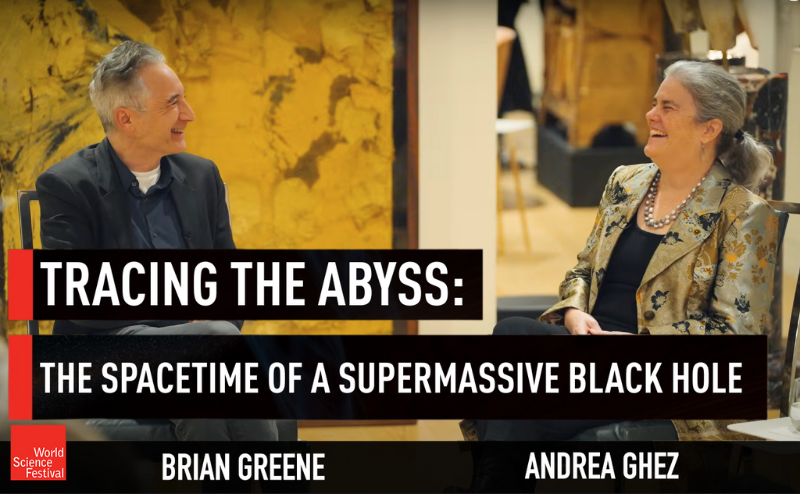
Nobel Laureate Andrea Ghez joins Brian Greene to explore her decade’s long pursuit of the supermassive black hole at the center of the Milky Way Galaxy. This program is part …
As a discipline, science aspires to be an evidence-based, non-partisan tool for revealing truth. But science is carried out by scientists, human beings like the rest of us, subject to …
Is our universe unique or one of many? What happened before the Big Bang? Why is there something rather than nothing? Physicists and cosmologists are closing in on how the …
The prestigious biennial Kavli Prizes recognize scientists for major advances in three research areas: astrophysics, nanoscience and neuroscience—the big, the small and the complex. The 2014 winners, sharing a $1 million award in each field, will be announced live via satellite from the Norwegian Academy of Science and Letters in Oslo.